
• Produktbild: Bioelectrochemistry of Cells and Tissues
  • Produktbild: Bioelectrochemistry of Cells and Tissues
Band 2

Bioelectrochemistry of Cells and Tissues

97,99 €

inkl. gesetzl. MwSt., Versandkostenfrei


Beschreibung

Produktdetails

Einband

Taschenbuch

Erscheinungsdatum

30.09.2011

Herausgeber

Dieter Walz + weitere

Verlag

Springer Basel

Seitenzahl

305

Maße (L/B/H)

24,4/17/1,8 cm

Gewicht

568 g

Auflage

Softcover reprint of the original 1st ed. 1995

Sprache

Englisch

ISBN

978-3-0348-9890-4

Beschreibung

Produktdetails

Einband

Taschenbuch

Erscheinungsdatum

30.09.2011

Herausgeber

Verlag

Springer Basel

Seitenzahl

305

Maße (L/B/H)

24,4/17/1,8 cm

Gewicht

568 g

Auflage

Softcover reprint of the original 1st ed. 1995

Sprache

Englisch

ISBN

978-3-0348-9890-4

Herstelleradresse

Springer Nature c/o IBS
Benzstrasse 21
48619 Heek
DE

Email: Tanja.Keller@springer.com

Ein neues Kapitel für Ihre Bücher

Ein neues Kapitel für Ihre Bücher

Schenken Sie Ihren alten Schätzen ein zweites Leben: Einfach Barcode scannen, Versandetikett ausdrucken, Bücher verschicken und Thalia Geschenkkarte erhalten.

Jetzt verkaufen
Jetzt verkaufen

Noch keine Bewertungen vorhanden

Verfassen Sie die erste Bewertung zu diesem Artikel

Helfen Sie anderen Kundinnen und Kunden durch Ihre Meinung.

Kundinnen und Kunden meinen

Bewertungen (0)

  • Produktbild: Bioelectrochemistry of Cells and Tissues
  • Produktbild: Bioelectrochemistry of Cells and Tissues
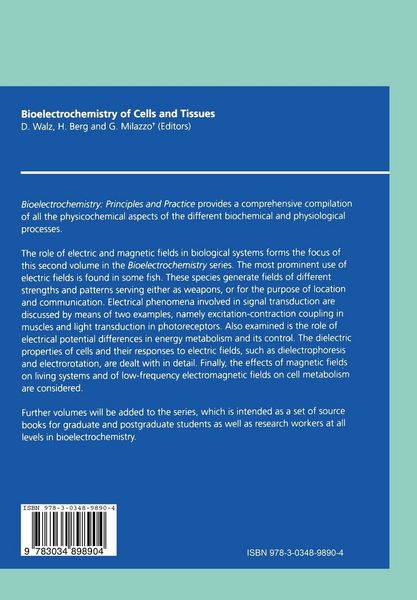
  • 1. Electric organs and their innervation: A model system for the study of cholinergic function.- • Introduction.- • Anatomy and embryology of the electromotor system.- • Electrophysiology of the electromotor system.- • Electrolocation and electrocommunication.- • The cellular and molecular biology of cholinergic synapses as deduced from work on the electromotor system.- • Summary.- 2. Contractility and motility of muscle and non-muscle cells.- • Introduction.- • Histology of striated muscle cells.- • Muscle physiology.- • The sliding filament model.- • Actin and myosin are proteins organized in filaments.- • Actin and myosin exist in a number of variants.- • The atomic structures of actin and myosin subfragment 1 have been solved.- • The cross-bridge cycle.- • The mechanism of ATP-hydrolysis by myosin and acto-myosin.- • Where in the myosin molecule is the force produced?.- • The regulation of muscle activity.- • Electrochemical coupling in muscle cells.- • Muscle diseases (Myopathies).- • Motor systems in non-muscle cells.- • Summary.- 3. Light-transduction in photoreceptors.- • Introduction.- • Structure and function of photoreceptors.- • Molecular basis of phototransduction.- • Light-induced currents.- • Function of calcium ions in photoreception.- • Voltage-gated currents and their physiological significance.- • Ion transport.- • Summary and conclusions.- 4. An electrochemical description of metabolism.- • Introduction.- • Cellular structure and enzyme organisation.- • Cellular energy transduction.- • Proton and electron flow in intracellular structures.- • Importance of electrical processes in the control of metabolism.- • Significance of cellular potentials.- • Theoretical considerations.- • Relevant experimental studies.- • Electrochemical regulation of metabolism.- 5. The low-frequency dielectric properties of biological cells.- • Introduction.- • Theory of the dielectric experiment.- • Mechanisms of dielectric dispersion in biological systems.- • Mechanisms of dielectric relaxation in cell suspensions and tissues.- • Nonlinear interactions of cells with electrical fields.- • A four state enzyme capable of harvesting electrical energy for the performance of useful (bio)chemical work.- 6. Dielectrophoretic and electrorotation behaviour of cells: Theory and experiment.- • Introduction.- • Theoretical background.- • Cell dielectrophoresis.- • Cell electrorotation.- • Relationship between dielectrophoresis and electrorotation.- 7. Effects of magnetic fields on living systems.- • Introduction.- • Field types and modes of action.- • Experimental in vitro results.- • Experimental in vivo results.- 8. Low-frequency electromagnetic field effects on cell metabolism.- • Introduction.- • Experimental techniques.- • Biochemical and biological response of biological systems.- • Current models for mechanisms of electrostimulation.