• Produktbild: Mining Subsidence Engineering
  • Produktbild: Mining Subsidence Engineering

Mining Subsidence Engineering

97,99 €

inkl. gesetzl. MwSt., Versandkostenfrei


Beschreibung

Produktdetails

Einband

Taschenbuch

Erscheinungsdatum

08.12.2011

Verlag

Springer Berlin

Seitenzahl

546

Maße (L/B/H)

24,4/17/3,1 cm

Gewicht

959 g

Auflage

Softcover reprint of the original 1st ed. 1983

Übersetzt von

R.F.S. Fleming

Sprache

Englisch

ISBN

978-3-642-81925-4

Beschreibung

Produktdetails

Einband

Taschenbuch

Erscheinungsdatum

08.12.2011

Verlag

Springer Berlin

Seitenzahl

546

Maße (L/B/H)

24,4/17/3,1 cm

Gewicht

959 g

Auflage

Softcover reprint of the original 1st ed. 1983

Übersetzt von

R.F.S. Fleming

Sprache

Englisch

ISBN

978-3-642-81925-4

Herstelleradresse

Springer-Verlag KG
Sachsenplatz 4-6
1201 Wien
AT

Email: ProductSafety@springernature.com

Ein neues Kapitel für Ihre Bücher

Ein neues Kapitel für Ihre Bücher

Schenken Sie Ihren alten Schätzen ein zweites Leben: Einfach Barcode scannen, Versandetikett ausdrucken, Bücher verschicken und Thalia Geschenkkarte erhalten.

Jetzt verkaufen
Jetzt verkaufen

Kundinnen und Kunden meinen

0 Bewertungen

Informationen zu Bewertungen

Zur Abgabe einer Bewertung ist eine Anmeldung im Konto notwendig. Die Authentizität der Bewertungen wird von uns nicht überprüft. Wir behalten uns vor, Bewertungstexte, die unseren Richtlinien widersprechen, entsprechend zu kürzen oder zu löschen.

Die Bewertungen sind nach Format, Anzahl Sterne und Datum sortiert.

Verfassen Sie die erste Bewertung zu diesem Artikel

Helfen Sie anderen Kund*innen durch Ihre Meinung

Kundinnen und Kunden meinen

0 Bewertungen filtern

  • Produktbild: Mining Subsidence Engineering
  • Produktbild: Mining Subsidence Engineering
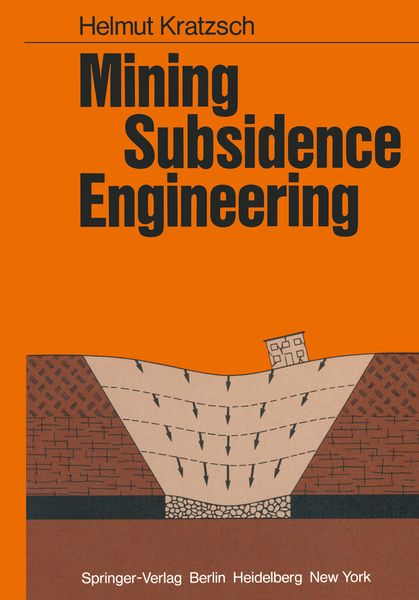
  • I Strata Movement.- 1. Strata Movement at the Mining Horizon.- 1.1 Mining Methods, from the Standpoint of Subsidence.- 1.2 Convergence in the Workings.- 1.2.1 Mining Without Permanent Pillars (Total Extraction).- 1.2.2 Mining with Permanent Pillars (Partial Extraction).- 1.3 Factors Influencing Convergence in the Workings.- 1.4 Horizontal Movement in the Roof Stratum.- 2. Deformation of the Rock Mass.- 2.1 Zones of Movement in the Overlying Beds.- 2.2 Vertical Movement and Deformation.- 2.3 Horizontal Movement and Deformation.- 2.4 Rock Kinematics in Steep-lying Measures.- 2.5 Surface Fracture over Shallow Workings.- 2.6 Chronological Stages in Strata Movement.- 3. The Calculation of Strata Movement.- 3.1 General Assumptions in Calculation Procedures.- 3.2 Calculating Convergence in the Workings.- 3.2.1 The Roof as an Overlying Beam.- 3.2.2 A Roof of Loose Rock.- 3.2.3 The Roof as a Kelvin Body.- 3.2.4 Empirical Formulae for Convergence in the Workings.- 3.3 The Pre-Calculation of Strata Movement.- 3.3.1 The Integration-grid, or Influence-Function, Method.- 3.3.2 The Rock Mass as an Elastic Material.- 3.3.3 The Rock Mass as an Inelastic Material.- 3.3.4 The Rock Mass as a Stochastic Medium.- 3.3.5 The Rock Mass as Finite Elements.- 4. Strata Movement at the Shaft.- 4.1 Subsidence Damage to the Shaft Lining.- 4.2 Bases of the Calculation Procedure.- 4.3 Calculation of Shaft Stress.- 4.4 Superposed Mining Influences; and Tilt.- 4.5 Extent of Vertical Expansion and Contraction in Strata.- 5. Systematic Mining of the Shaft Safety-pillar.- 5.1 Measures to Protect the Shaft.- 5.2 The Mining Plan for the Shaft Safety Zone.- 5.3 Protecting the Shaft Lining Against Mining Damage.- 6. The Influence of Previous Workings and Mining Practice on Strata Movement.- 6.1 The Reciprocal Influence of Workings.- 6.2 The Border Effects of Neighbouring Workings.- 6.3 Changes in Convergence with Multilevel Workings.- 6.4 Coal-pillar Pressure in a Panel.- 6.5 The Influence of Mining Procedures on the Break-up of the Rock Fabric.- 6.6 The Swelling of Clay-bearing Beds.- II The Study of Ground Movement.- 7. The Components of Ground Movement.- 7.1 Historical Development.- 7.2 Ground Movement with Flat-lying Measures.- 7.2.1 Shape of the Trough.- 7.2.2 Calculation of Trough Components.- 7.3 Anomalies in the Trough Outline.- 7.4 Ground Movement in Steep-lying Measures.- 8. The Pre-calculation of Ground Subsidence.- 8.1 Varieties of Calculation Procedure.- 8.2 Empirical Methods.- 8.2.1 The Angle-of-Intersection Method.- 8.2.2 The British Profile-curve Method.- 8.2.3 The Russian Profile-curve Method.- 8.2.4 The Polish Profile-curve Method.- 8.2.5 The Hungarian Profile-curve Method.- 8.2.6 The Programmed Profile-curve Method.- 8.2.7 The Empirical Integration-grid Method.- 8.3 Methods Employing Influence Functions.- 8.3.1 The Theoretical Basis.- 8.3.2 The Graphical Method in Flat-lying Measures.- 8.3.3 Methods for Adapting to Distorted Superposition.- 8.3.4 Integration Grids in Steep-lying Measures.- 8.3.5 Semi-graphical Methods, and Methods Employing Analogues.- 8.3.6 Programmed Calculation of the Influence Factor.- 8.4 Methods Employing Theoretical Models.- 8.4.1 The Stochastic Model.- 8.4.2 The Elastic Model.- 8.4.3 The Plastic Model.- 8.4.4 The Finite-Elements Model.- 9. Pre-calculation of Ground Displacement.- 9.1 Special Features of Displacement Calculation.- 9.2 The Focal-Point Method.- 9.3 The Method with Influence Functions.- 9.3.1 Deriving the Grid from the Focal-point Formula.- 9.3.2 Deriving Displacement from Curvature.- 9.3.3 Displacement by the Statistical Theory.- 9.3.4 Displacement Grids for Inclined Measures.- 9.4 Calculating Displacement from Tilt.- 9.5 Methods Employing Theoretical Models.- 9.5.1 The Stochastic Model.- 9.5.2 The Elastic Model.- 9.5.3 The Plastic Model.- 9.6 Displacement as Observed on Strata Models.- 9.7 The Graphical Method of the U.K. National Coal Board.- 10. The Time Factor.- 10.1 Significance of the Time Factor.- 10.2 Analysis of Ground Movement over Time.- 10.2.1 The Curve of a Surface Point’s Subsidence over Time.- 10.2.1.1 Examples from Longwall Coal-mining.- 10.2.1.2 Influence of the Rock’s Mechanical Properties on Subsidence over Time in Room-and-Pillar Working.- 10.2.1.3 Determination of the Time Factor in Salt-mining.- 10.2.2 The Dynamic Trough Profile.- 10.2.3 Dynamic Displacement and Linear Change.- 10.3 The Calculation of Ground Movement over Time.- 10.3.1 The Strip Method with z = 1.- 10.3.2 The Time Factor zt for the Unit Area.- 10.3.3 The Method with Differential Extraction Strips.- 10.3.4 The Influence-related Time Factor ze.- 10.3.5 The Calculation of Static Delayed Subsidence over a Chamber-and-Pillar Working.- 11. Impact of Ground Deformation on Structures.- 11.1 Types of Stress on Structures.- 11.2 Stress/Strain Behaviour of Soils.- 11.3 Earth Pressure on a Foundation Sidewall.- 11.4 Friction Forces Acting on the Structure.- 11.5 Changes in Base Pressure as a Result of Ground Curvature.- 11.6 Time-dependence in the Transmission of Forces.- 12. Mining Damage Above Ground.- 12.1 Types of Damage.- 12.2 Mining Damage to Buildings and Fittings.- 12.2.1 Structural Dislocation and Expansion Cracks.- 12.2.2 Bending Cracks.- 12.2.3 Alternations in Stress.- 12.3 Mining Damage to Industrial Installations.- 12.4 Damage to Communications and Public Utilities Installations.- 12.4.1 Railway Tracks.- 12.4.2 Roads and Bridges.- 12.4.3 Cables and Pipes.- 12.4.4 Canals and Locks.- 12.5 Ground-water Damage from Mining.- 12.6 Settlement Damage Ahead of an Opencast Face.- 12.7 Surface Cave-ins over Abandoned Workings.- 12.8 Pseudo Mining Damage.- 12.8.1 Natural and Artificially Induced Damage to Structures.- 12.8.2 Frequency of Structurally Induced Damage.- 13. The Law Governing Mining Damage.- 13.1 Historical Background.- 13.2 The Legal Relationship Between Mining and Land-Ownership.- 13.2.1 The Law on Mining Damage.- 13.2.2 The Priority Rights of Communications Installations.- 13.2.3 Compensation for Subsidence Damage.- 13.3 The Calculation of Diminished Value.- 13.3.1 Tilt as a Basis of Measurement.- 13.3.2 Determining a Building’s Value.- 13.3.3 Reduction in Value for Landed Property.- 13.4 Sharing the Costs for Damage from Two or More Mines.- 13.5 Contingency Funds for Future Mining Damage.- 14. Measures to Reduce Mining Damage.- 14.1 Types of Preventive Measure.- 14.2 Layout Planning Having Regard to Mining Damage.- 14.2.1 Static Measures.- 14.2.2 Dynamic Measures.- 14.2.3 Some Examples of Mining Procedures to Minimize Damage.- 14.3 Structural Precautions.- 14.3.1 Total and Partial Precautions.- 14.3.2 Some Examples of Structural Precautions.- 14.3.2.1 Total Precautions.- 14.3.2.2 Partial Precautions.- 14.3.2.3 Foundation-slab.- 14.3.3 The Protection of Communications Installations and Public Utilities.- 14.4 Regional Planning.- Outlook.- Appendix I Building Standards.- 1. Mining and the Building Ground.- 2. Load Assumptions.- 3. Degree of Mining-damage Precautions.- 4. General Considerations for the Positioning and Design of Structures.- 5. Special Construction for Stage 1 Precautions.- 6. Special Standards for Structures in Stage 2 Precautions.- 7. Special Standards for Structures in Stage 3 Precautions.- 8. Acceptable Stresses, Allowing for the Effects of Mining.- Appendix II Calculation of Ground Movement by the Computer System of Ruhrkohle AG.- Appendix III Classification of Interim Ground Movement in Terms of Time t, Influence Factor e and Extraction Stage r.- Appendix IV Determination of the Time Factor in Mining with Yielding, Permanent Pillars.- Appendix V Examples of Mining Damage.- References.- Note on the SI Units Used.- List of Symbols.