• Produktbild: Capital Market Equilibria
  • Produktbild: Capital Market Equilibria

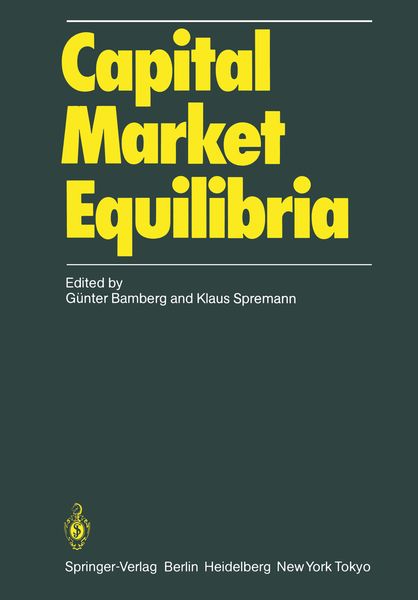
Capital Market Equilibria

146,99 €

inkl. gesetzl. MwSt., Versandkostenfrei


Beschreibung

Produktdetails

Einband

Taschenbuch

Erscheinungsdatum

17.11.2011

Herausgeber

Günter Bamberg + weitere

Verlag

Springer Berlin

Seitenzahl

228

Maße (L/B/H)

24,4/17/1,4 cm

Gewicht

422 g

Auflage

Softcover reprint of the original 1st ed. 1986

Sprache

Englisch

ISBN

978-3-642-70997-5

Beschreibung

Portrait

Prof. Dr. Dr. h.c. Günter Bamberg ist Inhaber des Lehrstuhls für Statistik der Universität Augsburg. Seine Arbeits- und Interessengebiete sind Statistik, Ökonometrie, Operations Research und Wirtschaftstheorie.
Prof. Dr. Klaus Spremann ist Direktor am Schweizerischen Institut für Banken und Finanzen (seit 1990). Er studierte Mathematik an der TU München: 1972 Dipl.-Math., 1973 Promotion zum Dr.rer.nat.; Habilitation 1975 an der wirtschaftswissenschaftlichen Fakultät der Universität Karlsruhe. Von 1977-90 war SPREMANN Professor für Wirtschaftswissenschaften im Studiengang Wirtschaftsmathematik an der Universität Ulm. Gastprofessuren an der University of British Columbia in Vancouver B.C. (1982), der National Taiwan University in Taipeh (1987), der Universität Innsbruck (2004). Zwei Jahre (1993-94) HongkongBank Professor of International Finance an der University of Hong Kong.

Produktdetails

Einband

Taschenbuch

Erscheinungsdatum

17.11.2011

Herausgeber

Verlag

Springer Berlin

Seitenzahl

228

Maße (L/B/H)

24,4/17/1,4 cm

Gewicht

422 g

Auflage

Softcover reprint of the original 1st ed. 1986

Sprache

Englisch

ISBN

978-3-642-70997-5

Herstelleradresse

Springer-Verlag KG
Sachsenplatz 4-6
1201 Wien
AT

Email: GPSR Kontakt

Ein neues Kapitel für Ihre Bücher

Ein neues Kapitel für Ihre Bücher

Schenken Sie Ihren alten Schätzen ein zweites Leben: Einfach Barcode scannen, Versandetikett ausdrucken, Bücher verschicken und Thalia Geschenkkarte erhalten.

Jetzt verkaufen
Jetzt verkaufen

Noch keine Bewertungen vorhanden

Verfassen Sie die erste Bewertung zu diesem Artikel

Helfen Sie anderen Kundinnen und Kunden durch Ihre Meinung.

Kundinnen und Kunden meinen

Bewertungen (0)

  • Produktbild: Capital Market Equilibria
  • Produktbild: Capital Market Equilibria
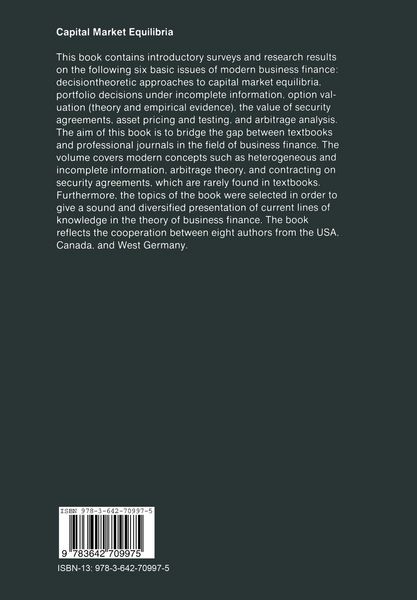
  • Prologue.- 1. Equilibrium versus Market Imperfections.- 2. Questions and Answers.- The Hybrid Model and Related Approaches to Capital Market Equilibria.- 1. Introduction.- 2. Portfolio Models Based on Different Sets of Parameters.- 2.1 One-Parameter Models.- 2.2 Two-Parameter Models: Mean-Semivariance Approach.- 2.3 Other Two-Parameter Approaches.- 2.4 Extensions to Three or More Parameters.- 3. Rationale of the Hybrid Model.- 3.1 Consistency of the Mean-Variance Approach with Expected Utility and Stochastic Dominance.- 3.2 Explicit Solutions of the Portfolio Problem.- 3.3 Explicit Solutions of the Equilibrium Conditions.- 3.4 Which Mean-Variance Approaches Provide Explicit Solutions?.- 4. Applications of the Hybrid Model.- 4.1 Consideration of Income Taxation.- 4.2 Heterogeneous Expectations.- 4.3 Restrictions on Short Sales.- 4.4 Some Other Market Imperfections.- 5. Appendix.- 5.1 Proof of Theorem 4.- 5.2 Solution of Partial Differential Equation (31).- References.- Portfolio Decisions and Capital Market Equilibria Under Incomplete Information.- 1. Introduction.- 2. Risk Situation with Regard to the Prior Parameters: A Two-Level Bayes Approach.- 3. Risk Situation with Regard to the Prior Parameters: Lin’s Approach.- 4. Partial Uncertainty with Regard to the Prior Parameters.- 5. Asset Pricing under Uncertainty.- References.- Option Valuation: Theory and Empirical Evidence.- 1. Introduction.- 2. Option Valuation Theory.- 2.1 Preference and Distribution-Free Results.- 2.1.1 Call Options.- 2.1.2 Put Options.- 2.1.3 Relations Between Puts and Calls.- 2.1.4 Additional Arbitrage Restrictions.- 2.2 Distributional Assumptions and Hedging Models.- 2.2.1 Hedge Portfolios.- 2.2.2 The Classical Black-Scholes Model.- 2.2.3 A Brief Description of Other Option Valuation Models.- 2.2.4 Analytic Models For American Calls and Puts.- 2.3 Preference Assumptions and Non-Hedging Models.- 2.4 New Option Instruments.- 2.5 Applications of Option Theory.- 3. Empirical Tests of Option Valuation.- 3.1 Test of Boundary Conditions Among an Individual Equity Option and the Underlying Stock.- 3.2 Test of Boundary Conditions Among Different Equity Options and the Underlying Stock.- 3.3 Tests of Equity Option Pricing Models.- 3.3.1 Results of Robustness Tests.- 3.3.2 Results of Predictability Tests.- 3.3.3 Results of Unbiasedness Tests.- 3.3.4 Results of Hedge Return Behavior Tests.- 3.4 Tests of New Option Instruments.- 3.5 Estimation Problems.- 4. Appendix: Formulae for the Evaluation of European Calls.- References.- The Value of Security Agreements.- 1. A Survey of Credit Support Decision Models.- 1.1 Credit Decisions in a Restricted Capital Market.- 1.2 Market Uncertainty.- 1.3 Credit Support Decisions with Event Uncertainty.- 2. Neoclassical Theory and Secured Debt.- 2.1 The Basic Approach.- 2.2 Secured Debt and Capital Market Equilibrium.- 2.3 Collateral Policy and Non-Market-Value Debt Claims.- 3. The Theory of Credit Support Decisions in the Light of the Economics of Information.- 3.1 Collaterals as a Tool to Limit the Creditability Risk.- 3.2 Contemporaneous Examination of Credit Standing Risk and Credit Reliability Risk.- 3.2.1 Changing the Dividend Policy.- 3.2.2 Changing the Credit Policy.- 3.2.3 Changing the Investment Policy.- 4. A Scheme of Credit Contract Covenants.- 4.1 Credit Contract Covenants.- 4.2 Covenants Referring Indirectly to Means of Payment.- 4.2.1 Special Obligations of the Debtors.- 4.2.2 Special Rights of the Creditors.- 4.3 Claims of Creditors which Refer to Means of Payment.- 5. The Efficiency of Securing Debt.- 6. Appendix: Secured Debt and Uncertainty.- 6.1 The Firm’s Position.- 6.2 Derivation of the Value of Secured Debt.- 6.3 Market Value of the Debt in Dependence of its Collateral Policy.- 6.4 The Maximization of the Market Value with Total Collateral Policy.- References.- Asset Pricing in a Small Economy: A Test of the Omitted Assets Model.- 1. Introduction.- 2. Portfolio Based Tests of Efficiency.- 3. Omitted Assets.- 3.1 The Model.- 3.2 Integrated and Segmented Capital Markets.- 4. The Data.- 5. Efficiency of the Canadian Market Index.- 5.1 Beta Estimation under Thin Trading.- 5.2 Preliminary Estimates.- 5.3 Maximum Likelihood Estimation.- 6. Tests of the Omitted Assets Hypothesis.- Appendix: Iterative Maximum Likelihood Procedure.- References.- The Simple Analytics of Arbitrage.- 1. General Equilibrium, Modern Finance, and Arbitrage Theory.- 1.1 General Equilibrium.- 1.2 Modern Finance.- 1.3 Arbitrage.- 2. An Example, its Generalization, and the Question.- 2.1 A Portfolio of Savings Bonds and Term Deposits.- 2.2 Is a Free Lunch Possible?.- 2.3 Events and Futures.- 2.4 The Question: Should the Original Portfolio be Revised?.- 3. Arbitrage versus Equilibrium.- 3.1 Some Borrowing from Production Theory.- 3.2 Either Arbitrage is Possible or Equilibrium Prices Exist.- 3.3 The Lemma of Minkowski-Farkas as Mathematical Background.- 3.4 The Derivation of an Issue Price.- 3.5 Summing up the Results.- 4. Derivative Contracts in Complete Capital Markets.- 4.1 Complete Capital Market.- 4.2 One-Period Option Pricing.- References.- About Contributors.- Author Index.