
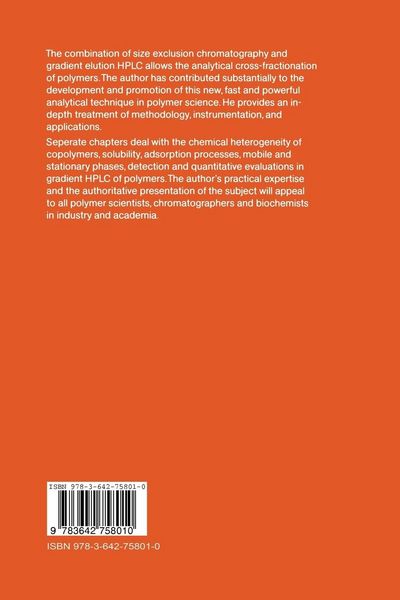
• Produktbild: Gradient HPLC of Copolymers and Chromatographic Cross-Fractionation
  • Produktbild: Gradient HPLC of Copolymers and Chromatographic Cross-Fractionation

Gradient HPLC of Copolymers and Chromatographic Cross-Fractionation

49,99 €

inkl. gesetzl. MwSt., Versandkostenfrei


Beschreibung

Produktdetails

Einband

Taschenbuch

Erscheinungsdatum

23.02.2012

Abbildungen

XVI, 210 p.

Verlag

Springer Berlin

Seitenzahl

210

Maße (L/B/H)

23,5/15,5/1,3 cm

Gewicht

359 g

Auflage

Softcover reprint of the original 1st ed. 1991

Sprache

Englisch

ISBN

978-3-642-75801-0

Beschreibung

Produktdetails

Einband

Taschenbuch

Erscheinungsdatum

23.02.2012

Abbildungen

XVI, 210 p.

Verlag

Springer Berlin

Seitenzahl

210

Maße (L/B/H)

23,5/15,5/1,3 cm

Gewicht

359 g

Auflage

Softcover reprint of the original 1st ed. 1991

Sprache

Englisch

ISBN

978-3-642-75801-0

Herstelleradresse

Springer-Verlag KG
Sachsenplatz 4-6
1201 Wien
AT

Email: ProductSafety@springernature.com

Ein neues Kapitel für Ihre Bücher

Ein neues Kapitel für Ihre Bücher

Schenken Sie Ihren alten Schätzen ein zweites Leben und erhalten dafür eine Thalia Geschenkkarte.

Jetzt verkaufen
Jetzt verkaufen

Noch keine Bewertungen vorhanden

Verfassen Sie die erste Bewertung zu diesem Artikel

Helfen Sie anderen Kundinnen und Kunden durch Ihre Meinung.

Kundinnen und Kunden meinen

Bewertungen (0)

  • Produktbild: Gradient HPLC of Copolymers and Chromatographic Cross-Fractionation
  • Produktbild: Gradient HPLC of Copolymers and Chromatographic Cross-Fractionation
  • 1 Introduction.- 1.1 About the Aims and Methods of Cross Fractionation.- 1.2 Classical Cross-Fractionation.- 1.3 Cross Fractionation Including Size Exclusion Chromatography.- 1.3.1 SEC Analysis of Fractions Obtained by Precipitation or Extraction.- 1.3.2 Preparative Thin-Layer Chromatography and SEC Analysis of the Fractions.- 1.3.3 Preparative SEC and TLC Analysis of the Fractions.- 1.4 Cross Fractionation by Coupled SEC Techniques.- 1.5 Elution Under Critical Conditions.- 1.6 References.- 2 Chemical Heterogeneity of Copolymers.- 2.1 Sequence Distribution.- 2.2 Instantaneous Heterogeneity.- 2.3 Modification of the Stockmayer Distribution.- 2.4 Conversion Heterogeneity.- 2.5 References.- 3 Size Exclusion Liquid Chromatography of Copolymers.- 3.1 Universal Calibration.- 3.2 Secondary Exclusion and Adsorption Effects.- 3.3 Detector Response.- 3.4 Fractionation by Hydrodynamic Volume.- 3.5 References.- 4 Special Features of Polymer HPLC.- 4.1 Diffusion Coefficients of Macromolecules in Solution.- 4.2 Stokes Radii and Hydrodynamic Dimensions of Macromolecules.- 4.3 Retention by Multiple Attachment.- 4.4 Conformation of Synthetic Polymers.- 4.5 Solubility of Polymers.- 4.6 Gradient Elution of Polymers.- 4.7 Gradient Elution of Polymers on Small Pore Packings.- 4.8 The Martin Equation.- 4.9 Effect of Block Structure on Retention.- 4.10 References.- 5 Solubility and Adsorption Effects in Polymer HPLC.- 5.1 Dependence of Retention Time on Sample Size.- 5.2 Comparison Between Solubility and Elution Characteristics...- 5.3 Correspondence Between Column Polarity and Gradient Orientation.- 5.4 Effect of Temperature.- 5.5 High-Performance Precipitation Liquid Chromatography.- 5.6 Normal-Phase Gradient Elution with Separate Adjustment of Polarity and Solvent Strength.- 5.7 References.- 6 Effect of Mobile and Stationary Phase in Polymer HPLC.- 6.1 Elution in the Critical Region.- 6.2 The Role of the Stationary Phase.- 6.3 Normal and Reversed Phase HPLC of Polymers.- 6.4 References.- 7 Detection in Gradient High-Performance Liquid Chromatography.- 7.1 Selective Detectors.- 7.2 Detection Subsequent to Eluent Vaporization.- 7.3 References.- 8 Quantitative Evaluation and Calibration.- 8.1 Features of a Proper Run in Polymer HPLC.- 8.2 Quantitative Evaluation.- 8.3 Incomplete Retention and Elution.- 8.4 Signal Enhancement by Turbidity.- 8.5 Calibration of Polymer Gradient HPLC.- 8.6 References.- 9 Separation of Copolymers by Composition through Gradient High-Performance Liquid Chromatography.- 9.1 Statistical Copolymers from Styrene and Acrylonitrile.- 9.2 Statistical Copolymers from Styrene and Methyl Acrylate.- 9.3 Copolymers from Styrene and Methyl Methacrylate.- 9.4 Statistical Copolymers from Styrene and Ethyl Acrylate.- 9.5 Statistical Copolymers from Styrene and Ethyl Methacrylate..- 9.6 Copolymers from Styrene and t-Butyl Methacrylate.- 9.7 Alkyl Methacrylates and Acrylates with Different Side Groups.- 9.8 Copolymers from Methyl Methacrylate and Methyl Acrylate..- 9.9 Copolymers from Styrene and 2-Methoxyethyl Methacrylate...- 9.10 Copolymers of Styrene and Butadiene.- 9.11 Copolymers of Decyl Methacrylate and Methyl Methacrylate..- 9.12 Graft Copolymers of Methyl Methacrylate onto Copoly (Ethylene/Propylene/Diene Monomer) (EPDM).- 9.13 Epoxy Composite Formulations, Phenol-Formaldehyde Prepolymers, Macromonomers, and Telechelic Prepolymers.- 9.14 Ethylene/?-Olefm Copolymers.- 9.15 Copolymers of Styrene and Acrylic Acid.- 9.16 Separation of PMMA Isomers.- 9.17 References.- 10 Chromatographic Cross-Fractionation.- 10.1 Scope of this Chapter.- 10.2Comparison of Calculated and Measured Curves of Chemical Composition Distribution.- 10.3 Chromatographic Cross-Fractionation of Model Mixtures 151 10.3.1 Model Mixtures of stat-Copoly(Styrene/Acrylonitrile).- 10.4 Chromatographic Cross-Fractionation of Real Copolymers...- 10.5 Cross Fractionation by Temperature-Rising Elution Fractionation and SEC Analysis of the Fractions.- 10.6 Chromatographic Cross-Fractionation of Graft Copolymers of Methyl Methacrylate onto Copoly(Ethylene/Propylene/Diene Monomer) (EPDM Rubber).- 10.7 Chromatographic Cross-Fractionation of Styrene/Vinyl Acetate Block Copolymers.- 10.8 References.- 11 Experimental Problems.- 11.1 THF as a Mobile Phase.- 11.2 Sample Solvent.- 11.3 Ghost Peaks.- 11.4 Sample Load and Column Blocking.- 11.5 Hazards Caused by Incompatible Sample Polymers.- 11.6 Column Flushing.- 11.7 Effect of Column Length.- 11.8 Peak Splitting.- 11.9 Column Conditioning by Sample Injection.- 11.10 Guidelines for Selecting Suitable Phase Systems for Copolymer HPLC.- 11.11 References.- 12 Glossary of Terms.- Author Index.