• Produktbild: Life Cycle Management For Dependability
  • Produktbild: Life Cycle Management For Dependability
- 10%

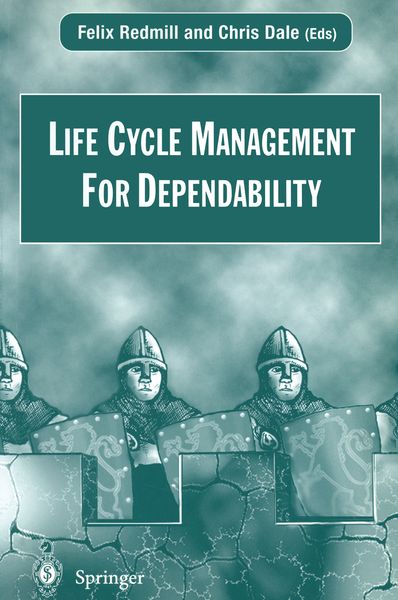
Life Cycle Management For Dependability

10% sparen

95,99 € UVP 106,99 €

inkl. gesetzl. MwSt., Versandkostenfrei


Beschreibung

Produktdetails

Einband

Taschenbuch

Erscheinungsdatum

18.04.1997

Herausgeber

Felix Redmill + weitere

Verlag

Springer Berlin

Seitenzahl

235

Maße (L/B/H)

23,5/15,5/1,5 cm

Gewicht

394 g

Auflage

Softcover reprint of the original 1st ed. 1997

Sprache

Englisch

ISBN

978-3-540-76073-3

Beschreibung

Produktdetails

Einband

Taschenbuch

Erscheinungsdatum

18.04.1997

Herausgeber

Verlag

Springer Berlin

Seitenzahl

235

Maße (L/B/H)

23,5/15,5/1,5 cm

Gewicht

394 g

Auflage

Softcover reprint of the original 1st ed. 1997

Sprache

Englisch

ISBN

978-3-540-76073-3

Herstelleradresse

Springer-Verlag KG
Sachsenplatz 4-6
1201 Wien
AT

Email: GPSR Kontakt

Ein neues Kapitel für Ihre Bücher

Ein neues Kapitel für Ihre Bücher

Schenken Sie Ihren alten Schätzen ein zweites Leben: Einfach Barcode scannen, Versandetikett ausdrucken, Bücher verschicken und Thalia Geschenkkarte erhalten.

Jetzt verkaufen
Jetzt verkaufen

Noch keine Bewertungen vorhanden

Verfassen Sie die erste Bewertung zu diesem Artikel

Helfen Sie anderen Kundinnen und Kunden durch Ihre Meinung.

Kundinnen und Kunden meinen

Bewertungen (0)

  • Produktbild: Life Cycle Management For Dependability
  • Produktbild: Life Cycle Management For Dependability
  • 1 This Business of Dependability.- 1.1 Introduction.- 1.2 Defining Dependability.- 1.3 Users’ and Society’s Needs for Dependable Systems.- 1.4 Some Failures of Systems Which Should Have Been Dependable.- 1.5 Achieving and Assessing Dependability.- 2 Getting the Culture Right.- 2.1 Introduction.- 2.2 Factors Affecting Organisational Performance.- 2.3 So What is Culture?.- 2.4 Characteristics of a Dependability Culture.- 2.5 What Happens if We Get It Wrong?.- 2.6 Developing the Right Culture.- 2.7 Final Remarks.- 3 Policy and Planning for Dependability.- 3.1 Introduction.- 3.2 Definitions.- 3.3 Compilation and Presentation.- 3.4 General Contents.- 3.5 Specific Content for Individual Life-cycle Phases.- 3.6 Summary.- 4 Measurement and Assurance.- 4.1 Introduction.- 4.2 Software Project Management and Management Challenges.- 4.3 Simple Process Measures.- 4.4 Refining the Measures.- 4.5 Best Practice.- 4.6 Use of the Measures.- 4.7 Assurance.- 4.8 Conclusions.- 5 Third Generation Project Management.- 5.1 The Challenge for Project Management.- 5.2 What is Project Success?.- 5.3 What Makes Projects Fail?.- 5.4 The Essential Elements of Project Management.- 5.5 The Characteristics of Successful Managers.- 5.6 A Final Note.- 6 Operations Management for Dependability.- 6.1 Introduction.- 6.2 Trends in Computer-related Systems.- 6.3 Incidents and Insights into Dependability.- 6.4 Organisational Structure, Management and Competence.- 6.5 Documentation, Including Operating Instructions.- 6.6 Contingency Planning.- 6.7 Security and Access Control.- 6.8 Hand-over Approval for Live Operation.- 6.9 Training.- 6.10 Preventative Maintenance and Calibration.- 6.11 Repair, Modification and Change Control.- 6.12 Reviewing Operations.- 6.13 Decommissioning from Live Operation.- 6.14 Regulation.- 6.15 Lessons and the Future.- 7 Managing Maintenance and Change.- 7.1 Introduction.- 7.2 Some Principles.- 7.3 Levels of Approval.- 7.4 Management Responsibilities.- 7.5 The Maintenance Cycle — The Maintenance and Modification Management Model.- 7.6 Revalidation and Configuration Management.- 7.7 Maintenance of System Architectures for Dependability.- 7.8 Engineering Aspects.- 8 Practical Risk Management.- 8.1 Introduction.- 8.2 What is Risk?.- 8.3 Risk Management Goals.- 8.4 Uncertainty and Risk.- 8.5 A Simple Approach.- 8.6 The Management of Risk.- 8.7 Tolerable Risk and the ‘ALARP’ Principle.- 8.8 A Simple Tool for Risk Analysis.- 8.9 Action Plans Against Risk.- 8.10 Beware of Underestimating Risk — Three Laws.- 8.11 Final Remarks.- References.