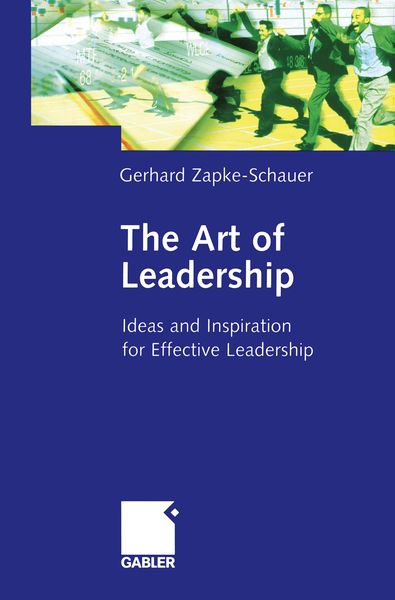
Produktbild: The Art of Leadership
- 10%

The Art of Leadership Ideas and Inspiration for Effective Leadership

10% sparen

95,99 € UVP 106,99 €

inkl. gesetzl. MwSt., Versandkostenfrei


Beschreibung

Produktdetails

Einband

Taschenbuch

Erscheinungsdatum

25.05.2012

Verlag

Betriebswirtschaftlicher Verlag Gabler

Seitenzahl

240

Maße (L/B/H)

20,3/13,3/1,4 cm

Gewicht

279 g

Auflage

2005

Sprache

Englisch

ISBN

978-3-322-89509-7

Beschreibung

Produktdetails

Einband

Taschenbuch

Erscheinungsdatum

25.05.2012

Verlag

Betriebswirtschaftlicher Verlag Gabler

Seitenzahl

240

Maße (L/B/H)

20,3/13,3/1,4 cm

Gewicht

279 g

Auflage

2005

Sprache

Englisch

ISBN

978-3-322-89509-7

Herstelleradresse

Gabler, Betriebswirt.-Vlg
Abraham-Lincoln-Str. 46
65189 Wiesbaden
DE

Email: GPSR Kontakt

Ein neues Kapitel für Ihre Bücher

Ein neues Kapitel für Ihre Bücher

Schenken Sie Ihren alten Schätzen ein zweites Leben: Einfach Barcode scannen, Versandetikett ausdrucken, Bücher verschicken und Thalia Geschenkkarte erhalten.

Jetzt verkaufen
Jetzt verkaufen

Noch keine Bewertungen vorhanden

Verfassen Sie die erste Bewertung zu diesem Artikel

Helfen Sie anderen Kundinnen und Kunden durch Ihre Meinung.

Kundinnen und Kunden meinen

Bewertungen (0)

  • Produktbild: The Art of Leadership
  • I: What Leadership Is About.- Basic Concepts.- What is good leadership?.- Good leadership consists of a clear vision calling for commitment.- Motivating people by encouraging them to pull together.- Making important contacts outside your group and organisation.- Good leadership functions via the group.- It’s difficult to change a group culture.- The contribution you should make to the group culture.- Good leadership at times of crisis.- The four categories of good leadership.- Phenomena are not goals.- Necessary steps.- A word to the wise.- What can be achieved with visions?.- Two meanings.- Who makes use of visions?.- Visions lead to a passive attitude.- Conditional visions give rise to hope.- Visions remove barriers.- The quickest way to lose the vision.- Make sure you focus on solutions.- Visions create ownership.- What is reality?.- What is the real problem?.- The solution: the right approach to planning.- Important decisions.- Do you really want to be a leader?.- Excellence in leadership.- Personal qualities.- Leading a balanced life.- Keeping calm.- Image processing speeds you up.- Image processing isn’t only for verbalising.- Learning to be a leader.- Summary.- The strategic vision.- Being able to arouse enthusiasm in other people.- Practical, concrete and intuitive intelligence.- The art of listening.- The right mixture of pride and modesty.- The ability to make decisions.- The ability to convince others.- Empathy.- Mutual reactions.- Belonging to groups.- Following decisions through.- Authority.- Scarcity.- Role models.- Reflections on Jack Welch: 1.- Self-confidence.- Reflections on Jack Welch: II.- Reflections on Jack Welch: III.- Reflections on Jack Welch: IV.- Reflections on Jack Welch: V.- Warren Buffet.- Whose interests do our managers represent?.- Low profit margins destroy jobs and shareholder value.- Executives make mistakes.- Conclusions for the practice.- Cisco: defined processes.- Management according to Walt Disney.- Tomorrow’s senior executives.- II: Good leadership in Practice.- Basic Principles.- Identification.- Coherence.- Working outside the ‘total picture’ is futile.- The consequences can be disastrous and extremely disheartening for all concerned.- Conflict.- The limbian system.- How executives can be effective at times of crisis.- Crowds.- Zero-sum-games and zero sums.- The basic pattern.- Using the basic pattern for predictions.- Examples of zero-sums.- How do you convert zero-sums?.- Examples of non-zero-sums.- The internal customer relationship.- Third parties as new players.- Ownership.- The difference between something and someone.- People.- Understanding our roles: 1.- Defining a company in terms of customer-orientation.- Understanding our roles: II.- Understanding by allocation to the correct context.- Have managers lost their way en route to company goals?.- Is a lot of management just hot air?.- Do managers promise too much?.- Why do company workers have to solve management’s problems?.- Coping with the behaviour of our staff.- Teams.- Soft factors.- Ways of Communicating.- The first hundred days.- Action comes before emotion.- Cultural change.- The specific process is the key.- Demonstrations.- Downsizing.- Keeping in touch with the workforce.- The layer of resistance.- The anticipatory effect.- The authority effect.- Passing on the baton.- The principle of understanding.- Leadership engineering.- The employee as a human being.- Converting the goals to concrete action.- Don’t leave success for the company to chance.- Management by objectives.- The wrong goals.- The right goals.- Applying creativity.- The experience of company workers and competitors.- Processes for achieving goals.- Mind camps.- Getting company workers to change.- Middle management.- Competition for the best staff.- Agreeing goals.- III: The Leadership of Companies.- The Guidelines.- Competence and shareholder value.- The need to make a profit.- Identity.- Legally separate entities.- 1. Be friendly at the beginning.- 2. Never be the first to defect.- 3. React in a resolute way.- 4. Never bear a grudge.- 5. Avoid bringing the co-operation to an end.- Innovation.- Cost accounting.- Marketing Performance.- Sales activities.- Are the visions of the new economies fading?.- Company philosophies.- About the Author.- Notes.