• Produktbild: Life Science Models
  • Produktbild: Life Science Models
Band 4

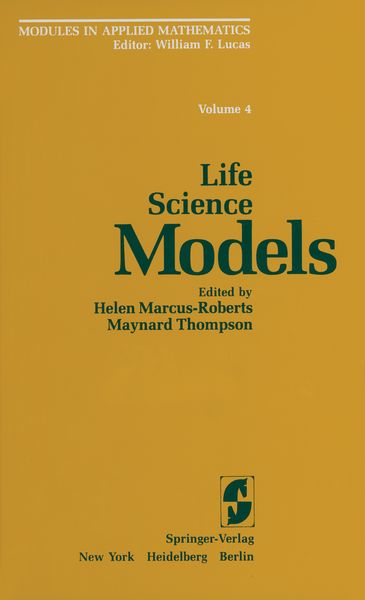
Life Science Models

49,99 €

inkl. gesetzl. MwSt., Versandkostenfrei


Beschreibung

Produktdetails

Einband

Taschenbuch

Erscheinungsdatum

27.12.2011

Herausgeber

H. Marcus-Roberts + weitere

Verlag

Springer Us

Seitenzahl

366

Maße (L/B/H)

23,5/15,5/2,2 cm

Gewicht

598 g

Auflage

Softcover reprint of the original 1st ed. 1983

Sprache

Englisch

ISBN

978-1-4612-5461-4

Beschreibung

Produktdetails

Einband

Taschenbuch

Erscheinungsdatum

27.12.2011

Herausgeber

Verlag

Springer Us

Seitenzahl

366

Maße (L/B/H)

23,5/15,5/2,2 cm

Gewicht

598 g

Auflage

Softcover reprint of the original 1st ed. 1983

Sprache

Englisch

ISBN

978-1-4612-5461-4

Herstelleradresse

Springer-Verlag KG
Sachsenplatz 4-6
1201 Wien
AT

Email: ProductSafety@springernature.com

Ein neues Kapitel für Ihre Bücher

Ein neues Kapitel für Ihre Bücher

Schenken Sie Ihren alten Schätzen ein zweites Leben: Einfach Barcode scannen, Versandetikett ausdrucken, Bücher verschicken und Thalia Geschenkkarte erhalten.

Jetzt verkaufen
Jetzt verkaufen

Kundinnen und Kunden meinen

0 Bewertungen

Informationen zu Bewertungen

Zur Abgabe einer Bewertung ist eine Anmeldung im Konto notwendig. Die Authentizität der Bewertungen wird von uns nicht überprüft. Wir behalten uns vor, Bewertungstexte, die unseren Richtlinien widersprechen, entsprechend zu kürzen oder zu löschen.

Die Bewertungen sind nach Format, Anzahl Sterne und Datum sortiert.

Verfassen Sie die erste Bewertung zu diesem Artikel

Helfen Sie anderen Kund*innen durch Ihre Meinung

Kundinnen und Kunden meinen

0 Bewertungen filtern

  • Produktbild: Life Science Models
  • Produktbild: Life Science Models
  • I. Population Models.- 1. Population Mathematics.- 1. Introduction.- 2. Formulation of a Model.- 3. A Stable Age Distribution.- 4. Population Waves.- References.- 2. Population Growth: An Age Structure Model.- 1. Introduction.- 2. An Example.- 3. Powers of a Nonnegative Matrix.- 4. Prediction and Implementation.- 5. Conclusion.- Solutions to the Exercises.- References.- Notes for the Instructor.- 3. A Comparison of Some Deterministic and Stochastic Models of Population Growth.- 1. Introduction.- 2. Basic Philosophy of Model Building.- 3. Probability Generating Functions (pgf’s).- 4. Derivation of the General System of Differential Equations for the Pure Birth Process.- 5. Models of Population Growth.- References.- Notes for the Instructor.- 4. Some Examples of Mathematical Models for the Dynamics of Several-Species Ecosystems.- Preface.- 1. Introduction.- 2. Predator-Prey.- 3. Mutualism and Competition.- 4. Some Remarks on N-Species Systems.- Appendix A.- Appendix B: Bibliography.- References.- Appendix C: Suggestions and Solutions.- II. Biomedicine: Epidemics, Genetics, and Bioengineering.- 5. Malaria: Models of the Population Dynamics of the Malaria Parasite.- 1. Introduction.- 2. Malaria.- 3. The First Model.- 4. The Second Model: Survival Proportions.- 5. A Look at Data.- 6. The Third Model: Varying Survival Proportions.- 7. The Fourth Model: Varying Reproduction Numbers.- 8. First Probabilistic Model.- 9. Second Probabilistic Model: Survival Probabilities.- 10. Third Probabilistic Model: Varying Survival Probabilities.- 11. Fourth Probabilistic Model: Varying Reproduction Probabilities.- 12. Discussion.- Exercises.- References.- Notes for the Instructor.- 6. MacDonald’s Work on Helminth Infections.- 1. Introduction.- 2. The Schistosomiasis Model.- 3. The Poisson Probability Distribution.- 4. Calculation of P(m).- 5. Analysis of Equation (6).- Appendix: An Alternate Model.- Appendix: Reprint of MacDonald’s Article.- References.- 7. A Model for the Spread of Gonorrhea.- Exercises.- Notes for the Instructor.- 8. DNA, RNA, and Random Mating: Simple Applications of the Multiplication Rule.- 1. Introduction.- 2. Multiplication Rule.- 3. DNA and RNA.- 4. Random Mating.- Exercises.- References.- Notes for the Instructor.- 9. Cigarette Filtration.- Exercises.- Appendix: Discussion of Density and Flow Rate.- Reference.- Notes for the Instructor.- III. Ecology.- 10. Efficiency of Energy Use in Obtaining Food, I: Humans.- 1. Introduction.- 2. Energy and Food: Some Biological and Physical Background.- 3. Efficiency and Optimally Efficient Behavior.- 4. Human Energy Use for Food.- References.- Notes for the Instructor.- 11. Efficiency of Energy Use in Obtaining Food, II: Animals.- 1. Introduction: The Problem.- 2. The Allometric Law.- 3. Predators as Efficient Users of Energy.- 4. Pure Pursuers.- 5. Pure Searchers.- 6. Discussion.- References.- Notes for the Instructor.- 12. The Spatial Distribution of Cabbage Butterfly Eggs.- 1. Purpose.- 2. The Biology.- 3. Biological Assumptions I.- 4. Biological Assumptions II.- 5. Biological Assumptions III.- 6. Suggestions for Further Study.- Appendix: Probability Generating Functions.- Solutions to the Exercises.- References.- Notes for the Instructor.