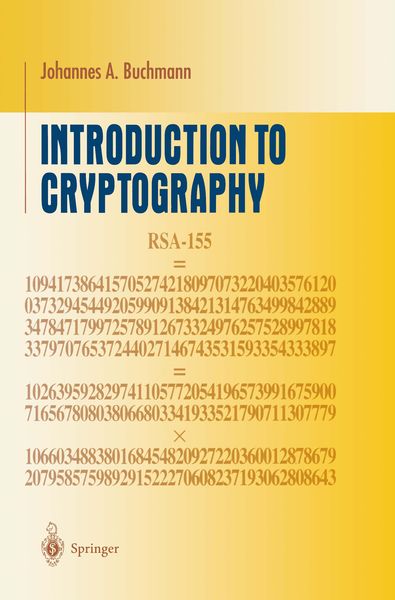
Introduction to Cryptography
-
- Taschenbuch ausgewählt
- eBook
-
Sprache:Englisch
-
Auflage:Softcover Reprint of the Original 1st 2001 edition
49,99 €
inkl. gesetzl. MwSt.,
Beschreibung
Produktdetails
Einband
Taschenbuch
Erscheinungsdatum
21.01.2012
Abbildungen
XI, 281 p.
Verlag
Springer UsSeitenzahl
281
Maße (L/B/H)
23,5/15,5/1,7 cm
Gewicht
458 g
Auflage
Softcover Reprint of the Original 1st 2001 edition
Sprache
Englisch
ISBN
978-1-4684-0498-2
Cryptography is a key technology in electronic key systems. It is used to keep data secret, digitally sign documents, access control, etc. Therefore, users should not only know how its techniques work, but they must also be able to estimate their efficiency and security. For this new edition, the author has updated the discussion of the security of encryption and signature schemes and recent advances in factoring and computing discrete logarithms. He has also added descriptions of time-memory trade of attacks and algebraic attacks on block ciphers, the Advanced Encryption Standard, the Secure Hash Algorithm, secret sharing schemes, and undeniable and blind signatures.
Johannes A. Buchmann is a Professor of Computer Science and Mathematics at the Technical University of Darmstadt, and the Associate Editor of the Journal of Cryptology. In 1985, he received the Feodor Lynen Fellowship of the Alexander von Humboldt Foundation. Furthermore, he has received the most prestigious award in science in Germany, the Leibniz Award of the German Science Foundation.
About the first edition:
It is amazing how much Buchmann is able to do in under 300 pages: self-contained explanations of the relevant mathematics (with proofs); a systematic introduction to symmetric cryptosystems, including a detailed description and discussion of DES; a good treatment of primality testing, integer factorization, and algorithms for discrete logarithms; clearly written sections describing most of the major types of cryptosystems....This book is an excellent reference, and I believe it would also be a good textbook for a course for mathematics or computer science majors..."
-Neal Koblitz, The American Mathematical Monthly
Ein neues Kapitel für Ihre Bücher
Ein neues Kapitel für Ihre Bücher
Schenken Sie Ihren alten Schätzen ein zweites Leben und erhalten dafür eine Thalia Geschenkkarte.
Noch keine Bewertungen vorhanden
Verfassen Sie die erste Bewertung zu diesem Artikel
Helfen Sie anderen Kundinnen und Kunden durch Ihre Meinung.
Kurze Frage zu unserer Seite
Vielen Dank für Ihr Feedback
Wir nutzen Ihr Feedback, um unsere Produktseiten zu verbessern. Bitte haben Sie Verständnis, dass wir Ihnen keine Rückmeldung geben können. Falls Sie Kontakt mit uns aufnehmen möchten, können Sie sich aber gerne an unseren Kund*innenservice wenden.
zum Kundenservice