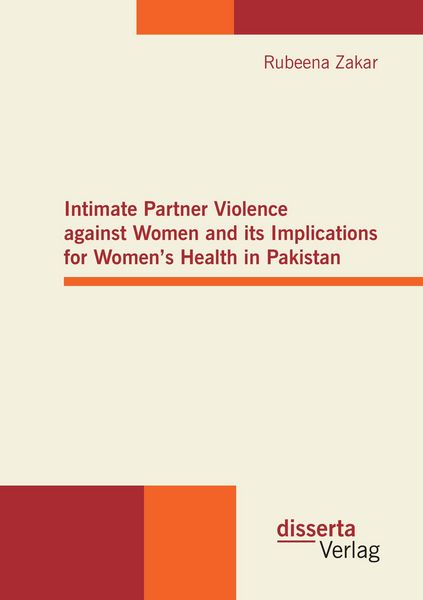
Intimate Partner Violence against Women and its Implications for Women's Health in Pakistan
-
- Englisch ausgewählt
49,50 €
inkl. gesetzl. MwSt.,
Beschreibung
Produktdetails
Einband
Taschenbuch
Erscheinungsdatum
24.09.2012
Verlag
DissertaSeitenzahl
380
Maße (L/B/H)
21/14,8/2,4 cm
Gewicht
554 g
Auflage
1. Auflage
Sprache
Englisch
ISBN
978-3-95425-080-6
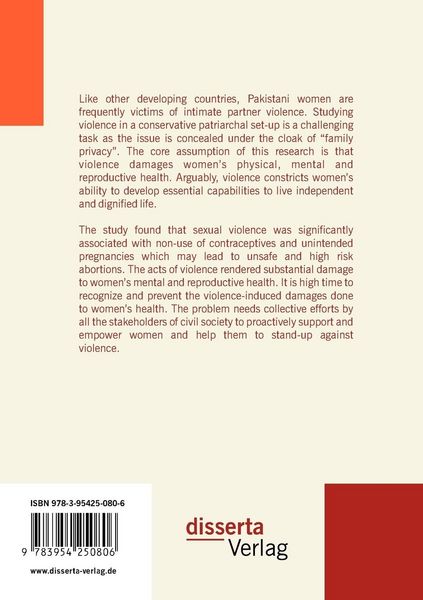
This research is theoretically embedded in the “integrated ecological framework” introduced by Heise (1998) to explain and explicate the complexity of the phenomenon of intimate partner violence. In patriarchal societies, girls are usually socialized in such a way that they become submissive and dependent on men. In order to ensure women’s docility and “obedience”, women are subjected to control, discipline and, sometimes, violent punishment (Foucault 1977). The core assumption of this research is that violence or threat of violence damages women’s physical, mental and reproductive health. Arguably, violence also constricts women’s ability to develop essential capabilities to live an independent and dignified life (Nussbaum 2005).
Data showed that the acts of violence rendered substantial damage to women’s mental and reproductive health. It was found that sexual violence was significantly associated with non-use of contraceptives and unintended pregnancies which may lead to unsafe and high risk abortions. The qualitative data revealed that physicians and other stakeholders (e.g. religious leaders, community leaders) lacked competence, training and resources to provide comprehensive care to the victims. This study demonstrates that without protecting women from violence, Pakistan cannot achieve Millennium Development Goals especially reduction in infant and maternal mortality, gender equality, and women’s active participation in socio-economic development.
The empirical data also suggested that the adverse effects of violence are far-reaching; be it inflicted in the past or present. It is high time to recognize the violence-induced damages done to women’s health and its resultant developmental cost. Thus far, the narrow legalistic approach and reductionist biomedical model have not been proved very effective. The problem needs a holistic approach and collective efforts by civil society, health care professionals, and religious leaders to proactively support and empower women to reduce their vulnerabilities and help them to stand-up against violence.
Ein neues Kapitel für Ihre Bücher
Ein neues Kapitel für Ihre Bücher
Schenken Sie Ihren alten Schätzen ein zweites Leben: Einfach Barcode scannen, Versandetikett ausdrucken, Bücher verschicken und Thalia Geschenkkarte erhalten.
Jetzt verkaufenNoch keine Bewertungen vorhanden
Verfassen Sie die erste Bewertung zu diesem Artikel
Helfen Sie anderen Kundinnen und Kunden durch Ihre Meinung.
Kurze Frage zu unserer Seite
Vielen Dank für Ihr Feedback
Wir nutzen Ihr Feedback, um unsere Produktseiten zu verbessern. Bitte haben Sie Verständnis, dass wir Ihnen keine Rückmeldung geben können. Falls Sie Kontakt mit uns aufnehmen möchten, können Sie sich aber gerne an unseren Kund*innenservice wenden.
zum Kundenservice