Zitat
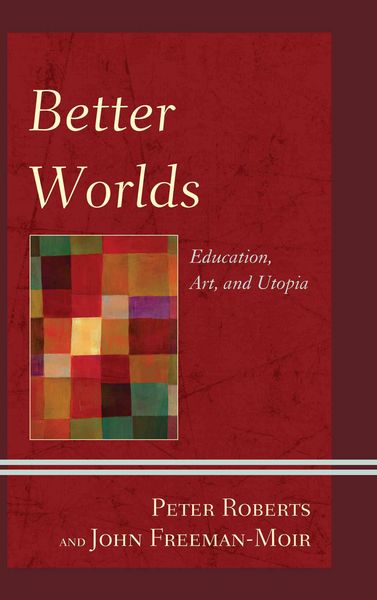
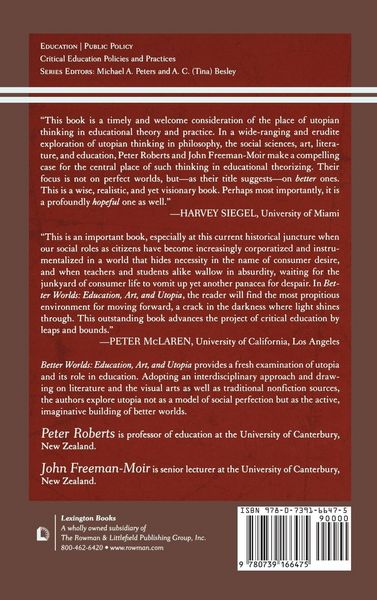
Better Worlds: Education, Art, and Utopia by Peter Roberts & John Freeman-Moir is a lifetime's reflection by two experienced and reputable scholars on the complex historical and philosophical relationship between utopia (dystopia) and education. It is a book that traverses the notion of crafting experience in William Morris and Dewey and runs the whole gamut of Iris Murdoch, Freire, Dostoevsky and Taoism, and Hermann Hesse to theorize art, creativity and the scholarly life. This book is a wonderful addition to the literature on utopian education and likely to become a classic. -- Michael Peters, University of Waikato Better Worlds: Education, Art, and Utopia is a timely and welcome consideration of the place of utopian thinking in educational theory and practice. In a wide-ranging and erudite exploration of utopian thinking in philosophy, the social sciences, art, literature and education, Peter Roberts and John Freeman-Moir make a compelling case for the central place of such thinking in educational theorizing. Their focus in not on perfect worlds, but - as their title suggests - on better ones. Through a series of detailed studies of authors such as Dewey, Dostoevsky, Hesse, Freire and Murdoch, and of works of philosophy, art, and literature, they argue for the enduring importance of imaginative contemplation of better worlds than the actual one, and of the role of education in promoting utopian thinking, acting, living, and social organization. In doing so they demonstrate how education can help us both bring about a better world and avoid a worse one. This is a wise, realistic and yet visionary book. Perhaps most importantly, it is a profoundly hopeful one as well. -- Harvey Siegel, University of Miami This is an important book, especially at this current historical juncture, when the indomitable human spirit gasps for air, when the translucent hues of hope seem ever more ethereal, when thinking about the future seems anachronistic, when the concept of utopia has become irretrievably Disneyfied, when our social roles as citizens have become increasingly corporatized and instrumentalized in a world which hides necessity in the name of consumer desire, and when teachers and students alike wallow in absurdity, waiting for the junkyard of consumer life to vomit up yet another panacea for despair. In Better Worlds: Education, Art, and Utopia, the reader will find the most propitious environment for moving forward, a crack in the darkness where light shines through. This outstanding book advances the project of critical education by leaps and bounds. -- Peter McLaren, University of California, Los Angeles and distinguished fellow in critical studies, Chapman University