• Produktbild: How Humans Learn to Think Mathematically
  • Produktbild: How Humans Learn to Think Mathematically

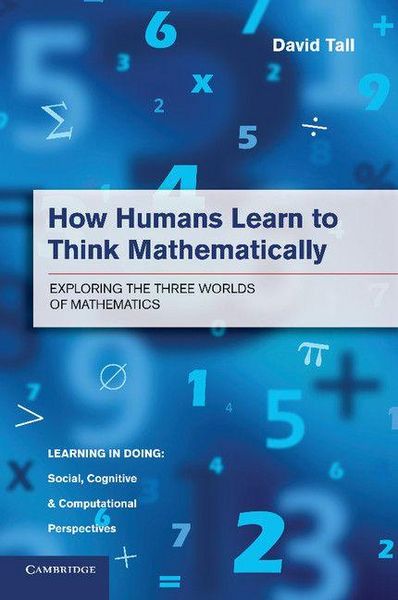
How Humans Learn to Think Mathematically Exploring the Three Worlds of Mathematics

67,99 €

inkl. gesetzl. MwSt., Versandkostenfrei


Beschreibung

Produktdetails

Einband

Taschenbuch

Erscheinungsdatum

30.07.2014

Abbildungen

175 b/w illus. 4 tables

Verlag

Cambridge University Press

Seitenzahl

484

Maße (L/B/H)

22,9/15,2/2,7 cm

Gewicht

695 g

Sprache

Englisch

ISBN

978-1-107-66854-6

Beschreibung

Produktdetails

Einband

Taschenbuch

Erscheinungsdatum

30.07.2014

Abbildungen

175 b/w illus. 4 tables

Verlag

Cambridge University Press

Seitenzahl

484

Maße (L/B/H)

22,9/15,2/2,7 cm

Gewicht

695 g

Sprache

Englisch

ISBN

978-1-107-66854-6

Herstelleradresse

Libri GmbH
Europaallee 1
36244 Bad Hersfeld
DE

Email: gpsr@libri.de

Ein neues Kapitel für Ihre Bücher

Ein neues Kapitel für Ihre Bücher

Schenken Sie Ihren alten Schätzen ein zweites Leben und erhalten dafür eine Thalia Geschenkkarte.

Jetzt verkaufen
Jetzt verkaufen

Noch keine Bewertungen vorhanden

Verfassen Sie die erste Bewertung zu diesem Artikel

Helfen Sie anderen Kundinnen und Kunden durch Ihre Meinung.

Kundinnen und Kunden meinen

Bewertungen (0)

Weitere Artikel finden Sie in

Die Leseprobe wird geladen.
  • Produktbild: How Humans Learn to Think Mathematically
  • Produktbild: How Humans Learn to Think Mathematically
  • Part I. Prelude: 1. About this book; Part II. School Mathematics and its Consequences: 2. The foundations of mathematical thinking; 3. Compression, connection and blending of mathematical ideas; 4. Set-befores, met-befores and long-term learning; 5. Mathematics and the emotions; 6. The three worlds of mathematics; 7. Journeys through embodiment and symbolism; 8. Problem-solving and proof; Part III. Interlude: 9. The historical evolution of mathematics; Part IV. University Mathematics and Beyond: 10. The transition to formal knowledge; 11. Blending knowledge structures in calculus; 12. Expert thinking and structure theorems; 13. Contemplating the infinitely large and the infinitely small; 14. Expanding frontiers through mathematical research; 15. Reflections; Appendix: where the ideas came from.