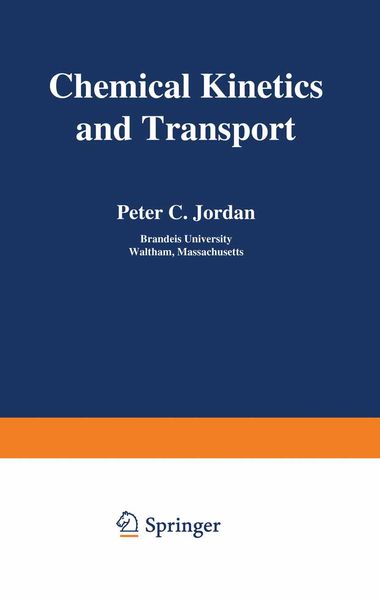

• Produktbild: Chemical Kinetics and Transport
  • Produktbild: Chemical Kinetics and Transport

Chemical Kinetics and Transport

49,99 €

inkl. gesetzl. MwSt., Versandkostenfrei


Beschreibung

Produktdetails

Einband

Taschenbuch

Erscheinungsdatum

04.08.2012

Verlag

Springer Us

Seitenzahl

368

Maße (L/B/H)

23,5/15,5/2,1 cm

Gewicht

587 g

Auflage

Softcover reprint of the original 1st ed. 1979

Sprache

Englisch

ISBN

978-1-4615-9100-9

Beschreibung

Produktdetails

Einband

Taschenbuch

Erscheinungsdatum

04.08.2012

Verlag

Springer Us

Seitenzahl

368

Maße (L/B/H)

23,5/15,5/2,1 cm

Gewicht

587 g

Auflage

Softcover reprint of the original 1st ed. 1979

Sprache

Englisch

ISBN

978-1-4615-9100-9

Herstelleradresse

Springer-Verlag KG
Sachsenplatz 4-6
1201 Wien
AT

Email: GPSR Kontakt

Ein neues Kapitel für Ihre Bücher

Ein neues Kapitel für Ihre Bücher

Schenken Sie Ihren alten Schätzen ein zweites Leben: Einfach Barcode scannen, Versandetikett ausdrucken, Bücher verschicken und Thalia Geschenkkarte erhalten.

Jetzt verkaufen
Jetzt verkaufen

Noch keine Bewertungen vorhanden

Verfassen Sie die erste Bewertung zu diesem Artikel

Helfen Sie anderen Kundinnen und Kunden durch Ihre Meinung.

Kundinnen und Kunden meinen

Bewertungen (0)

  • Produktbild: Chemical Kinetics and Transport
  • Produktbild: Chemical Kinetics and Transport
  • 1. Kinetic Theory of Gases—Equilibrium.- 1.1. Introduction.- 1.2. The Maxwell-Boltzmann Distribution of Velocities.- 1.3. Determination of Pressure.- 1.4. Properties of the Maxwell Distribution.- 1.5. The Molecular Flux and Effusion of Gases.- Problems.- General References.- 2. Kinetic Theory of Gases—Transport.- 2.1. Introduction.- 2.2. Mean Free Path.- 2.3. Collision Frequency.- 2.4. Macroscopic Equations of Transport.- 2.5. Solution of the Transport Equations.- 2.6. Kinetic Theory of Transport and Postulate of Local Equilibrium.- 2.7. Simplified Transport Theory: Dilute Hard-Sphere Gas.- 2.8. Comparison with Experiment.- Appendix. Coordinate Transformation by Jacobian Method.- Problems.- General References.- 3. Electrolytic Conduction and Diffusion.- 3.1. Introduction.- 3.2. Ionic Conduction in Solution—a Review.- 3.3. Nernst-Einstein Relation.- 3.4. Electrolyte Diffusion.- 3.5. Stokes’ Law and the Microscopic Interpretation of ?0.- 3.6. The Mobility of H+ and OH- in Water.- 3.7. The Concentration Dependence of ?.- 3.8. The Wien Effects.- Problems.- General References.- 4. Determination of Rate Laws.- 4.1. Introduction.- 4.2. Stoichiometry, Rate Law, and Mechanism.- 4.3. Elementary Rate Laws and the Principle of Mass Action.- 4.4. Reaction Order and Molecularity.- 4.5. The Principle of Detailed Balance.- 4.6. Experimental Methods for Determining Rate Laws.- 4.7. Integrated Rate Laws—First Order.- 4.8. Isolation Methods.- 4.9. Relaxation Methods.- 4.10. Determination of Rate Law from Data—Two Examples.- 4.11. Temperature Dependence of Rate Constants.- Appendix. Linear Least-Squares Analysis.- Problems.- General References.- 5. Stationary State Mechanisms.- 5.1. Introduction.- 5.2. Consecutive Reactions—First Order.- 5.3. Consecutive Reactions—Arbitrary Order.- 5.4. Unimolecular Decomposition—Gases.- 5.5. Radical Recombination—Gases.- 5.6. Complex Mechanisms—Gaseous Chain Reactions.- 5.7. Simple Mechanisms—Solution.- 5.8. Complex Mechanisms—Solution.- 5.9. Homogeneous Catalysis.- 5.10. Enzyme Catalysis.- 5.11. Heterogeneous Catalysis.- Appendix A. Matrix Solution to the Coupled Rate Equation (5.2).- Appendix B. Approximations to ?+ and ?-.- Problems.- General References.- 6. Photochemistry.- 6.1. Introduction.- 6.2. Measurement of Intensity.- 6.3. Spectroscopic Review.- 6.4. Primary Processes.- 6.5. Secondary Processes.- 6.6. Chemiluminescence.- 6.7. Orbital Symmetry Correlations: Woodward-Hoffman Rules.- 6.8. Laser Activation.- 6.9. Laser-Controlled Isotope Separation.- Problems.- General References.- 7. Nonstationary State Mechanisms.- 7.1. Introduction.- 7.2. Thermal Explosion.- 7.3. Population Explosion—Autocatalysis.- 7.4. The Lotka Problem: Chemical Oscillations.- 7.5. The Belousov-Zhabotinskii Reaction.- 7.6. Other Oscillating Systems.- 7.7. Multiple Stationary States: The NO2-N2O4 Reaction.- Problems.- General References.- 8. Single-Collision Chemistry.- 8.1. Introduction.- 8.2. Reaction Cross Section: Relation to the Rate Constant.- 8.3. Scattering Measurements—Molecular Beams.- 8.4. Reaction Cross Section: Hard-Sphere Model.- 8.5. Reaction Cross Section : Ion-Molecule Systems.- 8.6. Reaction Cross Section : Atom-Molecule Systems.- 8.7. Product Distribution Analysis.- 8.8. Direct, Forward-Peaked—The Ar+ + D2 System.- 8.9. Recoil—The D + Cl2 System.- 8.10. Collision Complexes—The O + Br2 System.- 8.11. State Selection Experiments.- Problems.- General References.- 9. Theories of Reaction Rates.- 9.1. Introduction.- 9.2. Potential-Energy Surfaces.- 9.3. Activated Complex Theory.- 9.4. Model Calculations of k2(T).- 9.5. The Kinetic Isotope Effect.- 9.6. Unimolecular Reaction—General Features.- 9.7. Unimolecular Reaction—RRKM Theory.- 9.8. Critique of RRKM Theory—Isomerization of Methyl Isocyanide.- 9.9. Thermodynamic Analogy.- 9.10. Gas-Phase Reactions.- 9.11. Solution Reactions.- 9.12. Primary Salt Effect.- 9.13. Diffusion-Limited Kinetics—Debye Theory.- Appendix A. Statistical Thermodynamics.- Appendix B. Evaluation of k? in RRKM Theory.- Problems.- General References.- 10. A Dynamical Model for Chemical Reaction.- 10.1. Introduction.- 10.2. Kinetic Energy of a Triatomic System.- 10.3. Model for Inelastic Collision.- 10.4. Effects Due to More Complex Potential-Energy Surfaces.- 10.5. Model for Thermoneutral Chemical Reaction.- 10.6. Exoergic Reactions.- 10.7. Endoergic Reactions.- 10.8. Noncollinear Geometries.- 10.9. Realistic Scattering Calculations.- Problems.- General References.- Physical Constants.