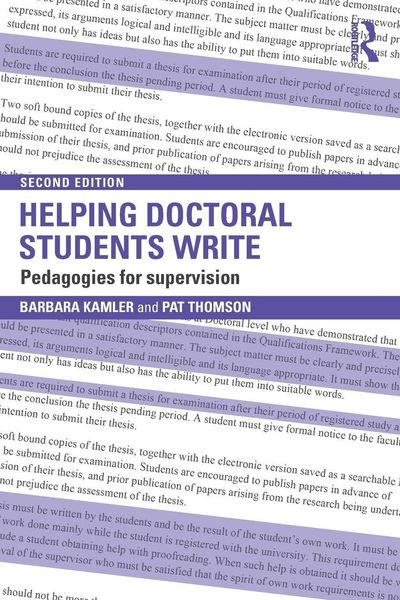
Helping Doctoral Students Write Pedagogies for supervision
-
- Englisch ausgewählt
119,99 €
inkl. gesetzl. MwSt.,
Beschreibung
Produktdetails
Einband
Taschenbuch
Erscheinungsdatum
06.03.2014
Abbildungen
schwarz-weiss Illustrationen, Zeichnungen, schwarz-weiss, Tabellen, schwarz-weiss
Verlag
KNV BesorgungSeitenzahl
194
Maße (L/B/H)
23,4/15,6/1,1 cm
Gewicht
300 g
Auflage
2. Auflage
Sprache
Englisch
ISBN
978-0-415-82349-4
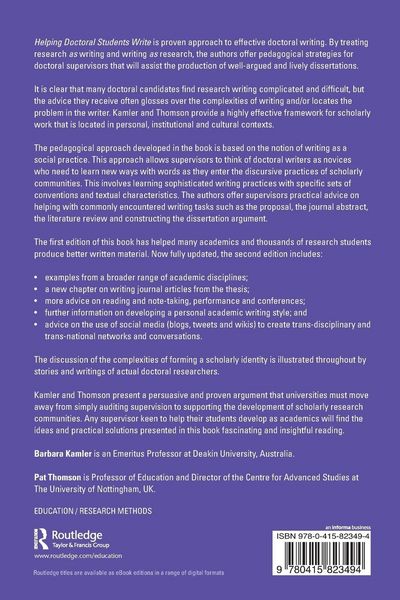
Helping Doctoral Students Write offers a proven approach to effective doctoral writing. By treating research as writing and writing as research, the authors offer pedagogical strategies for doctoral supervisors that will assist the production of well-argued and lively dissertations.
It is clear that many doctoral candidates find research writing complicated and difficult, but the advice they receive often glosses over the complexities of writing and/or locates the problem in the writer. Kamler and Thomson provide a highly effective framework for scholarly work that is located in personal, institutional and cultural contexts.
The pedagogical approach developed in the book is based on the notion of writing as a social practice. This approach allows supervisors to think of doctoral writers as novices who need to learn new ways with words as they enter the discursive practices of scholarly communities. This involves learning sophisticated writing practices with specific sets of conventions and textual characteristics. The authors offer supervisors practical advice on helping with commonly encountered writing tasks such as the proposal, the journal abstract, the literature review and constructing the dissertation argument.
The first edition of this book has helped many academics and thousands of research students produce better written material. Now fully updated the second edition includes:
- Examples from a broader range of academic disciplines
- A new chapter on writing from the thesis for peer reviewed journals
- More advice on reading and note taking, performance and conferences,
- Further information on developing a personal academic writing style, and
- Advice on the use of social media (blogs, tweets and wikis) to create trans-disciplinary and trans-national networks and conversations.
Their discussion of the complexities of forming a scholarly identity is illustrated throughout by stories and writings of actual doctoral students.
In conclusion, they present a persuasive and proven argument that universities must move away from simply auditing supervision to supporting the development of scholarly research communities. Any supervisor keen to help their students develop as academics will find the ideas and practical solutions presented in this book fascinating and insightful reading.
Ein neues Kapitel für Ihre Bücher
Ein neues Kapitel für Ihre Bücher
Schenken Sie Ihren alten Schätzen ein zweites Leben: Einfach Barcode scannen, Versandetikett ausdrucken, Bücher verschicken und Thalia Geschenkkarte erhalten.
Jetzt verkaufenNoch keine Bewertungen vorhanden
Verfassen Sie die erste Bewertung zu diesem Artikel
Helfen Sie anderen Kundinnen und Kunden durch Ihre Meinung.
Kurze Frage zu unserer Seite
Vielen Dank für Ihr Feedback
Wir nutzen Ihr Feedback, um unsere Produktseiten zu verbessern. Bitte haben Sie Verständnis, dass wir Ihnen keine Rückmeldung geben können. Falls Sie Kontakt mit uns aufnehmen möchten, können Sie sich aber gerne an unseren Kund*innenservice wenden.
zum Kundenservice