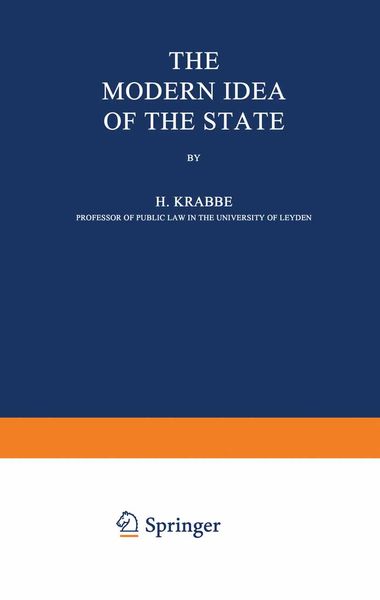

Beschreibung
Produktdetails
Einband
Taschenbuch
Erscheinungsdatum
01.01.1922
Herausgeber
George H. Sabine + weitereVerlag
Springer NetherlandSeitenzahl
281
Maße (L/B/H)
23,5/15,5/2 cm
Gewicht
557 g
Auflage
1921
Sprache
Englisch
ISBN
978-94-015-0395-2
The Modern Idea of the State.- I The Authority of the State and the Authority of Law.- I. The Opposition between the Old and the New Idea of the State.- II. The Rise of the Modern Idea of the State.- III. The Significance of the Modern Idea of the State.- II The Authority of the Sovereign and the Authority of the Law in History.- I. The State Originally a Community founded on Law.- II. The Rise of the Authority of the Sovereign.- III. Ancient Political Theory as a Theory of the Legal Order of the Community.- IV. The Political Theory of the Middle Ages as a Theory of Sovereignty.- V. The Meaning of the Contract with the Sovereign and of the Social Contract under Absolutism.- VI. The Relation between the Sovereign Authority and the Organization of the Community in Grotius and Others.- VII. Political Theory as Exclusively a Theory of the Sovereign Authority.- VIII. The Relation between Sovereign Authority and the Organization of the Community in England.- IX. The German Philosophy of the State under the Ancien Régime.- X. Montesquieu's Separation of Powers: A Product of Political Theory as a Theory of Sovereign Authority.- XI. The Theory of State Sovereignty in the Eighteenth Century.- XII. Rousseau's Popular Sovereignty.- XIII. The Rise of the Modern Idea of the State under the Constitutional System.- XIV. The Supplanting of the Authority of the Sovereign by the Authority of the Law.- III The Basis of the Binding Force of Law.- I. The Concept of the Sovereignty of Law.- II. The Authority of Law as the Rulership of Will.- III. Criticism of the Rulership of Will.- IV. The Conditions for the Validity of Law.- V. The Basis of Legal Rules.- VI. Objections to the Theory.- VII. Law as the Rule of a Community.- VIII. Majority Rule.- IX. Criticism of Objections to theMajority Principle.- X. The Individual Sense of Right.- XI. The Quality of the Sense of Right.- XII. The Making of Statutory Law.- XIII. Legislation as the Operation of an Organized Sense of Right.- XIV. Unwritten Law.- XV. Strengthening the Authority of Law.- IV The Making of Law.- I. Law-making as an Intellectual Process.- II. The Influence of Codification.- III. The Revolution in Criminal Law.- IV. The Revolution in Private Law.- V. The Influence upon Judicial Decisions.- VI. The Idea of Sovereignty and Constitutional Law.- VII. The Idea of Sovereignty in Administrative Law.- VIII. The Hybrid Character of the Systems of Constitutional and Administrative Law.- IX. The Logical Consequences of the Old and New Political Theories.- V Interests and the Sense of Right.- I. Knowledge of Interests and Impartiality.- II. The Platonic Ideal.- III. Monarchy.- IV. The Intellect.- V. The Balance of Interests.- VI. The Solution of the Conflict.- VI Decentralization of Law-Making.- I. Decentralization Based upon Community of Interest.- II. Transforming Organized Interests into Legal Communities.- III. The Lack of Legislative Organs.- VII The Sources of Law.- VIII The Development of Law.- I. The Historical Process.- II. Intellectualism.- III. The Emotional Life.- IX The State.- I. The Old Theory of the State.- II. Criticism.- III. The Modern Theory of the State.- IV. The State as a Community of Interests.- V. Origin of the State as a Community of Interests.- VI. Origin of the State as a Legal Community.- VII. The Organization of the Community of Interests.- X The International Legal Community.- I. The Authority of International Law.- II. The Content of International Law.- III. The Creation of International Law.
Ein neues Kapitel für Ihre Bücher
Ein neues Kapitel für Ihre Bücher
Schenken Sie Ihren alten Schätzen ein zweites Leben: Einfach Barcode scannen, Versandetikett ausdrucken, Bücher verschicken und Thalia Geschenkkarte erhalten.
Jetzt verkaufenKundinnen und Kunden meinen
Verfassen Sie die erste Bewertung zu diesem Artikel
Helfen Sie anderen Kund*innen durch Ihre Meinung
Kurze Frage zu unserer Seite
Vielen Dank für Ihr Feedback
Wir nutzen Ihr Feedback, um unsere Produktseiten zu verbessern. Bitte haben Sie Verständnis, dass wir Ihnen keine Rückmeldung geben können. Falls Sie Kontakt mit uns aufnehmen möchten, können Sie sich aber gerne an unseren Kund*innenservice wenden.
zum Kundenservice