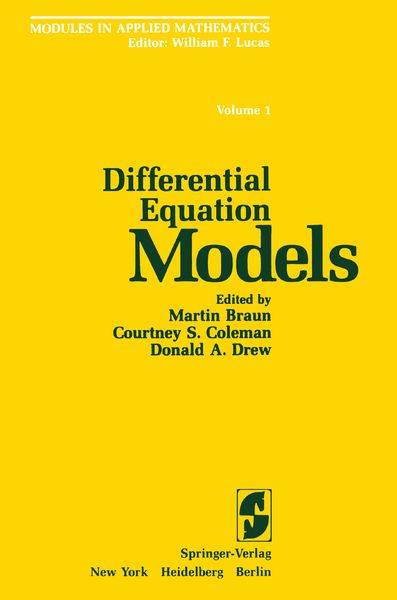
Produktbild: Differential Equation Models

Differential Equation Models

49,99 €

inkl. gesetzl. MwSt., Versandkostenfrei


Beschreibung

Produktdetails

Einband

Taschenbuch

Erscheinungsdatum

12.12.2012

Herausgeber

Martin Braun + weitere

Verlag

Springer Us

Seitenzahl

380

Maße (L/B/H)

23,5/15,5/2,2 cm

Gewicht

617 g

Auflage

Softcover reprint of the original 1st ed. 1983

Sprache

Englisch

ISBN

978-1-4612-5429-4

Beschreibung

Produktdetails

Einband

Taschenbuch

Erscheinungsdatum

12.12.2012

Herausgeber

Verlag

Springer Us

Seitenzahl

380

Maße (L/B/H)

23,5/15,5/2,2 cm

Gewicht

617 g

Auflage

Softcover reprint of the original 1st ed. 1983

Sprache

Englisch

ISBN

978-1-4612-5429-4

Herstelleradresse

Springer-Verlag GmbH
Tiergartenstr. 17
69121 Heidelberg
DE

Email: ProductSafety@springernature.com

Ein neues Kapitel für Ihre Bücher

Ein neues Kapitel für Ihre Bücher

Schenken Sie Ihren alten Schätzen ein zweites Leben: Einfach Barcode scannen, Versandetikett ausdrucken, Bücher verschicken und Thalia Geschenkkarte erhalten.

Jetzt verkaufen
Jetzt verkaufen

Kundinnen und Kunden meinen

0 Bewertungen

Informationen zu Bewertungen

Zur Abgabe einer Bewertung ist eine Anmeldung im Konto notwendig. Die Authentizität der Bewertungen wird von uns nicht überprüft. Wir behalten uns vor, Bewertungstexte, die unseren Richtlinien widersprechen, entsprechend zu kürzen oder zu löschen.

Die Bewertungen sind nach Format, Anzahl Sterne und Datum sortiert.

Verfassen Sie die erste Bewertung zu diesem Artikel

Helfen Sie anderen Kund*innen durch Ihre Meinung

Kundinnen und Kunden meinen

0 Bewertungen filtern

  • Produktbild: Differential Equation Models
  • I. Differential Equations, Models, and What To Do with Them.- 1. Setting Up First-Order Differential Equations from Word Problems.- 1. Introduction.- 2. Guidelines.- 3. Examples.- Exercises.- Solutions.- Notes for the Instructor.- 2. Qualitative Solution Sketching for First-Order Differential Equations.- 1. Introduction.- 2. Direction Field.- 3. Relevance of Uniqueness Theorems.- 4. Sketching of Solutions.- 5. Discussion of Equilibria and Stability.- 6. A More Difficult Example.- Exercises.- Solutions to Exercises.- Notes for the Instructor.- 3. Difference and Differential Equation Population Growth Models.- 1. Introduction.- 2. Solution of the Difference Equation.- 3. Solution of the Differential Equation.- 4. Linearized Stability Analysis.- 5. Interpretation of Results.- 6. Concluding Remarks.- 7. Appendix: The Basic Model.- Exercises.- Solutions.- References.- Notes for the Instructor.- II. Growth and Decay Models: First-Order Differential Equations.- 4. The Van Meegeren Art Forgeries.- Exercises.- References.- Notes for the Instructor.- 5. Single Species Population Models.- Exercises.- References.- Notes for the Instructor.- 6. The Spread of Technological Innovations.- Martin Braun.- Exercises.- References.- Notes for the Instructor.- III. Higher Order Linear Models.- 7. A Model for the Detection of Diabetes.- Exercises.- References.- Notes for the Instructor.- 8. Combat Models.- 1. Introduction.- 2. Three Lanchester Combat Models.- 3. Conventional Combat: The Square Law.- 4. Guerrilla Combat: The Linear Law.- 5. Vietnam: The Parabolic Law.- 6. The Battle of Iwo Jima.- 7. Mathematical Models of Combat: The Dark Side of Modeling.- Exercises.- Project.- References.- Notes for the Instructor.- 9. Modeling Linear Systems by Frequency Response Methods.- 1. Introduction.- 2. Modeling the Human Operator.- 3. Properties and Techniques of Frequency Response Modeling.- 4. Project Human Operator Experimental Data.- 5. Further Topics.- References.- Notes for the Instructor.- IV. Traffic Models.- 10. How Long Should a Traffic Light Remain Amber?.- 1. The Problem and the Model.- 2. The Solution.- Exercises.- References.- Notes for the Instructor.- 11. Queue Length at a Traffic Light via Flow Theory.- 1. The Problem: A Simple Model.- 2. A Better Model.- Exercises.- References.- Notes for the Instructor.- 12. Car-Following Models.- 1. Introduction.- 2. Complexity of Actual Car-Following: Simplicity of Car-Following Models.- 3. Pipes’ Model.- 4. Linear Car-Following with Delays.- 5. Incorporation of Pipes’ Model into Linear Car-Following.- 6. Stability of Linear Car-Following Theory.- 7. Nonlinear Car-Following Laws.- 8. Steady-State Flow.- 9. Conclusion.- 10. Appendices.- Exercises.- References.- Notes for the Instructor.- 13. Equilibrium Speed Distributions.- 1. Speed Distributions.- 2. Overtaking.- 3. Passing.- 4. Equilibrium Distributions.- Exercises.- References.- Notes for the Instructor.- 14. Traffic Flow Theory.- 1. Basic Equations.- 2. Propagation of a Disturbance.- 3. Shocks.- Exercises.- References.- Notes for the Instructor.- V. Interacting Species: Steady States of Nonlinear Systems.- 15. Why the Percentage of Sharks Caught in the Mediterranean Sea Rose Dramatically During World War I.- Exercises.- References.- Notes for the Instructor.- 16. Quadratic Population Models: Almost Never Any Cycles.- 1. Quadratic Population Models.- 2. Equilibrium Populations: No Cycles.- 3. The D’Ancona-Volterra Model: All Cycles.- 4. Stability.- 5. Which Model?.- Exercises.- References.- Notes for the Instructor.- 17. The Principle of Competitive Exclusion in Population Biology.- Exercises.- References.- Notes for the Instructor.- 18. Biological Cycles and the Fivefold Way.- 1. Prologue.- 2. The Canadian Lynx Cycle.- 3. The Canadian Lynx-Snowshoe Hare Cycle.- 4. A Two-Species Population Model.- 5. Differential Systems—Solutions, Orbits, Equilibria.- 6. The Fivefold Way.- 7. Predator-Prey Models: Kolmogorov’s Theorem.- 8. Epilogue: Do Hares Eat the Lynx?.- Exercises.- Annotated Bibliography References.- Notes for the Instructor.- 19. Hilbert’s 16th Problem: How Many Cycles?.- 1. Introduction.- 2. Cycles.- 3. Hilbert’s 16th Problem.- 4. An Ecological Interpretation.- 5. Three Almost Impossible Projects.- Exercises.- References.- Notes for the Instructor.- VI. Models Leading to Partial Differential Equations.- 20. Surge Tank Analysis.- 1. Surge Tanks.- 2. Equations of Flow.- 3. Stability of Steady State.- Exercises.- References.- Notes for the Instructor.- 21. Shaking a Piece of String to Rest.- 1. Introduction.- 2. Linear Model for the Vibrating String.- 3. Conditions at the End of the String.- 4. The Mixed Initial/Boundary Value Problem for the Vibrating String.- 5. Characteristics.- 6. The Cauchy Problem for the Wave Equation.- 7. Properties of Solutions of the Wave Equation.- 8. Solution of the Mixed Initial/Boundary Problem.- 9. Shaking a String to Rest.- Exercises.- References.- Notes for the Instructor.- 22. Heat Transfer in Frozen Soil.- 1. Description of the Problem.- 2. The Model.- 3. A Solution Algorithm.- 4. An Application.- 5. Convergence.- Exercises.- References.- Notes for the Instructor.- 23. Network Analysis of Steam Generator Flow.- 1. Origin of the Problem.- 2. Some Elements of Network Theory.- 3. Modeling the Flow Problem.- 4. Numerical Solution of the Network Equations.- 5. Illustrative Problem.- References.- Notes for the Instructor.