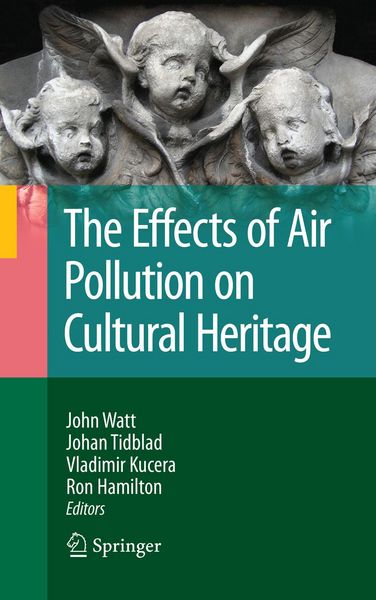
The Effects of Air Pollution on Cultural Heritage
-
- Hardcover
- Taschenbuch
- eBook ausgewählt
-
Form:Einzelkauf Download
-
Sprache:Englisch
149,79 €
inkl. gesetzl. MwSt.Beschreibung
Produktdetails
Format
ePUB
Kopierschutz
Nein
Family Sharing
Nein
Text-to-Speech
Ja
Erscheinungsdatum
10.06.2009
Herausgeber
John Watt + weitereVerlag
SpringerSeitenzahl
306 (Printausgabe)
Dateigröße
10657 KB
Auflage
2009
Sprache
Englisch
EAN
9780387848938
This book examines the impact of air pollution on cultural heritage materials, which is a serious concern because it can lead to loss of important parts of our history and culture. Damage includes corrosion, bio-degradation and soiling. In recent years, there have been major changes in both the sources and amounts of emissions of air pollution that have altered the rate and extent of building damage. The book reviews the sources of the air pollutants responsible for building damage and the mechanisms involved. Studies investigating the relationships between pollution concentration (dose) and the resulting damage (response) are described and the latest research findings for dose-response functions presented.
Trends in pollutant emissions, ambient concentrations and changes in building damage over time are discussed and future predictions presented.. Procedures for estimating the economic implications are described and the consequences are discussed in detail, because economic factors are important for reaching policy and management decisions at local, national and international scales. An important part of the economic evaluation relies on having reliable estimates of theactual amounts of material that need to be considered - the stock at risk. This estimation is difficult for heritage materials, since the buildings and monuments involved are very varied in size, shape, age and composition. The most up to date studies are presented, with a number of case studies to show how this subject may be approached.
Damage to cultural heritage buildings is an important effect of air pollution, which needs to be considered as current air quality standards, largely based on health effects, are revised. The factors which will need to be brought into the assessment, including potential ways to address the fact that there is no general consensus on what might be considered a tolerable or acceptable rate, are presented. Finally, a range of possible strategies and methods for conservation and maintenance, as required by building managers, is described and a number of case studies presented.
This book combines the results of recent research with practical information and provides an important reference manual for researchers, policy makers, economists and historic building managers working in the field of cultural heritage protection.
Noch keine Bewertungen vorhanden
Verfassen Sie die erste Bewertung zu diesem Artikel
Helfen Sie anderen Kundinnen und Kunden durch Ihre Meinung.
Kurze Frage zu unserer Seite
Vielen Dank für Ihr Feedback
Wir nutzen Ihr Feedback, um unsere Produktseiten zu verbessern. Bitte haben Sie Verständnis, dass wir Ihnen keine Rückmeldung geben können. Falls Sie Kontakt mit uns aufnehmen möchten, können Sie sich aber gerne an unseren Kund*innenservice wenden.
zum Kundenservice