• Produktbild: Virtual Clothing
  • Produktbild: Virtual Clothing

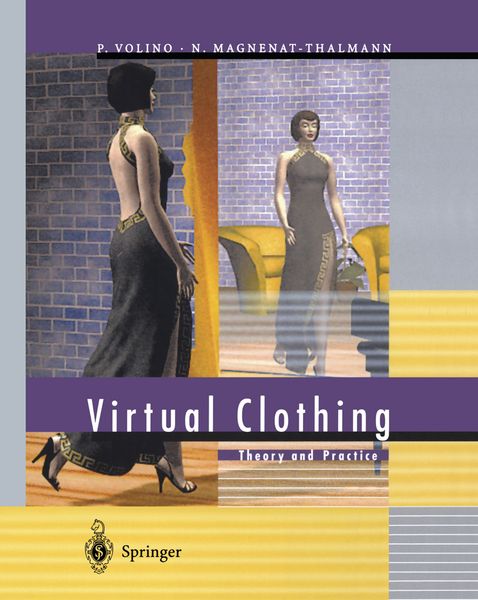
Virtual Clothing Theory and Practice

128,99 €

inkl. gesetzl. MwSt., Versandkostenfrei


Beschreibung

Produktdetails

Einband

Taschenbuch

Erscheinungsdatum

01.11.2012

Verlag

Springer Berlin

Seitenzahl

283

Maße (L/B/H)

24,2/19,3/1,7 cm

Gewicht

602 g

Auflage

Softcover reprint of the original 1st ed. 2000

Sprache

Englisch

ISBN

978-3-642-63189-4

Beschreibung

Produktdetails

Einband

Taschenbuch

Erscheinungsdatum

01.11.2012

Verlag

Springer Berlin

Seitenzahl

283

Maße (L/B/H)

24,2/19,3/1,7 cm

Gewicht

602 g

Auflage

Softcover reprint of the original 1st ed. 2000

Sprache

Englisch

ISBN

978-3-642-63189-4

Herstelleradresse

Springer-Verlag KG
Sachsenplatz 4-6
1201 Wien
AT

Email: GPSR Kontakt

Ein neues Kapitel für Ihre Bücher

Ein neues Kapitel für Ihre Bücher

Schenken Sie Ihren alten Schätzen ein zweites Leben: Einfach Barcode scannen, Versandetikett ausdrucken, Bücher verschicken und Thalia Geschenkkarte erhalten.

Jetzt verkaufen
Jetzt verkaufen

Noch keine Bewertungen vorhanden

Verfassen Sie die erste Bewertung zu diesem Artikel

Helfen Sie anderen Kundinnen und Kunden durch Ihre Meinung.

Kundinnen und Kunden meinen

Bewertungen (0)

  • Produktbild: Virtual Clothing
  • Produktbild: Virtual Clothing
  • 1 Introduction.- 1.1 A Brief Historical Background.- 1.2 Problems.- 1.2.1 Shape and Geometry.- 1.2.2 Behavior.- 1.2.3 Interaction with Environment.- 1.2.4 From Cloth to Garment.- 1.2.5 Rendering.- 1.3 Garment Design and Simulation System: An Example.- 2 Simulation Models.- 2.1 Introduction.- 2.1.1 Dynamics.- 2.1.2 Designing a Mechanical Simulation System.- 2.2 Mechanical Properties of Fabric Materials.- 2.2.1 Fabric Mechanical Parameters.- 2.2.2 Experimental Analysis of Fabric Properties.- 2.3 Implementing Mechanical Models.- 2.3.1 Defining Behavior Laws.- 2.3.2 Fundamental Laws of Mechanics.- 2.3.3 Defining a Simulation Scheme.- 2.4 Mechanical Simulation Systems.- 2.4.1 A Good Simulation System.- 2.4.2 Geometrical Models.- 2.4.3 Continuum Mechanics Models.- 2.4.4 Particle System Models.- 2.4.5 A Fast Particle System for Irregular Meshes.- 2.5 Numerical Integration.- 2.5.1 Integration Techniques.- 2.5.2 Choosing the Suitable Integration Method.- 3 Collision Detection.- 3.1 The Collision Detection Problem.- 3.1.1 Introduction.- 3.1.2 Mastering Complexity.- 3.1.3 An Overview of Different Techniques.- 3.1.4 Robustness.- 3.2 A Hierarchical Scheme for Polygonal Meshes.- 3.2.1 Collision Detection on Hierarchical Meshes.- 3.2.2 Optimizing for Self-Collision Detection.- 3.2.3 Efficiency.- 4 Collision Response.- 4.1 Characterizing Collisions Geometrically.- 4.1.1 Intersections and Proximities.- 4.1.2 Collisions and Surface Orientation.- 4.2 Implementing Collision Response.- 4.2.1 Collision Response on Polygonal Meshes.- 4.2.2 Collision Models.- 4.3 Constraints & Seaming.- 4.3.1 Elastics to Bring Objects Together.- 4.3.2 Controlling the Elastic Effect.- 4.3.3 Applications.- 5 Smoothing & Wrinkles.- 5.1 Multilayer Models.- 5.2 A Simple Geometrical Interpolation Algorithm.- 5.2.1 The Problem.- 5.2.2 Constructing the Surface.- 5.2.3 Results.- 5.2.4 Texture as a Height Field.- 5.2.5 Modulating Wrinkle Amplitude.- 5.2.6 Multilayer Wrinkle Textures.- 5.2.7 Rendering Wrinkles.- 5.2.8 Applications.- 6 Rendering Garments.- 6.1 Rendering Techniques.- 6.1.1 Visualization Principles.- 6.1.2 Rendering Systems.- 6.2 Rendering Textiles.- 6.2.1 Anisotropic Lighting of Textiles.- 6.2.2 Volumetric Textile Models.- 6.2.3 Rendering Choices for Realistic Garments.- 7 The MIRACloth Software.- 7.1 Introduction.- 7.2 Approach.- 7.2.1 Design of Garment Patterns.- 7.2.2 Putting Patterns on Bodies.- 7.2.3 Seaming and Constructing Garments.- 7.2.4 Animation of Garments.- 7.2.5 Defining the Garment Materials and Textures.- 7.2.6 Cutting and Modifications.- 7.3 Software Description.- 7.3.1 Program Features.- 7.3.2 Interface Description.- 7.3.3 V.R. Manipulation Tools.- 7.4 MIRACloth at Work.- 7.4.1 Versatile Fabric Simulation.- 7.4.2 Computer Films and Fashion Shows.- 7.4.3 Model Design.- 7.4.4 Garment Prototyping.- 8 Potential Applications.