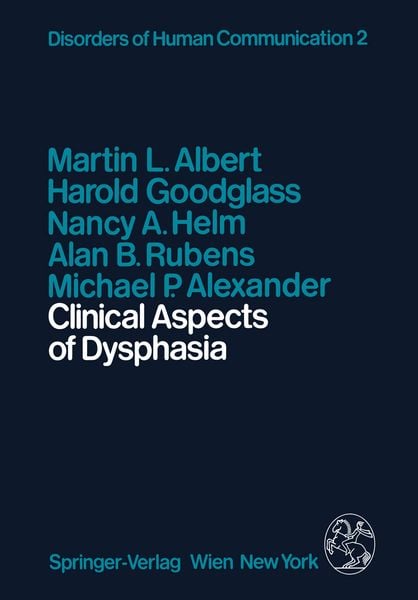
Produktbild: Clinical Aspects of Dysphasia
Band 2

Clinical Aspects of Dysphasia

49,99 €

inkl. gesetzl. MwSt., Versandkostenfrei


Beschreibung

Produktdetails

Einband

Taschenbuch

Erscheinungsdatum

24.01.2012

Verlag

Springer Wien

Seitenzahl

194

Maße (L/B/H)

24,4/17/1,2 cm

Gewicht

369 g

Auflage

Softcover reprint of the original 1st ed. 1981

Sprache

Englisch

ISBN

978-3-7091-8607-7

Beschreibung

Produktdetails

Einband

Taschenbuch

Erscheinungsdatum

24.01.2012

Verlag

Springer Wien

Seitenzahl

194

Maße (L/B/H)

24,4/17/1,2 cm

Gewicht

369 g

Auflage

Softcover reprint of the original 1st ed. 1981

Sprache

Englisch

ISBN

978-3-7091-8607-7

Herstelleradresse

Springer-Verlag KG
Sachsenplatz 4-6
1201 Wien
AT

Email: GPSR Kontakt

Ein neues Kapitel für Ihre Bücher

Ein neues Kapitel für Ihre Bücher

Schenken Sie Ihren alten Schätzen ein zweites Leben: Einfach Barcode scannen, Versandetikett ausdrucken, Bücher verschicken und Thalia Geschenkkarte erhalten.

Jetzt verkaufen
Jetzt verkaufen

Noch keine Bewertungen vorhanden

Verfassen Sie die erste Bewertung zu diesem Artikel

Helfen Sie anderen Kundinnen und Kunden durch Ihre Meinung.

Kundinnen und Kunden meinen

Bewertungen (0)

  • Produktbild: Clinical Aspects of Dysphasia
  • I. Examination of the Dysphasic Patient.- A. General Clinical Considerations.- B. Brief, Clinical (Bedside) Examination for Dysphasia.- C. Clinical Guide to Classification of Dysphasic Syndromes.- D. Formal Language Evaluation.- 1. Five Aspects of Assessment in Dysphasia.- Dysphasia Testing as an Inventory of Language Input and Output Modalities.- Linguistic Aspects of Dysphasia Testing.- Diagnostic Aims of Dysphasia Testing.- The Dysphasia Examination as a Case Study.- Quantitative Aspects of Assessment.- 2. Non-Language Aspects of Assessment.- Non-Specific Indicators.- Specific (Localizing) Non-Language Deficits.- 3. Assessment and Therapy.- 4. The Formal Dysphasia Examination.- a) The Free Conversational Sample.- b) The Evaluation of Auditory Comprehension.- c) The Assessment of Productive Speech.- d) Repetition.- e) Tests of Word Retrieval.- f) Reading.- g) Examination of Writing Ability.- 5. Testing for Dyspraxia.- 6. Beyond the Formal Examination.- II. Clinical Features of Dysphasic Syndromes.- A. Introduction.- B. Neuroanatomical and Neurophysiological Considerations.- C. Dysphasia with Repetition Disturbance.- 1. Broca’s Dysphasia.- 2. Wernicke’s Dysphasia.- 3. Conduction Dysphasia.- 4. Global Dysphasia.- 5. Aphemia.- 6. Pure Word Deafness.- D. Dysphasia without Repetition Disturbance.- 1. Transcortical Dysphasias.- 2. Transcortical Motor Dysphasia.- 3. Transcortical Sensory Dysphasia.- 4. Mixed Transcortical Dysphasia.- 5. Anomic Dysphasia.- 6. Dysphasia from Left Subcortical Lesions.- E. Disturbances of Reading and Writing.- 1. Dyslexias.- Disorders of Written Language Associated with Dysphasia: Dysphasic Dyslexia.- Dyslexia with Dysgraphia in the Absence of Dysphasia.- Dyslexia without Dysgraphia (Pure Dyslexia, Agnostic Dyslexia).- 2. Dysgraphias.- F. Special Clinical Forms of Dysphasia.- 1. Crossed Dysphasia.- 2. Dysphasia in Polyglots.- 3. Dysphasia in Left-Handers.- 4. Dysphasia in Deaf-Mutes.- 5. Dysphasia in Dementia.- III. Therapy of Dysphasia in Adults.- A. Is Dysphasia Rehabilitation Effective?.- 1. Introduction.- 2. Measuring Response to Treatment.- 3. Studies of Dysphasia Treatment.- 4. Conclusion.- B. What Approaches to Dysphasia Rehabilitation Are Feit to Be Most Effective?.- 1. Introduction.- 2. Treatment of Global Dysphasia.- Specific Approaches to Global Dysphasia.- 3. Treatment of Non-Fluent Dysphasia.- Specific Approaches to Non-Fluent Dysphasia.- A Case Report of Treatment with Melodie Intonation Therapy.- 4. Treatment of Agrammatism.- 5. Treatment of Anomia.- 6. Treatment of Comprehension Disorders.- C. General Considerations for Dysphasia Rehabilitation.- 1. Group versus Individual Language Therapy.- 2. The Influence of Fatigue and Perseveration on Dysphasia Rehabilitation.- 3. The Influence of Reinforcement and Feedback on Dysphasia Rehabilitation.- 4. The Influence of Repetition on Dysphasia Rehabilitation.- 5. The Influence of Sensory Input Variables on Dysphasia Rehabilitation.- 6. Conclusion.- References.