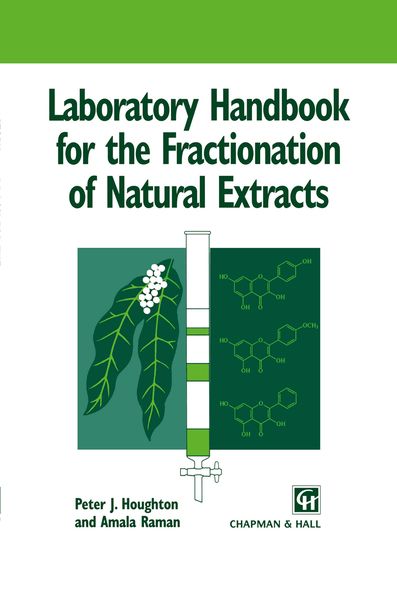
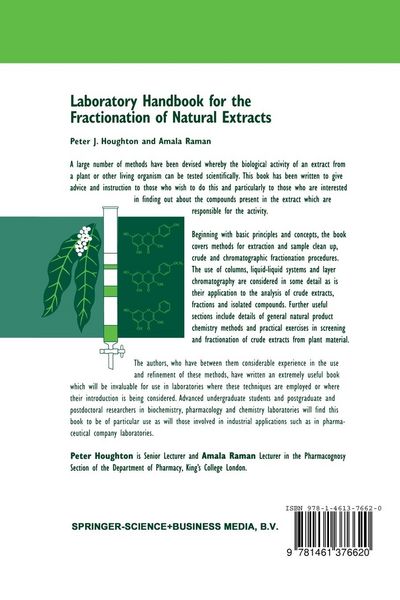
Laboratory Handbook for the Fractionation of Natural Extracts
-
- Hardcover
- Taschenbuch ausgewählt
- eBook
-
Sprache:Englisch
139,99 €
UVP
160,49 €
inkl. gesetzl. MwSt.,
Beschreibung
Produktdetails
Einband
Taschenbuch
Erscheinungsdatum
02.11.2012
Verlag
Springer UsSeitenzahl
199
Maße (L/B/H)
23,5/15,5/1,2 cm
Gewicht
333 g
Auflage
Softcover reprint of the original 1st ed. 1998
Sprache
Englisch
ISBN
978-1-4613-7662-0
1 Introduction.- 1.1 The need for this book - an active extract, what happens next?.- 1.2 Why is it important to find out the nature of the active components?.- 1.3 Green chemicals - the renewed interest in natural products as sources of bioactive compounds.- 1.4 What are we doing?.- 1.5 Bibliography.- 2 Important concepts.- 2.1 Introduction.- Polarity.- 2.3 Dilution and concentration factors.- 2.4 Synergy.- 2.5 Deterioration, decomposition and storage.- 2.6 Biological variation.- 2.7 Authentication of material.- 2.8 Dereplication.- 3 Methods for extraction and sample clean-up.- 3.1 Introduction.- 3.2 Factors to be considered in selecting an extraction method.- 3.3 General extraction methods.- 3.4 Extraction methods for specific phytochemical groups.- 3.5 Clean-up techniques to remove unwanted substances.- 3.6 Bibliography.- 4 Crude fractionation procedures.- 4.1 Introduction.- 4.2 Choice of fractionation method.- 4.3 Common fractionation methods.- 4.4 Bibliography.- 5 Chromatographic fractionation procedures.- 5.1 Introduction.- 5.2 The principles of chromatography.- 5.3 Physico-chemical processes taking place in chromatography.- 5.4 Bibliography.- 6 Chromatographic procedures using columns and liquid-liquid systems.- 6.1 Column chromatography.- 6.2 Liquid-liquid partition schemes.- 6.3 Bibliography.- 7 Layer chromatography.- 7.1 Layer chromatography.- 7.2 Preparative thin-layer chromatography and paper chromatography.- 7.3 Bibliography.- 8 Analysis of crude extracts, fractions and isolated compounds.- 8.1 Introduction.- 8.2 Qualitative analysis of mixtures and isolates.- 8.3 Quantitative analytical methods.- 8.4 Biological assays.- 8.5 Bibliography.- 9 General methods.- 9.1 Basic techniques in handling extracts.- 9.2 Isolation of active compounds.- 9.3Chromatographic procedures.- 9.4 Basic techniques in thin-layer chromatography.- 9.5 Bibliography.- 10 Practical exercises in chemical screening and fractionation of crude extracts from plant materials.- 10.1 Chemical screening.- 10.2 Exercises in extraction, clean-up, fractionation and Chromatographicmethods.- Appendix A Recipes for chemical test reagents.
Ein neues Kapitel für Ihre Bücher
Ein neues Kapitel für Ihre Bücher
Schenken Sie Ihren alten Schätzen ein zweites Leben und erhalten dafür eine Thalia Geschenkkarte.
Noch keine Bewertungen vorhanden
Verfassen Sie die erste Bewertung zu diesem Artikel
Helfen Sie anderen Kundinnen und Kunden durch Ihre Meinung.
Kurze Frage zu unserer Seite
Vielen Dank für Ihr Feedback
Wir nutzen Ihr Feedback, um unsere Produktseiten zu verbessern. Bitte haben Sie Verständnis, dass wir Ihnen keine Rückmeldung geben können. Falls Sie Kontakt mit uns aufnehmen möchten, können Sie sich aber gerne an unseren Kund*innenservice wenden.
zum Kundenservice