• Produktbild: Comparative Biochemistry of Parasitic Helminths
  • Produktbild: Comparative Biochemistry of Parasitic Helminths

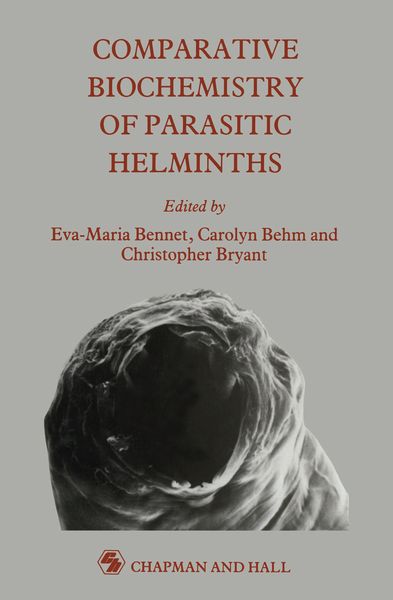
Comparative Biochemistry of Parasitic Helminths

48,99 €

inkl. gesetzl. MwSt., Versandkostenfrei


Beschreibung

Produktdetails

Einband

Taschenbuch

Erscheinungsdatum

03.10.2013

Abbildungen

VIII, 180 p. 2 illus.

Herausgeber

Eva Bennett

Verlag

Springer Netherland

Seitenzahl

180

Maße (L/B/H)

23,5/15,5/1,1 cm

Gewicht

300 g

Auflage

Softcover reprint of the original 1st ed. 1989

Sprache

Englisch

ISBN

978-94-010-6861-1

Beschreibung

Produktdetails

Einband

Taschenbuch

Erscheinungsdatum

03.10.2013

Abbildungen

VIII, 180 p. 2 illus.

Herausgeber

Eva Bennett

Verlag

Springer Netherland

Seitenzahl

180

Maße (L/B/H)

23,5/15,5/1,1 cm

Gewicht

300 g

Auflage

Softcover reprint of the original 1st ed. 1989

Sprache

Englisch

ISBN

978-94-010-6861-1

Herstelleradresse

Springer-Verlag KG
Sachsenplatz 4-6
1201 Wien
AT

Email: ProductSafety@springernature.com

Ein neues Kapitel für Ihre Bücher

Ein neues Kapitel für Ihre Bücher

Schenken Sie Ihren alten Schätzen ein zweites Leben und erhalten dafür eine Thalia Geschenkkarte.

Jetzt verkaufen
Jetzt verkaufen

Noch keine Bewertungen vorhanden

Verfassen Sie die erste Bewertung zu diesem Artikel

Helfen Sie anderen Kundinnen und Kunden durch Ihre Meinung.

Kundinnen und Kunden meinen

Bewertungen (0)

  • Produktbild: Comparative Biochemistry of Parasitic Helminths
  • Produktbild: Comparative Biochemistry of Parasitic Helminths
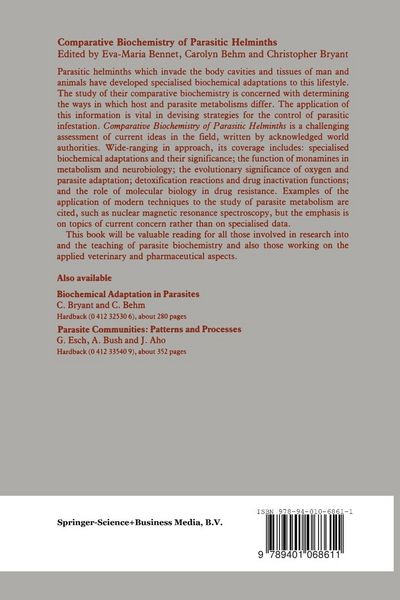
  • 1 Ascris suum: a useful model for anerobic mitochondrial metabolism and the transition in aerobic-anaerobic developing parasitic helminths.- 2 The role of 5-hydroxytryptamine (5-HT: serotonin) in glucose transport, intermediary carbohydrate metabolism and helminth neurobiology.- 3 What are the functions of the catecholamines and 5-hydroxytryptamine in the parasitic nematodes?.- 4 The physiological significance of Complex II (succinate-ubiquinone reductase) in respiratory adaptation.- 5 Oxygen and the lower Metazoa.- 6 How do parasitic helminths use and survive oxygen and oxygen metabolites?.- 7 Carbohydrate and energy metabolism in adult schistosomes: a reappraisal.- 8 Using carbon-13 Nuclear Magnetic Resonance spectroscopy to study helminth metabolism.- 9 Detoxification reactions in parasitic helminths.- 10 Parasite transport and inactivation functions involved in antiparasitic efficacy.- 11 The molecular biology of drug resistance in parasitic helminths.- 12 Comparative biochemistry of parasites and its role in drug resistance—an investigation of species differences in tubulin.- 13 Systemic effects of helminth infections as revealed by serum LDH isozymes and kinetic parameters of transport (Vmax and K1) of the host tissue.- Helminth index.