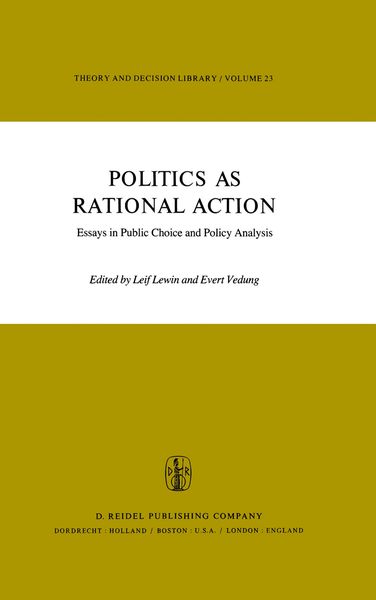
Produktbild: Politics as Rational Action
Band 23 - 29%

Politics as Rational Action Essays in Public Choice and Policy Analysis

29% sparen

74,99 € UVP 106,99 €

inkl. gesetzl. MwSt., Versandkostenfrei


Beschreibung

Produktdetails

Einband

Taschenbuch

Erscheinungsdatum

03.11.2011

Herausgeber

L. Lewin + weitere

Verlag

Springer Netherland

Seitenzahl

276

Maße (L/B/H)

23,5/15,5/1,6 cm

Gewicht

446 g

Auflage

Softcover reprint of the original 1st ed. 1980

Sprache

Englisch

ISBN

978-94-009-8957-3

Beschreibung

Produktdetails

Einband

Taschenbuch

Erscheinungsdatum

03.11.2011

Herausgeber

Verlag

Springer Netherland

Seitenzahl

276

Maße (L/B/H)

23,5/15,5/1,6 cm

Gewicht

446 g

Auflage

Softcover reprint of the original 1st ed. 1980

Sprache

Englisch

ISBN

978-94-009-8957-3

Herstelleradresse

Springer-Verlag KG
Sachsenplatz 4-6
1201 Wien
AT

Email: GPSR Kontakt

Ein neues Kapitel für Ihre Bücher

Ein neues Kapitel für Ihre Bücher

Schenken Sie Ihren alten Schätzen ein zweites Leben und erhalten dafür eine Thalia Geschenkkarte.

Jetzt verkaufen
Jetzt verkaufen

Noch keine Bewertungen vorhanden

Verfassen Sie die erste Bewertung zu diesem Artikel

Helfen Sie anderen Kundinnen und Kunden durch Ihre Meinung.

Kundinnen und Kunden meinen

Bewertungen (0)

  • Produktbild: Politics as Rational Action
  • Political Trust as Rational Choice.- 1. Introduction.- 2. Trust as an Attitude.- 3. A Definition of Trust.- 4. Deutsch’s Definition of Trust.- 5. The Inadequacy of the Prisoners’ Dilemma Model of Trust.- 6. Risk in the Prisoners’ Dilemma.- 7. The Assessment of Risk.- 8. Rational Trust.- On ‘Normative’ Rational-Choice Theories of Politics.- 1. Introduction.- 2. The Liberal Theory of the State.- 3. The Destination of Small Communities.- 4. The State and the Decay of Voluntary Cooperation.- 5. Concluding Remarks.- Various Meanings of ‘Rational Political Decisions’.- 1. Meanings of ‘Politics’.- 2. One Actor: Decisions under Certainty.- 3. One Actor: Decisions under Risk.- 4. More than One Actor: Noncooperative Games.- 5. More than One Actor: Cooperative Games.- 6. Conclusion.- Political Aspects of Economic Power: A Critique of the Market Concept.- 1. Introduction.- 2. The Eclipse of Power in Economics: Power and Economic Law.- 3. Economic Power as Market Power.- 4. The Evidence: Tight Oligopoly and the Dominant Firm.- 5. Neglect of Bipartite Market Structure: Bilateral Monopoly.- 6. Inadequacy of Bipartite Market Paradigm: Multipartite Markets.- 7. External or Extra Market Power.- On the Significance of Language and a Richer Concept of Rationality.- 1. Introduction.- 2. Speech Acts.- 3. Rules of Political Interlocutions.- 4. The Element of Strategy in Political Interlocutions.- 5. On the Preference Structure of a Rational Political Actor.- 6. Conclusion.- Individual and Collective Rationality.- 1. Economic and Political Rationality.- 2. Discrete Social Choice Theory.- 3. Smooth Social Choice Theory.- 4. Conclusion.- Strategy and Reflexivity.- 1. Introduction.- 2. Problems of Reflexive Processes of Cognition.- 3. Reflexivity-Oriented Rationality and Socialization.- When Are Decision-Makers Irrational? Some Methodological Problems Related to the Analysis of Political Decision-Making.- 1. Introduction.- 2. An Empirical Example: Relocation of the Central State Administration in Sweden.- 3. Determining Preferences.- 4. Explaining Discrepancies.- Explaining Rational Political Action.- Some Problems in the Study of Party Strategies.- 1. On the Analysis of Party Strategies.- 2. Types of Empirical Material.- 3. Three Types of Studies.- 4. The Problem of Category Proliferation.- 5. The Problem of Circularity.- 6. A Research Program.- Housing, Building, and Planning.- 1. Introduction.- 2. Placing the 1974 Choice in Historical Perspective.- 3. Making the Meaning of the Alternatives as Precise as Possible in Order to Explain the Choice.- 4. Suggesting How the Choice, thus Stated, Might Possibly Be Explained.- Positions on Energy Policy: A General Framework and the Case of the Swedish Center Party in the Decision of May, 1975.- 1. Introduction.- 2. Elements of an Energy Policy Position.- 2.1. The Questions of Consideration; Managing Agencies; Finances; Supervision; and Form of Decision.- 2.2. The Goal Issue.- 2.3. Question of Management Subject: Kinds of Primary Energy Sources and Their Flow through Society.- 2.4. Policy Instruments.- 3. The Position of the Center Party.- 3.1. Long-Range Goals.- 3.2. Long-Range Policy Instruments.- 3.3. Middle-Range Goals.- 3.4. Middle-Range Policy Instruments.- Testing Coalition Theories: The Combined Evidence.- 1. Introduction.- 2. What Is an Event: Testing Theories or Predicting Coalitions?.- 3. The Combined Evidence: Comparing Methods and Data.- 4. The Combined Evidence.- 5. Conclusion.- The Dilemma of Rational Legislative Action: Some Danish Evidence.- 1. Introduction.- 2. Rational Behavior Models and Politics.- 2.1. Application Problems.- 2.2. Normative and Empirical Aspects.- 2.3. Individual Choice and Social Outcome.- 3. The Rationale of Legislative Specialization.- 4. Legislative Specialization in Denmark.- 5. Consequences of Legislative Specialization.- Implementation Analysis: The ‘Missing Chapter’ in Conventional Analysis Illustrated by a Teaching Exercise.- 1. Introduction.- 2. The Student’s Assignment.- 3. Background on the University of Massachusetts Medical School.- 4. A ‘Classic’ Cost-Benefit Analysis.- 5. Guidelines for Critiquing Analysis: Notes on the Massachusetts Medical School Assignment.- 6. Epilogue: What Happened?.- About the Contributors.- Index of Names.- Index of Subjects.