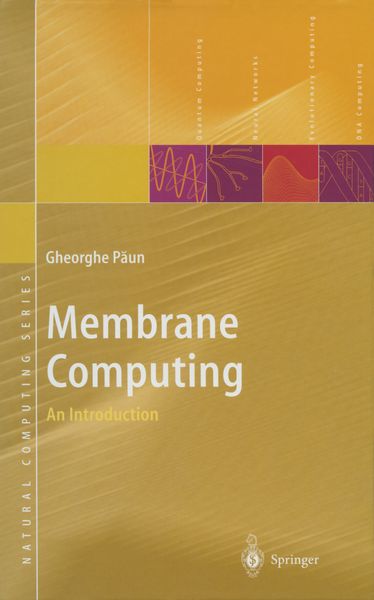
Membrane Computing An Introduction
-
- Hardcover
- Taschenbuch ausgewählt
- eBook
-
Sprache:Englisch
-
Verlag:Springer Berlin
- Springer 49,99 €
- Springer Berlin 51,99 € ausgewählt
-
Auflage:Softcover reprint of the original 1st edition 2002
51,99 €
inkl. gesetzl. MwSt.,
Beschreibung
Produktdetails
Einband
Taschenbuch
Erscheinungsdatum
20.11.2013
Abbildungen
XI, 420 p. 7 illus.
Verlag
Springer BerlinSeitenzahl
420
Maße (L/B/H)
23,5/15,5/2,4 cm
Gewicht
657 g
Auflage
Softcover reprint of the original 1st edition 2002
Sprache
Englisch
ISBN
978-3-642-62833-7
Like quantum computing or DNA computing, membrane computing is an unconventional model of computation associated with a new computing paradigm. The field of membrane computing was initiated in 1998 by the author of this book; it is a branch of natural computing inspired by the structure and functioning of the living cell and devises distributed parallel computing models in the form of membrane systems, also called P systems.
This book is the first monograph surveying the new field in a systematic and coherent way. It presents the central notions and results: the main classes of P systems, the main results about their computational power and efficiency, a complete bibliography, and a series of open problems and research topics. Thus, the book is indispensible reading for anybody interested in molecular computing.
Ein neues Kapitel für Ihre Bücher
Ein neues Kapitel für Ihre Bücher
Schenken Sie Ihren alten Schätzen ein zweites Leben und erhalten dafür eine Thalia Geschenkkarte.
Noch keine Bewertungen vorhanden
Verfassen Sie die erste Bewertung zu diesem Artikel
Helfen Sie anderen Kundinnen und Kunden durch Ihre Meinung.
Kurze Frage zu unserer Seite
Vielen Dank für Ihr Feedback
Wir nutzen Ihr Feedback, um unsere Produktseiten zu verbessern. Bitte haben Sie Verständnis, dass wir Ihnen keine Rückmeldung geben können. Falls Sie Kontakt mit uns aufnehmen möchten, können Sie sich aber gerne an unseren Kund*innenservice wenden.
zum Kundenservice