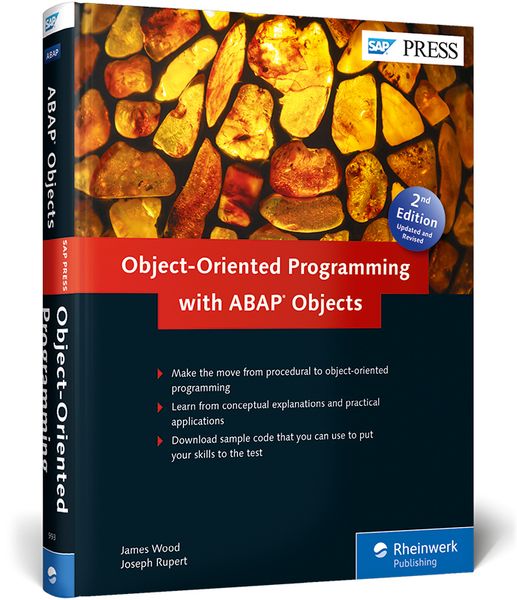
Produktbild: Object-Oriented Programming with ABAP Objects
- 11%

Object-Oriented Programming with ABAP Objects

Aus der Reihe SAP PRESS Englisch
11% sparen

61,99 € UVP 69,95 €

inkl. gesetzl. MwSt., Versandkostenfrei


Beschreibung

Produktdetails

Einband

Gebundene Ausgabe

Erscheinungsdatum

28.10.2015

Verlag

Rheinwerk Publishing

Seitenzahl

470

Maße (L/B/H)

24/18,4/3,5 cm

Gewicht

1023 g

Auflage

2nd Enlarged edition

Sprache

Englisch

ISBN

978-1-59229-993-5

Beschreibung

Produktdetails

Einband

Gebundene Ausgabe

Erscheinungsdatum

28.10.2015

Verlag

Rheinwerk Publishing

Seitenzahl

470

Maße (L/B/H)

24/18,4/3,5 cm

Gewicht

1023 g

Auflage

2nd Enlarged edition

Sprache

Englisch

ISBN

978-1-59229-993-5

Herstelleradresse

Libri GmbH
Europaallee 1
36244 Bad Hersfeld
DE

Email: GPSR Kontakt

Ein neues Kapitel für Ihre Bücher

Ein neues Kapitel für Ihre Bücher

Schenken Sie Ihren alten Schätzen ein zweites Leben und erhalten dafür eine Thalia Geschenkkarte.

Jetzt verkaufen
Jetzt verkaufen

Noch keine Bewertungen vorhanden

Verfassen Sie die erste Bewertung zu diesem Artikel

Helfen Sie anderen Kundinnen und Kunden durch Ihre Meinung.

Kundinnen und Kunden meinen

Bewertungen (0)

  • Produktbild: Object-Oriented Programming with ABAP Objects


  • Introduction … 15

    PART I Introduction

    1 … Introduction to Object-Oriented Programming … 23

    1.1 … The Need for a Better Abstraction … 23

    1.2 … Classes and Objects … 26

    1.3 … Establishing Boundaries … 30

    1.4 … Reuse … 34

    1.5 … Object Management … 38

    1.6 … UML Tutorial: Class Diagram Basics … 38

    1.7 … Summary ... 45

    2 … Getting Started with Objects … 47

    2.1 … Defining Classes … 47

    2.2 … Working with Objects … 59

    2.3 … Building your First Object-Oriented Program ... 78

    2.4 … Working with Global Classes ... 84

    2.5 … Developing Classes Using the ABAP Development Tools in Eclipse ... 97

    2.6 … New Syntax Features in Release 7.40 ... 114

    2.7 … UML Tutorial: Object Diagrams ... 117

    2.8 … Summary ... 119

    3 … Encapsulation and Implementation Hiding … 121

    3.1 … Lessons Learned from Procedural Programming … 121

    3.2 … Data Abstraction with Classes … 131

    3.3 … Defining Component Visibilities … 133

    3.4 … Designing by Contract … 139

    3.5 … UML Tutorial: Sequence Diagrams … 140

    3.6 … Summary … 142

    4 … Object Initialization and Cleanup … 143

    4.1 … Understanding the Object Creation Process … 143

    4.2 … Working with Constructors … 148

    4.3 … Object-Creational Patterns ... 152

    4.4 … Garbage Collection … 157

    4.5 … Tuning Performance ... 159

    4.6 … UML Tutorial: State Machine Diagrams ... 161

    4.7 … Summary … 163

    5 … Inheritance and Composition … 165

    5.1 … Generalization and Specialization ... 166

    5.2 … Inheriting Components ... 175

    5.3 … The Abstract and Final Keywords ... 183

    5.4 … Inheritance vs. Composition … 191

    5.5 … Working with ABAP Refactoring Tools ... 194

    5.6 … UML Tutorial: Advanced Class Diagrams ... 198

    5.7 … Summary … 201

    6 … Polymorphism ... 203

    6.1 … Object Reference Assignments Revisited ... 204

    6.2 … Dynamic Method Call Binding ... 210

    6.3 … Interfaces ... 212

    6.4 … UML Tutorial: Advanced Class Diagrams Part II ... 229

    6.5 … Summary ... 232

    7 … Component-Based Design Concepts ... 233

    7.1 … Understanding the SAP Component Model … 233

    7.2 … The Package Concept ... 236

    7.3 .. Package Design Concepts ... 258

    7.4 … UML Tutorial: Package Diagrams ... 260

    7.5 … Summary … 262

    8 … Error Handling with Exception Classes … 263

    8.1 … Lessons Learned from Prior Approaches … 263

    8.2 … The Class-Based Exception Handling Concept ... 266

    8.3 … Creating Exception Classes ... 268

    8.4 … Dealing with Exceptions ... 275

    8.5 … Raising and Forwarding Exceptions ... 281

    8.6 … UML Tutorial: Activity Diagrams ... 294

    8.7 … Summary ... 297

    9 … Unit Tests with ABAP Unit ... 299

    9.1 … ABAP Unit Overview ... 300

    9.2 … Creating Unit Test Classes … 301

    9.3 … Assertions in ABAP Unit ... 307

    9.4 … Managing Dependencies ... 310

    9.5 … Case Study: Creating a Unit Test in ABAP Unit ... 313

    9.6 … Executing Unit Tests ... 316

    9.7 … Evaluating Unit Test Results ... 319

    9.8 … Moving Towards Test-Driven Development ... 321

    9.9 … Behavior-Driven Development ... 322

    9.10 … UML Tutorial: Use Case Diagrams ... 323

    9.11 … Summary ... 328

    PART II … Case Studies

    10 … ABAP Object Services ... 331

    10.1 … Introduction ... 331

    10.2 … Working with the Persistence Service ... 335

    10.3 … Querying Persistent Objects with the Query Service ... 357

    10.4 … Modeling Complex Entity Relationships ... 362

    10.5 … Transaction Handling with the Transaction Service ... 369

    10.6 … UML Tutorial: Communication Diagrams ... 375

    10.7 … Summary ... 377

    11 … Business Object Development with the BOPF ... 379

    11.1 … What is the BOPF? ... 379

    11.2 … Anatomy of a Business Object ... 382

    11.3 … Working with the BOPF Client API ... 397

    11.4 … Where to Go From Here ... 408

    11.5 … UML Tutorial: Advanced Sequence Diagrams ... 411

    11.6 … Summary ... 413

    12 … Working with the SAP List Viewer ... 415

    12.1 … What is the SAP List Viewer? ... 415

    12.2 … Introducing the ALV Object Model ... 418

    12.3 … Developing a Reporting Framework on top of ALV ... 421

    12.4 … UML Tutorial: Advanced Activity Diagrams ... 430

    12.5 … Summary … 432

    13 … Where to Go From Here … 433

    13.1 … Object-Oriented Analysis and Design … 433

    13.2 … Design Patterns … 434

    13.3 … Reading and Writing ABAP Objects Code … 435

    13.4 … Summary .... 436

    … Appendices …. 437

    A … Installing the Eclipse IDE ... 439

    A.1 … Installing the Java SDK ... 439

    A.2 … Installing Eclipse ... 440

    A.3 … Installing the ABAP Development Tools ... 442

    A.4 … Where to Go to Find Help ... 445

    B … Debugging Objects ... 447

    B.1 … Understanding Debugger Types ... 447

    B.2 … Debugging Objects Using the Classic Debugger ... 447

    B.3 … Debugging Objects Using the New Debugger ... 455

    C … Bibliography ... 459

    D … The Authors ... 461