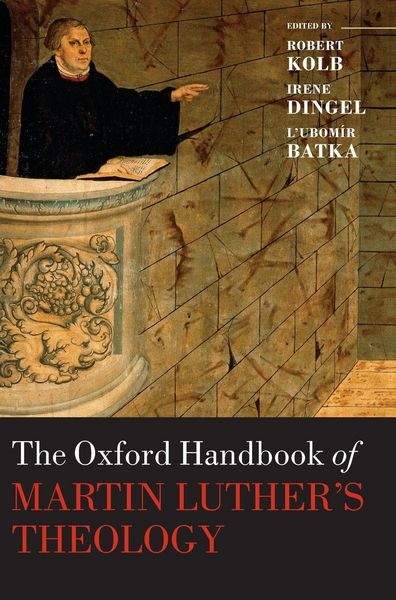
• Produktbild: The Oxford Handbook of Martin Luther's Theology
  • Produktbild: The Oxford Handbook of Martin Luther's Theology

The Oxford Handbook of Martin Luther's Theology

285,99 €

inkl. gesetzl. MwSt., Versandkostenfrei


Beschreibung

Produktdetails

Einband

Gebundene Ausgabe

Erscheinungsdatum

24.04.2014

Herausgeber

Kolb Robert + weitere

Verlag

Oxford University Press

Seitenzahl

688

Maße (L/B/H)

25/17,5/4,1 cm

Gewicht

1338 g

Sprache

Englisch

ISBN

978-0-19-960470-8

Beschreibung

Produktdetails

Einband

Gebundene Ausgabe

Erscheinungsdatum

24.04.2014

Herausgeber

Verlag

Oxford University Press

Seitenzahl

688

Maße (L/B/H)

25/17,5/4,1 cm

Gewicht

1338 g

Sprache

Englisch

ISBN

978-0-19-960470-8

Herstelleradresse

Libri GmbH
Europaallee 1
36244 Bad Hersfeld
DE

Email: gpsr@libri.de

Ein neues Kapitel für Ihre Bücher

Ein neues Kapitel für Ihre Bücher

Schenken Sie Ihren alten Schätzen ein zweites Leben: Einfach Barcode scannen, Versandetikett ausdrucken, Bücher verschicken und Thalia Geschenkkarte erhalten.

Jetzt verkaufen
Jetzt verkaufen

Noch keine Bewertungen vorhanden

Verfassen Sie die erste Bewertung zu diesem Artikel

Helfen Sie anderen Kundinnen und Kunden durch Ihre Meinung.

Kundinnen und Kunden meinen

Bewertungen (0)

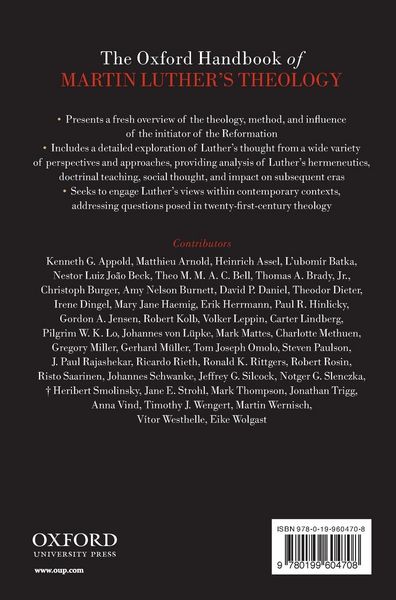
  • Produktbild: The Oxford Handbook of Martin Luther's Theology
  • Produktbild: The Oxford Handbook of Martin Luther's Theology
    • Introduction: Luther s Thought and its role in the Twenty-First-Century Global Societies

    • I. Luther s Life

    • 1: Charlotte Methuen: Luther s Life

    • II. The medieval background and origins of Luther s thought

    • 2: Theodor Dieter: Luther as Late Medieval Theologian: His Positive and Negative use of Nominalism and Realism

    • 3: Volker Leppin: Luther s roots in Monastic-Mystical piety

    • 4: Martin Wernisch: Luther and Medieval Reform Movements, Particularly the Hussites

    • 5: Erik Herrmann: Luther s Absorption of Medieval Biblical Interpretation and His Use of the Church Fathers

    • 6: Robert Rosin: Humanism, Luther and the Wittenberg Reformation

    • 7: Gerhard Müller: Luther s Transformation of Medieval Thought: Discontinuity and Continuity

    • 8: Volker Leppin: Luther s Transformation of Medieval Thought: Continuity and Discontinuity

    • III. The hermeneutical principles that guided Luther s teaching and preaching

    • 9: Mark Thompson: Luther on God and History

    • 10: Johannes von Lüpke: Luther s Use of Language

    • 11: Vitor Westhelle: Luther s Theologia crucis

    • 12: Robert Kolb: Luther s Hermeneutics of Distinctions: Law and Gospel, Two Kinds of Righteousness, Two Realms, Freedom and Bondage

    • IV. Luther s treatment of the traditional topics of western Christian theology

    • 13: Steven Paulson: Luther Doctrine of God

    • 14: Johannes Schwanke: Luther Theology of Creation

    • 15: Notger Slenczka: Luther s Anthropology

    • 16: L ubomír Batka: Luther s Teaching on Sin and Evil

    • 17: Risto Saaarinen: Justification by Faith: The View of the Mannermaa School

    • 18: Mark Mattes: Luther on Justification as Forensic and Effective

    • 19: Mattheiu Arnold: Luther on Christ s Person and Work

    • 20: Jeffrey Silcock: Luther on the Holy Spirit and His Use of God s Word

    • 21: Jonathan Trigg: Luther on Baptism and Penance

    • 22: Gordon A. Jensen: Luther and the Lord s Supper

    • 23: David P. Daniel: Luther on the Church

    • 24: Jane E. Strohl: Luther s Eschatology

    • V. Luther s view of sanctified living

    • 25: Jane E. Strohl: The Framework for Christian Living: Luther on the Christian s Callings

    • 26: Jane E. Strohl: Luther on Marriage, Sexuality and the Family

    • 27: Ricardo Rieth: Luther s Treatment of Economic Life

    • 28: Eike Wolgast: Luther s Treatment of Political and Societal Life

    • 29: Carter Lindberg: Piety, Prayer, and Worship in Luther s View of Daily Life

    • 30: Gregory Miller: Luther s Views of Jews and Turks

    • 31: Paul Rajashekar: Luther as a Resource for Christian Dialogue with Other World Religions

    • VI. The genre in which Luther shaped his theology

    • 32: Mary Jane Haemig: The Influence of the Genre of Exegetical Instruction, Preaching, and Catechesis on Luther

    • 33: Ronald K. Rittgers: How Luther s Engagement in Pastoral Care Shaped Luther s Theology

    • 34: Anna Vind: Luther s Thought Assumed Form in Polemics

    • 35: Christoph Burger: Translation of Scripture and Hymns Shaped Luther s Theology

    • VI. The Impact and Reception of Luther's Thought in History and in the twenty-first Century

    • 36: Timothy J. Wengert: The Wittenberg circle

    • 37: Heribert Smolinsky: Luther s Roman Catholic Critics

    • 38: Amy Nelson Burnett: Luther and the Schwärmer

    • 39: Irene Dingel: Luther s Authority in the Late Reformation and Protestant Orthodoxy

    • 40: Paul R. Hinlicky: The Use of Luther s Thought in Pietism and the Enlightenment

    • 41: Heinrich Assel: The Use of Luther s Thought in the Nineteenth Century and the Luther Renaissance

    • 42: Thomas A. Brady, Jr.: Marxist Evaluations of Luther s Thought

    • 43: Theo M. M. A. C. Bell: Roman Catholic Luther Research in the Twentieth Century: From Rejection to Rehabilitation

    • 44: Kenneth G. Appold: Luther s Abiding Significance for World Protestantism

    • 45: Pilgrim W. K. Lo: Luther and Asia

    • 46: Luther in Africa

    • 47: Nestor Luiz João Beck: Luther Studies in Latin America

    • Conclusion: Venturing into the Study of Luther

    • Appendices: Sources and Resources, and Glossary