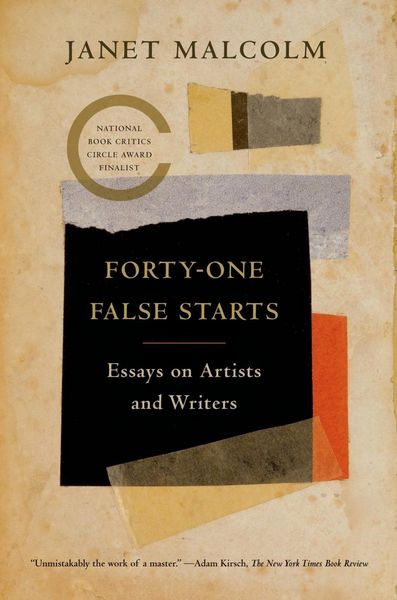
Forty-one False Starts Essays on Artists and Writers
-
- Taschenbuch
- eBook ausgewählt
-
Form:Einzelkauf Download
-
Sprache:Englisch
-
Verlag:Farrar, Straus and Giroux
12,49 €
inkl. gesetzl. MwSt.Beschreibung
Produktdetails
Format
ePUB
Kopierschutz
Ja
Family Sharing
Nein
Text-to-Speech
Ja
Erscheinungsdatum
07.05.2013
Verlag
Farrar, Straus and GirouxSeitenzahl
320 (Printausgabe)
Dateigröße
711 KB
Sprache
Englisch
EAN
9780374709723
A National Book Critics Circle Finalist for Criticism A deeply Malcolmian volume on painters, photographers, writers, and critics. Janet Malcolm's In the Freud Archives and The Journalist and the Murderer, as well as her books about Sylvia Plath and Gertrude Stein, are canonical in the realm of nonfiction-as is the title essay of this collection, with its forty-one "false starts," or serial attempts to capture the essence of the painter David Salle, which becomes a dazzling portrait of an artist. Malcolm is "among the most intellectually provocative of authors," writes David Lehman in The Boston Globe, "able to turn epiphanies of perception into explosions of insight." Here, in Forty-one False Starts, Malcolm brings together essays published over the course of several decades (largely in The New Yorker and The New York Review of Books) that reflect her preoccupation with artists and their work. Her subjects are painters, photographers, writers, and critics. She explores Bloomsbury's obsessive desire to create things visual and literary; the "passionate collaborations" behind Edward Weston's nudes; and the character of the German art photographer Thomas Struth, who is "haunted by the Nazi past," yet whose photographs have "a lightness of spirit." In "The Woman Who Hated Women," Malcolm delves beneath the "onyx surface" of Edith Wharton's fiction, while in "Advanced Placement" she relishes the black comedy of the Gossip Girl novels of Cecily von Zeigesar. In "Salinger's Cigarettes," Malcolm writes that "the pettiness, vulgarity, banality, and vanity that few of us are free of, and thus can tolerate in others, are like ragweed for Salinger's helplessly uncontaminated heroes and heroines." "Over and over," as Ian Frazier writes in his introduction, "she has demonstrated that nonfiction-a book of reporting, an article in a magazine, something we see every day-can rise to the highest level of literature." One of Publishers Weekly's Best Nonfiction Books of 2013
Noch keine Bewertungen vorhanden
Verfassen Sie die erste Bewertung zu diesem Artikel
Helfen Sie anderen Kundinnen und Kunden durch Ihre Meinung.
Kurze Frage zu unserer Seite
Vielen Dank für Ihr Feedback
Wir nutzen Ihr Feedback, um unsere Produktseiten zu verbessern. Bitte haben Sie Verständnis, dass wir Ihnen keine Rückmeldung geben können. Falls Sie Kontakt mit uns aufnehmen möchten, können Sie sich aber gerne an unseren Kund*innenservice wenden.
zum Kundenservice