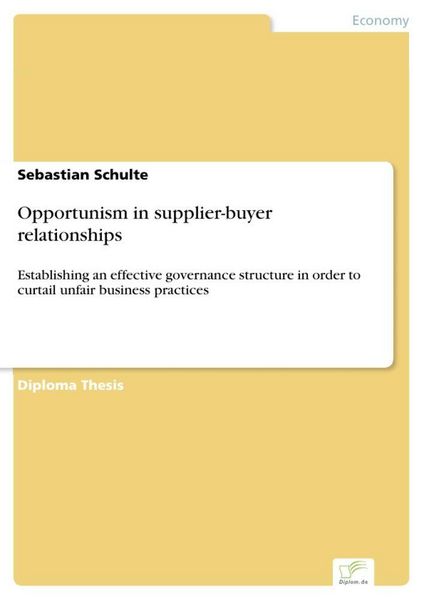
Opportunism in supplier-buyer relationships Establishing an effective governance structure in order to curtail unfair business practices
-
- Englisch ausgewählt
148,00 €
inkl. gesetzl. MwSt.,
Beschreibung
Produktdetails
Einband
Taschenbuch
Erscheinungsdatum
11.01.2007
Verlag
GRINSeitenzahl
116
Maße (L/B/H)
21/14,8/0,9 cm
Gewicht
180 g
Auflage
5. Auflage
Sprache
Englisch
ISBN
978-3-8366-0091-0
Inhaltsangabe:Abstract: In 1996, managers of U.S. based automaker Ford Corporation realized that they had been fooled: The decision to allocate the company¿s seat construction to the single supplier Lear Corporation had turned out to be a disaster. Lear had made unrealistic promises concerning their engineering talent in order to get into business with the major carmaker. As Ford was locked-in with a supplier that was unable to keep deadlines and that produced parts that did not work, the production and on time launch of the 1996 version of Ford Taurus were severely put at risk. In this industry example, the supplier behaved opportunistically towards the buyer by misrepresenting the true skills of its employees. According to Transaction Cost Economics (TCE), opportunism is considered as an endogenous factor ¿ it forms an inherent part of business relationships. Following Williamson¿s explanation, opportunism is one of the ¿rudimentary attributes of human nature¿. Whenever individuals will be given the chance to act opportunistically, they will do so. However, taking a look at current literature, the classical view of opportunism as a ¿ubiquitous phenomenon¿ becomes unsustainable. The emergence and degree of opportunistic behaviour is influenced by a variety of antecedent factors, such as institutional environment (e.g., competition, technology), or social determinants of behaviour (e.g., commitment, trust). Psychological research on this topic has shown that TCE lacks an explicit distinction between opportunism as an attitude and as a type of behaviour or action. Whether an agent behaves opportunistically or not does not only depend on his inclination towards carrying out unfair business practices, but also on the incentives that are given to him. Furthermore, recent approaches drawing on Agency Theory have replaced the traditional model of a self-serving man by an agent showing cooperative behaviours, as described in Stewardship Theory. In his original version of TCE, Williamson relied on vertical integration as an effective governance mechanism to attenuate opportunism and to safeguard specific investments. Transactions with high asset specificity should be governed by hierarchy mechanisms that are not accessible to markets, such as intensive monitoring or incentive structures. As a result, transaction costs would be minimized. In fact, hierarchical controls should not be treated as a universal remedy to curtail unfair business practices ¿ [...]
Ein neues Kapitel für Ihre Bücher
Ein neues Kapitel für Ihre Bücher
Schenken Sie Ihren alten Schätzen ein zweites Leben: Einfach Barcode scannen, Versandetikett ausdrucken, Bücher verschicken und Thalia Geschenkkarte erhalten.
Jetzt verkaufenNoch keine Bewertungen vorhanden
Verfassen Sie die erste Bewertung zu diesem Artikel
Helfen Sie anderen Kundinnen und Kunden durch Ihre Meinung.
Kurze Frage zu unserer Seite
Vielen Dank für Ihr Feedback
Wir nutzen Ihr Feedback, um unsere Produktseiten zu verbessern. Bitte haben Sie Verständnis, dass wir Ihnen keine Rückmeldung geben können. Falls Sie Kontakt mit uns aufnehmen möchten, können Sie sich aber gerne an unseren Kund*innenservice wenden.
zum Kundenservice