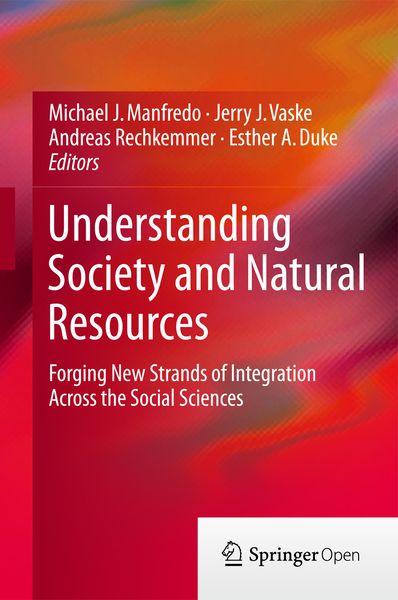
Understanding Society and Natural Resources Forging New Strands of Integration Across the Social Sciences
-
- Hardcover ausgewählt
- Taschenbuch
-
Sprache:Englisch
48,99 €
inkl. gesetzl. MwSt.,
Beschreibung
Produktdetails
Einband
Gebundene Ausgabe
Erscheinungsdatum
01.07.2014
Abbildungen
XXV, 38 illus., 2 illus. in color., schwarz-weiss Illustrationen, farbige Illustrationen
Herausgeber
Michael J. Manfredo + weitereVerlag
Springer NetherlandSeitenzahl
261
Maße (L/B/H)
24,1/16/2,2 cm
Gewicht
600 g
Auflage
1. Auflage
Sprache
Englisch
ISBN
978-94-017-8958-5
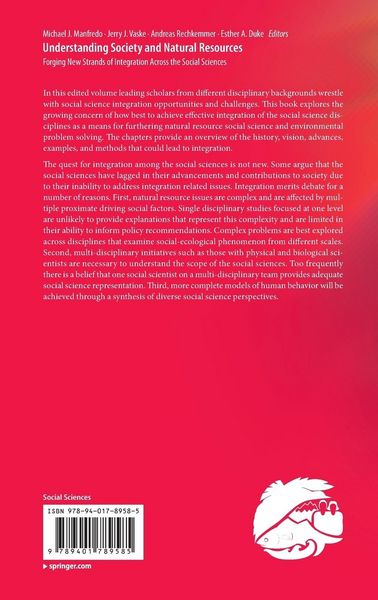
In this edited open access book leading scholars from different disciplinary backgrounds wrestle with social science integration opportunities and challenges. This book explores the growing concern of how best to achieve effective integration of the social science disciplines as a means for furthering natural resource social science and environmental problem solving. The chapters provide an overview of the history, vision, advances, examples and methods that could lead to integration.
The quest for integration among the social sciences is not new. Some argue that the social sciences have lagged in their advancements and contributions to society due to their inability to address integration related issues. Integration merits debate for a number of reasons. First, natural resource issues are complex and are affected by multiple proximate driving social factors. Single disciplinary studies focused at one level are unlikely to provide explanations that represent this complexity and are limited in their ability to inform policy recommendations. Complex problems are best explored across disciplines that examine social-ecological phenomenon from different scales. Second, multi-disciplinary initiatives such as those with physical and biological scientists are necessary to understand the scope of the social sciences. Too frequently there is a belief that one social scientist on a multi-disciplinary team provides adequate social science representation. Third, more complete models of human behavior will be achieved through a synthesis of diverse social science perspectives.
Ein neues Kapitel für Ihre Bücher
Ein neues Kapitel für Ihre Bücher
Schenken Sie Ihren alten Schätzen ein zweites Leben und erhalten dafür eine Thalia Geschenkkarte.
Noch keine Bewertungen vorhanden
Verfassen Sie die erste Bewertung zu diesem Artikel
Helfen Sie anderen Kundinnen und Kunden durch Ihre Meinung.
Kurze Frage zu unserer Seite
Vielen Dank für Ihr Feedback
Wir nutzen Ihr Feedback, um unsere Produktseiten zu verbessern. Bitte haben Sie Verständnis, dass wir Ihnen keine Rückmeldung geben können. Falls Sie Kontakt mit uns aufnehmen möchten, können Sie sich aber gerne an unseren Kund*innenservice wenden.
zum Kundenservice