Rezension
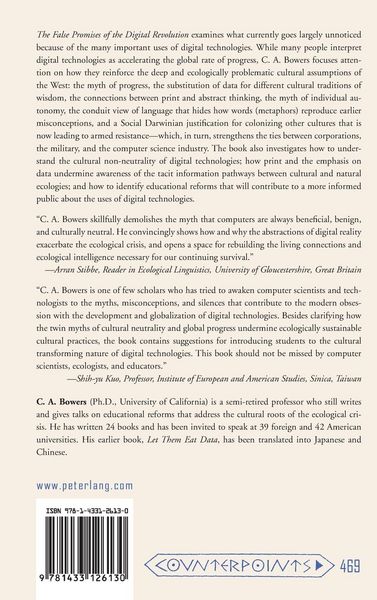
«C. A. Bowers skillfully demolishes the myth that computers are always beneficial, benign, and culturally neutral. He convincingly shows how and why the abstractions of digital reality exacerbate the ecological crisis, and opens a space for rebuilding the living connections and ecological intelligence necessary for our continuing survival.» (Arran Stibbe, Reader in Ecological Linguistics, University of Gloucestershire, Great Britain)
«C. A. Bowers is one of few scholars who has tried to awaken computer scientists and technologists to the myths, misconceptions, and silences that contribute to the modern obsession with the development and globalization of digital technologies. Besides clarifying how the twin myths of cultural neutrality and global progress undermine ecologically sustainable cultural practices, the book contains suggestions for introducing students to the cultural transforming nature of digital technologies. This book should not be missed by computer scientists, ecologists, and educators.» (Shih-yu Kuo, Professor, Institute of European and American Studies, Sinica, Taiwan)
«This book offers a potent indictment of the current globalizing of online educational programs as cultural genocide that is, at the same time, ecologically suicidal. For those of us in the global South who believe in education as the nurturance of the cultural commons, Bowers’ exemplary contribution is his engaged attitude of dialogue with other traditions of knowledge, which makes his book a source of inspiration in our own search for pertinence in education.» (Jorge Ishizawa, Co-Director, Proyecto Andino de Tecnologías Campesinas (PRATEC), Peru)
«No one has taught me more about the link between the ecological crisis and education than C. A. Bowers. When so many educators regarded computers as the newest pedagogical savior, Bowers was asking the hard questions. Bowers continues to peel away the shiny packaging of ‘progress’ and the myths of the new digital age. I’m delighted that Bowers is still challenging us to evaluate the ‘false promises of the digital revolution.’ We need this analysis now more than ever.» (Bill Bigelow, Editor, ‘Rethinking Schools’)
«The False Promises of the Digital Revolution is a powerful critique of the dangers inherent in the globalization of digital technologies. This revolution has not only engendered a marginalization and colonization of other cultures and systems of intelligibility that are necessary for civil and ecological sustainability, but has contributed to the loss of languages and cultures that cannot be appropriated through digitalization. As we enter an ominous ‘post-biological’ era of technological development, Bowers’ message cannot be ignored. Bowers’ new work is a prescient warning that should be heeded by all those committed to the survival of the planet, which I presume is all of us. A remarkable work of critical scholarship that demands all of our attention.»
(Peter McLaren, Distinguished Fellow in Critical Studies, Chapman University and Professor, University of California, Los Angeles; Author of ‘Che Guevara, Paulo Freire and Pedagogy of Revolution’)
«C. A. Bowers skillfully demolishes the myth that computers are always beneficial, benign, and culturally neutral. He convincingly shows how and why the abstractions of digital reality exacerbate the ecological crisis, and opens a space for rebuilding the living connections and ecological intelligence necessary for our continuing survival.» (Arran Stibbe, Reader in Ecological Linguistics, University of Gloucestershire, Great Britain)
«C. A. Bowers is one of few scholars who has tried to awaken computer scientists and technologists to the myths, misconceptions, and silences that contribute to the modern obsession with the development and globalization of digital technologies. Besides clarifying how the twin myths of cultural neutrality and global progress undermine ecologically sustainable cultural practices, the book contains suggestions for introducing students to the cultural transforming nature of digital technologies. This book should not be missed by computer scientists, ecologists, and educators.» (Shih-yu Kuo, Professor, Institute of European and American Studies, Sinica, Taiwan)
«This book offers a potent indictment of the current globalizing of online educational programs as cultural genocide that is, at the same time, ecologically suicidal. For those of us in the global South who believe in education as the nurturance of the cultural commons, Bowers’ exemplary contribution is his engaged attitude of dialogue with other traditions of knowledge, which makes his book a source of inspiration in our own search for pertinence in education.» (Jorge Ishizawa, Co-Director, Proyecto Andino de Tecnologías Campesinas (PRATEC), Peru)
«No one has taught me more about the link between the ecological crisis and education than C. A. Bowers. When so many educators regarded computers as the newest pedagogical savior, Bowers was asking the hard questions. Bowers continues to peel away the shiny packaging of ‘progress’ and the myths of the new digital age. I’m delighted that Bowers is still challenging us to evaluate the ‘false promises of the digital revolution.’ We need this analysis now more than ever.» (Bill Bigelow, Editor, ‘Rethinking Schools’)
«The False Promises of the Digital Revolution is a powerful critique of the dangers inherent in the globalization of digital technologies. This revolution has not only engendered a marginalization and colonization of other cultures and systems of intelligibility that are necessary for civil and ecological sustainability, but has contributed to the loss of languages and cultures that cannot be appropriated through digitalization. As we enter an ominous ‘post-biological’ era of technological development, Bowers’ message cannot be ignored. Bowers’ new work is a prescient warning that should be heeded by all those committed to the survival of the planet, which I presume is all of us. A remarkable work of critical scholarship that demands all of our attention.»
(Peter McLaren, Distinguished Fellow in Critical Studies, Chapman University and Professor, University of California, Los Angeles; Author of ‘Che Guevara, Paulo Freire and Pedagogy of Revolution’)