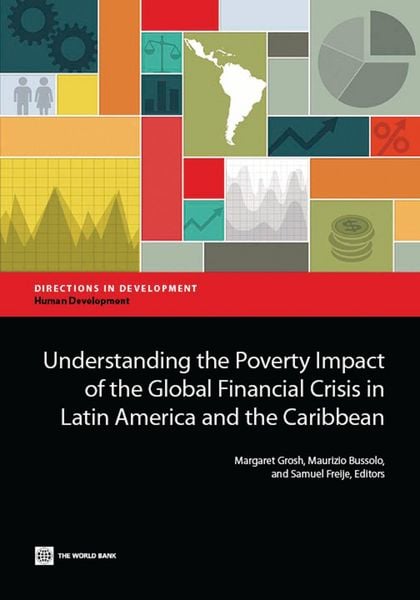
Understanding the Poverty Impact of the Global Financial Crisis in Latin America and the Caribbean
-
- Taschenbuch ausgewählt
- eBook
-
Sprache:Englisch
49,99 €
inkl. gesetzl. MwSt.,
Beschreibung
Produktdetails
Einband
Taschenbuch
Erscheinungsdatum
16.06.2014
Herausgeber
Margaret Grosh + weitereVerlag
World Bank PublicationsSeitenzahl
290
Maße (L/B/H)
25,4/17,7/2 cm
Gewicht
524 g
Sprache
Englisch
ISBN
978-1-4648-0241-6
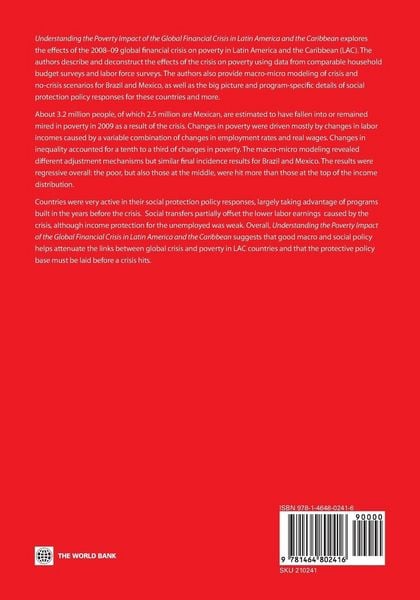
This study documents the effects of the 2008–09 global financial crisis on poverty in Latin America and the Caribbean (LAC). In doing so, it describes and decomposes the effects of the crisis on poverty using data from comparable household budget surveys for Argentina, Brazil, Chile, Colombia, Costa Rica, Dominican Republic, Ecuador, El Salvador, Mexico, Paraguay, Peru, and Uruguay, and labor force surveys for Argentina, Brazil, Chile, Colombia, Ecuador, Mexico, Peru, and Uruguay. The study also provides macro-micro modeling of crisis and no-crisis scenarios for Mexico and Brazil, as well as the big picture and program-specific details of the social protection policy responses for these countries and more.
Among the findings are the following. First, the effects of the global financial crisis on those living in poverty were not trivial: more than 3 million people fell into or remained mired in poverty in 2009 as a result of the crisis. Of these, 2.5 million were Mexican. Second, the changes in poverty were driven by changes in labor incomes caused by a variable combination of changes in employment rates and real wages. Third, the macro-micro modeling revealed different adjustment mechanisms but similar final incidence results for Brazil and Mexico. The results were regressive overall, with the middle of the income distribution hit even a bit more than the poor. According to the descriptive results from the larger set of countries, changes in inequality accounted for a tenth to a third of changes in poverty. Fourth, countries were quite active in their social protection policy responses, largely taking advantage of programs built in precrisis years. Social transfers partially offset the lower labor earnings of the poor, although income protection for the unemployed was weak. Finally, overall the policy messages are that good policy helps attenuate the links between a global crisis and poverty in the LAC countries, and many of the important things need to be done ex ante such as dealing with the macro fundamentals and building social protection programs.
Ein neues Kapitel für Ihre Bücher
Ein neues Kapitel für Ihre Bücher
Schenken Sie Ihren alten Schätzen ein zweites Leben und erhalten dafür eine Thalia Geschenkkarte.
Noch keine Bewertungen vorhanden
Verfassen Sie die erste Bewertung zu diesem Artikel
Helfen Sie anderen Kundinnen und Kunden durch Ihre Meinung.
Kurze Frage zu unserer Seite
Vielen Dank für Ihr Feedback
Wir nutzen Ihr Feedback, um unsere Produktseiten zu verbessern. Bitte haben Sie Verständnis, dass wir Ihnen keine Rückmeldung geben können. Falls Sie Kontakt mit uns aufnehmen möchten, können Sie sich aber gerne an unseren Kund*innenservice wenden.
zum Kundenservice