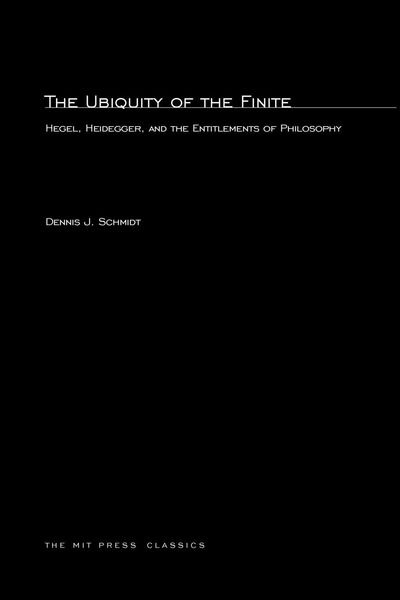
The Ubiquity of the Finite Hegel, Heidegger, and the Entitlements of Philosophy
-
- Englisch ausgewählt
38,99 €
inkl. gesetzl. MwSt.,
Beschreibung
Produktdetails
Einband
Taschenbuch
Erscheinungsdatum
14.03.1990
Verlag
MIT PressSeitenzahl
264
Maße (L/B/H)
22,9/15,2/1,6 cm
Gewicht
434 g
Sprache
Englisch
ISBN
978-0-262-69139-0
What are the assumptions and tasks hidden in contemporary calls to overcome the metaphysical tradition? Reflecting upon the internal contradictions of the notions of tradition and finiteness, Dennis J. Schmidt offers novel insights into how philosophy must relate to its traditions if it is to retain a vital sense of the plurality of edges that constitute its finiteness. He does this through a close examination of issues found in the work of Hegel and Heidegger, two philosophers who made the ideas of both tradition and finiteness the center of their concern. Schmidt begins by asking how Heidegger can claim to have destroyed metaphysics despite Hegel's claim to have perfected its possibilities. Systematically following the development of Heidegger's critique of Hegel, Schmidt generates a dialogue between them. The topic of that dialogue is the nature of finiteness as it is articulated in time, nothing, the dialectical and hermeneutical circles, and in the notions of experience, work, technology, history, and preSocratic thought.Beginning with Heidegger's critique of Hegel in Being and Time, Schmidt's strategy is to disclose the complexities of philosophical discourse about the finite by drawing out the proximities between Hegel and Heidegger. The dialogue that results presents novel portraits of both philosophers. It also reveals that Heidegger's early, unacknowledged failure to separate himself from the Hegelian dialectic is the motive behind many of the turns and decisions of his later career. In concluding, Schmidt offers an interpretation of the wider significance of the results of that dialogue, and connects his study to other contemporary discussions of postmodernism. He expands upon the idea of the plurality of edges opened by finiteness, arguing that philosophy only understands its own past and future once it recognizes the meaning of its own finiteness.
The Ubiquity of the Finite is included in the series Studies in Contemporary German Social Thought, edited by Thomas McCarthy.
Ein neues Kapitel für Ihre Bücher
Ein neues Kapitel für Ihre Bücher
Schenken Sie Ihren alten Schätzen ein zweites Leben: Einfach Barcode scannen, Versandetikett ausdrucken, Bücher verschicken und Thalia Geschenkkarte erhalten.
Jetzt verkaufenNoch keine Bewertungen vorhanden
Verfassen Sie die erste Bewertung zu diesem Artikel
Helfen Sie anderen Kundinnen und Kunden durch Ihre Meinung.
Kurze Frage zu unserer Seite
Vielen Dank für Ihr Feedback
Wir nutzen Ihr Feedback, um unsere Produktseiten zu verbessern. Bitte haben Sie Verständnis, dass wir Ihnen keine Rückmeldung geben können. Falls Sie Kontakt mit uns aufnehmen möchten, können Sie sich aber gerne an unseren Kund*innenservice wenden.
zum Kundenservice