• Produktbild: Ferdinand de Saussure
  • Produktbild: Ferdinand de Saussure
Band 7

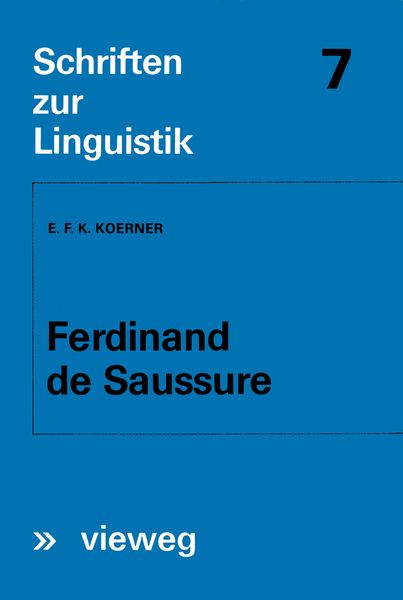
Ferdinand de Saussure Origin and Development of his Linguistic Thought in Western Studies of Language

Aus der Reihe Schriften zur Linguistik

64,99 €

inkl. gesetzl. MwSt., Versandkostenfrei


Produktdetails

Einband

Taschenbuch

Erscheinungsdatum

01.01.1973

Verlag

Vieweg & Teubner

Seitenzahl

428

Maße (L/B/H)

23,5/15,5/2,6 cm

Gewicht

709 g

Auflage

Softcover reprint of the original 1st ed. 1973

Sprache

Deutsch

ISBN

978-3-528-03706-2

Produktdetails

Einband

Taschenbuch

Erscheinungsdatum

01.01.1973

Verlag

Vieweg & Teubner

Seitenzahl

428

Maße (L/B/H)

23,5/15,5/2,6 cm

Gewicht

709 g

Auflage

Softcover reprint of the original 1st ed. 1973

Sprache

Deutsch

ISBN

978-3-528-03706-2

Herstelleradresse

Vieweg+Teubner Verlag
Abraham-Lincoln-Straße 46
65189 Wiesbaden
DE

Email: ProductSafety@springernature.com

Ein neues Kapitel für Ihre Bücher

Ein neues Kapitel für Ihre Bücher

Schenken Sie Ihren alten Schätzen ein zweites Leben: Einfach Barcode scannen, Versandetikett ausdrucken, Bücher verschicken und Thalia Geschenkkarte erhalten.

Jetzt verkaufen
Jetzt verkaufen

Noch keine Bewertungen vorhanden

Verfassen Sie die erste Bewertung zu diesem Artikel

Helfen Sie anderen Kundinnen und Kunden durch Ihre Meinung.

Kundinnen und Kunden meinen

Bewertungen (0)

  • Produktbild: Ferdinand de Saussure
  • Produktbild: Ferdinand de Saussure
  • 0.0 INTRODUCTION: Outline of the Goal of the Investigation.- 1.0 F. de Saussure and the Development of His Linguistic Theory.- 1.1 A Biographical Sketch on Ferdinand de Saussure.- 1.2 The Intellectual Paradigm of Saussure’s Formative Years.- 1.2.1 The Question of Extra-Linguistic Influences on Saussure.- 1.2.1.1 Durkheim’s Principles of Sociology, Tarde’s Sociological and Economic Theories, and Saussure’s Alleged Sociologism.- 1.2.1.2 Walras’ Theories of Political Economy and the Saussurean Concept of Yalue.- 1.3 The Question of Linguistic Influences on Saussure.- 1.3.1 Whitney and His Consideration of General Linguistic Problems.- 1.3.2 Neogrammarian Tenets concerning the Principles of Language (with special reference to Paul and Sievers).- 1.3.2.1 The Position of the Neogrammarians in Contemporary Histories of Linguistics.- 1.3.2.2 Hermann Paul and His Principles of Language Study.- 1.3.2.2.1 Paul’s Distinction between Descriptive and Historical Linguistics, and the Aspect of Language State.- 1.3.2.2.2 Language Usage versus Individual Expression.- 1.3.2.2.3 Formal and Material Connections of Words.- 1.3.2.3 Eduard Sievers and His Principles of Phonetics.- 1.3.3 Baudouin de Courtenay, Kruszewski, and Their Ideas about Language Study in General and Their Theories of Phonological Analysis in Particular.- 1.3.3.1 Saussure’s Acquaintance with the work of the ‘Kazan School’, and the Importance of His Earlier Work on Baudouin de Courtenay and Kruszewski.- 1.3.3.2 J. Baudouin de Courtenay and His Ideas concerning the Investigation of Language.- 1.3.3.3 Miko?aj Kruszewski’s Linguistic Theories.- 1.3.4 The Humboldtian Tradition in Nineteenth Century Linguistics.- 1.3.4.1 A Brief Survey of Humboldtian Trends at the Turn of the Century.- 1.3.4.2 Georg von der Gabelentz and His Suggestions concerning the General Study of Language.- 1.3.4.2.1 Gabelentz’s Limited Recognition in the History of Linguistics.- 1.3.4.2.2 Gabelentz’s Principles of General Linguistics.- 1.3.4.3 F. N. Finck and Some General Considerations concerning Language Description.- 1.4 Concluding Remarks on the First Part of the Investigation.- 2.0 The Evolution of Saussurean Principles and their Relevance to Contemporary Theories of Language.- 2.1 The Compilation of the Cours and the Problems of Interpretation.- 2.2 Discussion of the Fundamental Concepts of Saussure’s Linguistic Theory and Their Post-Saussurean Evolution.- 2.2.1 The Distinction between langue and parole, and Its Relation to langage.- 2.2.1.1 Precursors of the langue/parole Dichotomy or the langue/parole/langage Trichotomy.- 2.2.1.2 The Development and Place of the langue/parole/langage Distinction in Saussure’s Theory of Language.- 2.2.1.3 Post-Saussurean Developments of the Concepts of langue, parole, and langage.- 2.2.2 The Dichotomy of Synchrony versus Diachrony in Language Description.- 2.2.2.1 A Brief Survey of the Pre-Saussurean Distinction between Descriptive and Historical Grammar.- 2.2.2.2 The Interpretation of Saussure’s Distinction between Synchronic and Diachronic Linguistics.- 2.2.2.3 Post-Saussurean Discussions of the Distinction between Synchrony and Diachrony in Linguistics.- 2.2.3 The Concept of the Language Sign and Related Notions.- 2.2.3.1 The Question of the Sources of Saussure’s Semiological Theory.- 2.2.3.2 Saussure’s Theory of the Language Sign and the Semiological Nature of Language.- 2.2.3.3 Post-Saussurean Developments in Semiological Theory.- 2.2.4 Language as a System of Relations: the rapports syntagmatiques et associatifs and Kindred Notions.- 2.2.4.l Traditional Ideas about the Systematic Nature of Language.- 2.2.4.2 Saussure’s Suggestions concerning the Systematic Nature of Language.- 2.2.4.3 Post-Saussurean Developments of the Nature of Language as a System of Relations.- 2.3 Concluding Remarks on the Second Part of the Inquiry.- 3.0 CONCLUSION: Saussure’s Cours and the State of Linguistic Science.- Master List of References.- Index of Authors.