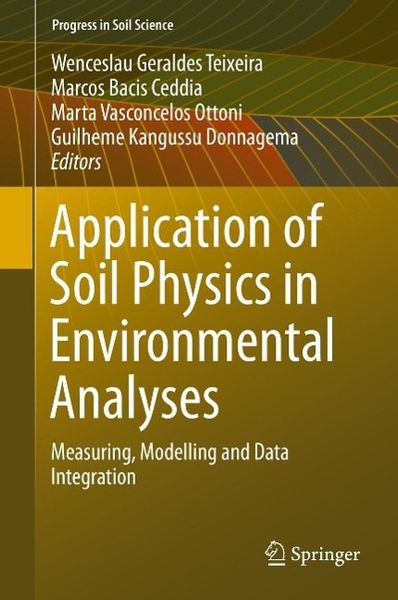
Application of Soil Physics in Environmental Analyses Measuring, Modelling and Data Integration
-
- Hardcover
- Taschenbuch
- eBook ausgewählt
-
Form:Einzelkauf Download
-
Sprache:Englisch
149,79 €
inkl. gesetzl. MwSt.Beschreibung
Produktdetails
Format
ePUB
Kopierschutz
Nein
Family Sharing
Nein
Text-to-Speech
Ja
Erscheinungsdatum
30.06.2014
Herausgeber
Wenceslau Geraldes Teixeira + weitereVerlag
SpringerSeitenzahl
499 (Printausgabe)
Dateigröße
15682 KB
Auflage
2014
Sprache
Englisch
EAN
9783319060132
The importance to preserve soil and water is widely recognized. Soil physics has grown considerably in the last years, however, those advances are thoroughly dispersed. In this volume, the authors will bring together the effectiveness of new field and lab sensors and the state-of-the-art in modeling and data analysis. The topics have been divided as follows: Part 1 - Integrating data in soil physics proposes re-establishing the knowledge chain, linking tacit knowledge to cutting edge science. The use of field soil data or what has been called hydropedology, is discussed and exemplified. Part 2 - Data analysis in soil physics and pedotransfers functions presents the analysis of data in state-space and geostatistical approaches. Part 3 - Different approaches to characterize soil physical quality indicators is focused on new techniques used to characterize, map and interpret soil physical parameters. The challenge of assessing soil physical quality is discussed from the simplest to the most complex indicators. Part 4 - Sensors and monitoring in soil physics centers the discussion on equipment and sampling techniques for monitoring soil physical parameters. Technological advances are addressed, such as X-ray tomography, which provides a means to evaluate pore topological properties in a noninvasive way. A comparison with in situ and remotely sensed data of soil moisture and limitations in using these data for hydrological modeling are also discussed. Part 5 - Creating data bases and models applied to soil physics discusses alternative approaches for modeling water flow and solute transport in the vadose zone. A review of multi-component solute transport models and examples of their use in agricultural and environmental applications are given. The phenomenon of dynamic non-equilibrium in soil water flow is discussed as the need of a paradigm change. Root water uptake is also covered with advanced approaches and the last two chapters address the challenges to develop soil data bases.
Noch keine Bewertungen vorhanden
Verfassen Sie die erste Bewertung zu diesem Artikel
Helfen Sie anderen Kundinnen und Kunden durch Ihre Meinung.
Kurze Frage zu unserer Seite
Vielen Dank für Ihr Feedback
Wir nutzen Ihr Feedback, um unsere Produktseiten zu verbessern. Bitte haben Sie Verständnis, dass wir Ihnen keine Rückmeldung geben können. Falls Sie Kontakt mit uns aufnehmen möchten, können Sie sich aber gerne an unseren Kund*innenservice wenden.
zum Kundenservice