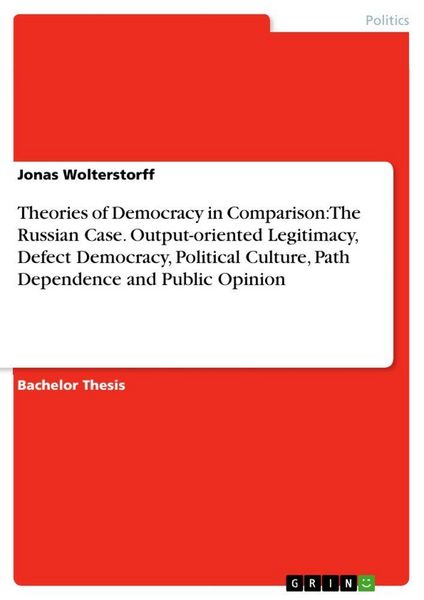
Theories of Democracy in Comparison: The Russian Case. Output-oriented Legitimacy, Defect Democracy, Political Culture, Path Dependence and Public Opi
-
- Taschenbuch ausgewählt
- eBook
-
Sprache:Englisch
47,95 €
inkl. gesetzl. MwSt.,
Beschreibung
Produktdetails
Einband
Taschenbuch
Erscheinungsdatum
02.10.2014
Verlag
GRINSeitenzahl
88
Maße (L/B/H)
21/14,8/0,7 cm
Gewicht
141 g
Auflage
2. Auflage
Sprache
Englisch
ISBN
978-3-656-75613-2
Bachelor Thesis from the year 2013 in the subject Politics - International Politics - Region: Russia, grade: 1,3, Otto-von-Guericke-University Magdeburg (Institute for Political Sciences), course: Theories of Democracy, language: English, abstract: Russia is an enigma. In the western hemisphere, respectively the countries of the European Union and USA, it produces a lot of suspicion and resentments. Its vast spatial dimensions, in terms of size; its controversial history and its stubborn focus on sovereignty, when it comes to foreign policy and the international community, are the most prominent sources for difficulties of understanding. In addition, the Russian people liketo sustain a hint of mystery themselves, in claiming that no other nationality can understand them. Apart from stereotypes and prejudices about typical Russian people and characteristics, there are a handful of assumptions one encounters that cling to public opinion about Russia's political landscape: (1) Political opposition does not exist, civic opposition is marginalised. (2) The independence of the judiciary system is a façade and de facto does not effectively monitor the executive. (3) The Soviet imprint on Russian people led to a mentality of subordination, inflexibility and obedience to any kind of authority. (4) The Russian media are corrupted and controlled by the Kremlin. (5) Putin only won the election due to massive vote manipulation. In line with the mentioned assumptions, Western media coverage tends to be polemic and jaundiced. As Russia is perceived as a watchdog of Sovereignty in the international community and in that sense with a tendency to veto humanitarian missions , criticism is very easily formulated. This work will treat the Russian political system as a contemporary phenomenon. Let us assume all of those assumptions are held true; why does the Russian population still accept those deficits? The fact that the circumstances can be that unpromising, and not many people try tochange something, leaves many spectators speechless. Where does the popular support of society for President Putin come from? Which is the source of stability? Why were the civil opposition movements in 2012/2013 mostly ignored by the majority? What are the reasons for the lack of proneness to protest? Do Russians perceive the political system differently; do they maybe put another focus? Or do they simply fear oppression? The central question, which will be answered, consequently reads "Why does the Russian population supports Putin's political system and regime?"
Ein neues Kapitel für Ihre Bücher
Ein neues Kapitel für Ihre Bücher
Schenken Sie Ihren alten Schätzen ein zweites Leben und erhalten dafür eine Thalia Geschenkkarte.
Noch keine Bewertungen vorhanden
Verfassen Sie die erste Bewertung zu diesem Artikel
Helfen Sie anderen Kundinnen und Kunden durch Ihre Meinung.
Kurze Frage zu unserer Seite
Vielen Dank für Ihr Feedback
Wir nutzen Ihr Feedback, um unsere Produktseiten zu verbessern. Bitte haben Sie Verständnis, dass wir Ihnen keine Rückmeldung geben können. Falls Sie Kontakt mit uns aufnehmen möchten, können Sie sich aber gerne an unseren Kund*innenservice wenden.
zum Kundenservice