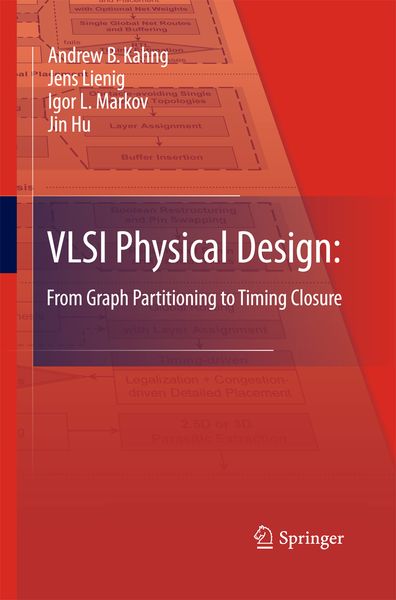

VLSI Physical Design: From Graph Partitioning to Timing Closure From Graph Partitioning to Timing Closure
-
- Hardcover
- Taschenbuch ausgewählt
- eBook
-
Sprache:Englisch
-
Verlag:Springer Netherland
- Springer 58,99 €
- Springer Netherland 74,99 € ausgewählt
74,99 €
UVP
85,59 €
inkl. gesetzl. MwSt.,
Beschreibung
Produktdetails
Einband
Taschenbuch
Erscheinungsdatum
15.10.2014
Verlag
Springer NetherlandSeitenzahl
310
Maße (L/B/H)
23,5/15,5/1,8 cm
Gewicht
493 g
Auflage
1. Auflage
Originaltitel
Lienig: Layoutsynthese elektronischer SchaltungenSprache
Englisch
ISBN
978-94-007-9020-9
Design and optimization of integrated circuits are essential to the creation of new semiconductor chips, and physical optimizations are becoming more prominent as a result of semiconductor scaling. Modern chip design has become so complex that it is largely performed by specialized software, which is frequently updated to address advances in semiconductor technologies and increased problem complexities. A user of such software needs a high-level understanding of the underlying mathematical models and algorithms. On the other hand, a developer of such software must have a keen understanding of computer science aspects, including algorithmic performance bottlenecks and how various algorithms operate and interact.
"VLSI Physical Design: From Graph Partitioning to Timing Closure"
introduces and compares algorithms that are used during the physical design phase of integrated-circuit design, wherein a geometric chip layout is produced starting from an abstract circuit design. The emphasis is on essential and fundamental techniques, ranging from hypergraph partitioning and circuit placement to timing closure.Ein neues Kapitel für Ihre Bücher
Ein neues Kapitel für Ihre Bücher
Schenken Sie Ihren alten Schätzen ein zweites Leben: Einfach Barcode scannen, Versandetikett ausdrucken, Bücher verschicken und Thalia Geschenkkarte erhalten.
Jetzt verkaufenNoch keine Bewertungen vorhanden
Verfassen Sie die erste Bewertung zu diesem Artikel
Helfen Sie anderen Kundinnen und Kunden durch Ihre Meinung.
Kurze Frage zu unserer Seite
Vielen Dank für Ihr Feedback
Wir nutzen Ihr Feedback, um unsere Produktseiten zu verbessern. Bitte haben Sie Verständnis, dass wir Ihnen keine Rückmeldung geben können. Falls Sie Kontakt mit uns aufnehmen möchten, können Sie sich aber gerne an unseren Kund*innenservice wenden.
zum Kundenservice