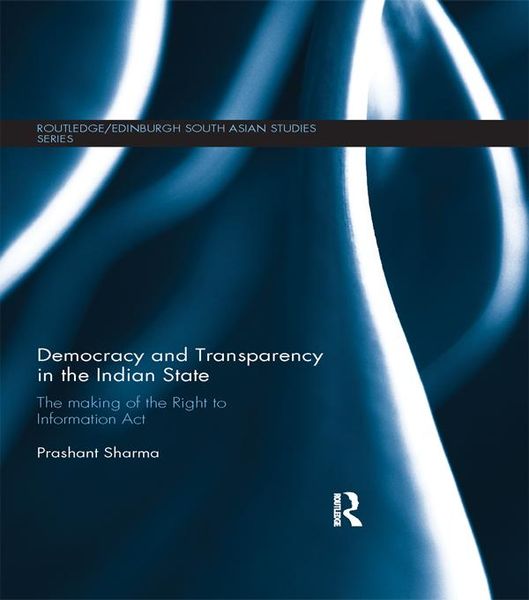
Democracy and Transparency in the Indian State The Making of the Right to Information Act
-
- Einzelkauf Download ausgewählt
-
Sprache:Englisch
-
eBook Format:PDF
- ePUB 3 69,99 €
- PDF 69,99 € ausgewählt
69,99 €
inkl. gesetzl. MwSt.Beschreibung
Produktdetails
Format
Kopierschutz
Ja
Family Sharing
Nein
Text-to-Speech
Nein
Erscheinungsdatum
24.03.2015
Verlag
Taylor & Francis eBooksSeitenzahl
258 (Printausgabe)
Dateigröße
6019 KB
Auflage
1. Auflage
Sprache
Englisch
EAN
9781317623953
The enactment of the national Right to Information (RTI) Act in 2005 has been produced, consumed, and celebrated as an important event of democratic deepening in India both in terms of the process that led to its enactment (arising from a grassroots movement) and its outcome (fundamentally altering the citizen--state relationship). This book proposes that the explanatory factors underlying this event may be more complex than imagined thus far.
The book discusses how the leadership of the grassroots movement was embedded within the ruling elite and possessed the necessary resources as well as unparalleled access to spaces of power for the movement to be successful. It shows how the democratisation of the higher bureaucracy along with the launch of the economic liberalisation project meant that the urban, educated, high-caste, upper-middle class elite that provided critical support to the demand for an RTI Act was no longer vested in the state and had moved to the private sector. Mirroring this shift, the framing of the RTI Act during the 1990s saw its ambit reduced to the government, even as there was a concomitant push to privatise public goods and services. It goes on to investigate the Indian RTI Act within the global explosion of freedom of information laws over the last two decades, and shows how international pressures had a direct and causal impact both on its content and the timing of its enactment.
Taking the production of the RTI Act as a lens, the book argues that while there is much to celebrate in the consolidation of procedural democracy in India over the last six decades, existing social and political structures may limit the extent and forms of democratic deepening occurring in the near future. It will be of interest to those working in the fields of South Asian Law, Asian Politics, and Civil Society.
Kundinnen und Kunden meinen
Verfassen Sie die erste Bewertung zu diesem Artikel
Helfen Sie anderen Kund*innen durch Ihre Meinung
Kurze Frage zu unserer Seite
Vielen Dank für Ihr Feedback
Wir nutzen Ihr Feedback, um unsere Produktseiten zu verbessern. Bitte haben Sie Verständnis, dass wir Ihnen keine Rückmeldung geben können. Falls Sie Kontakt mit uns aufnehmen möchten, können Sie sich aber gerne an unseren Kund*innenservice wenden.
zum Kundenservice