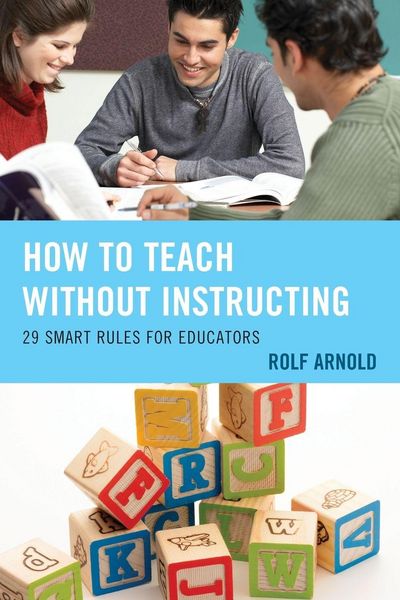
Produktbild: How to Teach without Instructing

How to Teach without Instructing 29 Smart Rules for Educators

59,99 €

inkl. gesetzl. MwSt., Versandkostenfrei


Beschreibung

Produktdetails

Einband

Taschenbuch

Erscheinungsdatum

03.06.2015

Abbildungen

20 BW Illustrations, 31 Tables

Verlag

Rowman & Littlefield

Seitenzahl

196

Maße (L/B/H)

22,9/15,2/1,1 cm

Gewicht

293 g

Sprache

Englisch

ISBN

978-1-4758-1776-8

Beschreibung

Produktdetails

Einband

Taschenbuch

Erscheinungsdatum

03.06.2015

Abbildungen

20 BW Illustrations, 31 Tables

Verlag

Rowman & Littlefield

Seitenzahl

196

Maße (L/B/H)

22,9/15,2/1,1 cm

Gewicht

293 g

Sprache

Englisch

ISBN

978-1-4758-1776-8

Herstelleradresse

Libri GmbH
Europaallee 1
36244 Bad Hersfeld
DE

Email: gpsr@libri.de

Ein neues Kapitel für Ihre Bücher

Ein neues Kapitel für Ihre Bücher

Schenken Sie Ihren alten Schätzen ein zweites Leben und erhalten dafür eine Thalia Geschenkkarte.

Jetzt verkaufen
Jetzt verkaufen

Noch keine Bewertungen vorhanden

Verfassen Sie die erste Bewertung zu diesem Artikel

Helfen Sie anderen Kundinnen und Kunden durch Ihre Meinung.

Kundinnen und Kunden meinen

Bewertungen (0)

Weitere Artikel finden Sie in

Die Leseprobe wird geladen.
  • Produktbild: How to Teach without Instructing
  • CONTENTS

    Author's Introduction:
    Teaching and Learning: Two Sides of the Same Coin

    Rules for Smart Teaching

    Rule 1: Examine your own learning theory!
    I learned it somewhere else.
    "We are all capable, but are often just out of practice."
    Rule 2: Support the competence competence of the learner!
    Rule 3: Strengthen the learner's self-learner skills!
    If you see that something is not working, let it be!
    What to do?
    Rule 4: Base the learning content on the learner's experience!
    Rule 5: Focus your teaching on developing talent!
    Reinvent the learner!
    How to avoid learning goals, yet still be effective
    Rule 6: Exercise situational and reflective educational activities!
    Preparation of the second order
    Rule 7: Relate your teaching activity to skill profiles!
    "Portfolio, therefore I am?"
    Rule 8: Try to create individual learning scenarios!
    Rule 9: Promote self-paced eLearning by your students!
    Rule 10: Practice triumvirate rule as you select, prepare, and deliver!
    Rule 11: Stage the learning process to be an effective experience!
    Rule 12: Follow the criteria for vibrant and long lasting learning!
    Rule 13: Learn how to "teach in stereo!"
    Rule 14:Train your sense of appreciation!
    Rule 15: Provide the framework and building materials for the learners' learning projects!
    Rule 16: Apply the concept of learning by doing!
    Rule 17:Be devoted to your own personality development!
    Teachers as mentors
    A cure for educational narcissism
    Rule 18:Surprise the students by using imaginative methods!
    On the gradual disappearance of mediated learning
    Rule 19:Expand your repertoire of methods!
    Rule 20:Review your own teaching style!
    Rule 21:Develop a preference for "open media" developed with the students!
    Media should become a form of student expression!
    Rule 22:Free yourself from hasty typifications!
    The differences in learning behaviors have been widely studied.
    Avoid learning types: "All inclusive" didactics!
    Rule 23:Practice dealing with classroom interruptions/distractions!
    Rule 24:Let outcomes guide your teaching activities!
    Rule 25:Follow the didactic debate!
    Didactic professionalism
    Didactics - the science of professional teaching
    Rule 26:Develop and use various forms of professional testing!
    Rule 27: Increase the feedback opportunities available to your users!
    Rule 28:Participate in the organizational and team development!
    Rule 29:Plan your own professional competency development!

    Afterword: Thoughts on the patent fears of teachers and educational theorists