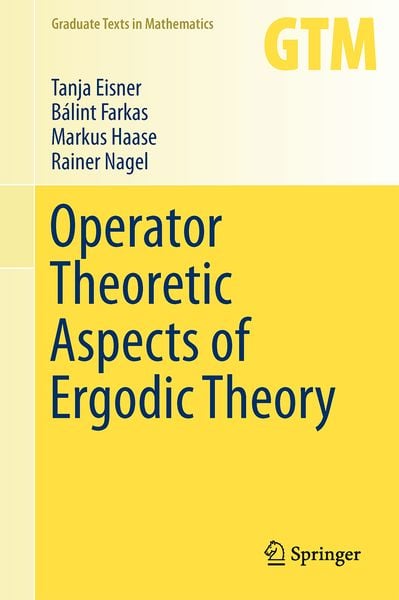
Operator Theoretic Aspects of Ergodic Theory
-
- Hardcover ausgewählt
- Taschenbuch
- eBook
-
Sprache:Englisch
65,99 €
UVP
74,89 €
inkl. gesetzl. MwSt.,
Beschreibung
Produktdetails
Einband
Gebundene Ausgabe
Erscheinungsdatum
28.11.2015
Abbildungen
XVIII, 628 p.
Verlag
SpringerSeitenzahl
628
Maße (L/B/H)
24,1/16/3,8 cm
Gewicht
1245 g
Auflage
1st ed. 2015
Sprache
Englisch
ISBN
978-3-319-16897-5
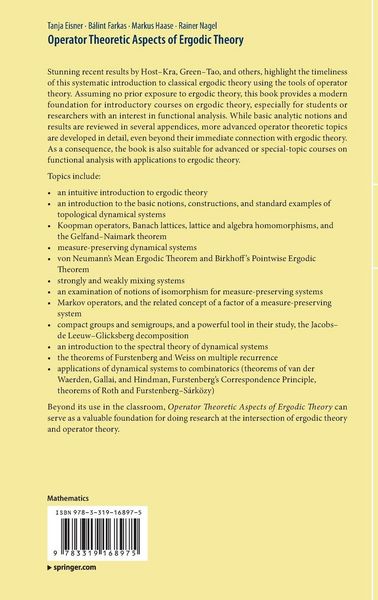
Stunning recent results by Host–Kra, Green–Tao, and others, highlight the timeliness of this systematic introduction to classical ergodic theory using the tools of operator theory. Assuming no prior exposure to ergodic theory, this book provides a modern foundation for introductory courses on ergodic theory, especially for students or researchers with an interest in functional analysis. While basic analytic notions and results are reviewed in several appendices, more advanced operator theoretic topics are developed in detail, even beyond their immediate connection with ergodic theory. As a consequence, the book is also suitable for advanced or special-topic courses on functional analysis with applications to ergodic theory.
Topics include:
• an intuitive introduction to ergodic theory
• an introduction to the basic notions, constructions, and standard examples of topological dynamical systems
• Koopman operators, Banach lattices, lattice and algebra homomorphisms, and the Gelfand–Naimark theorem
• measure-preserving dynamical systems
• von Neumann’s Mean Ergodic Theorem and Birkhoff’s Pointwise Ergodic Theorem
• strongly and weakly mixing systems
• an examination of notions of isomorphism for measure-preserving systems
• Markov operators, and the related concept of a factor of a measure preserving system
• compact groups and semigroups, and a powerful tool in their study, the Jacobs–de Leeuw–Glicksberg decomposition
• an introduction to the spectral theory of dynamical systems, the theorems of Furstenberg and Weiss on multiple recurrence, and applications of dynamical systems to combinatorics (theorems of van der Waerden, Gallai,and Hindman, Furstenberg’s Correspondence Principle, theorems of Roth and Furstenberg–Sárközy)
Beyond its use in the classroom, Operator Theoretic Aspects of Ergodic Theory can serve as a valuable foundation for doing research at the intersection of ergodic theory and operator theory
Ein neues Kapitel für Ihre Bücher
Ein neues Kapitel für Ihre Bücher
Schenken Sie Ihren alten Schätzen ein zweites Leben und erhalten dafür eine Thalia Geschenkkarte.
Noch keine Bewertungen vorhanden
Verfassen Sie die erste Bewertung zu diesem Artikel
Helfen Sie anderen Kundinnen und Kunden durch Ihre Meinung.
Kurze Frage zu unserer Seite
Vielen Dank für Ihr Feedback
Wir nutzen Ihr Feedback, um unsere Produktseiten zu verbessern. Bitte haben Sie Verständnis, dass wir Ihnen keine Rückmeldung geben können. Falls Sie Kontakt mit uns aufnehmen möchten, können Sie sich aber gerne an unseren Kund*innenservice wenden.
zum Kundenservice