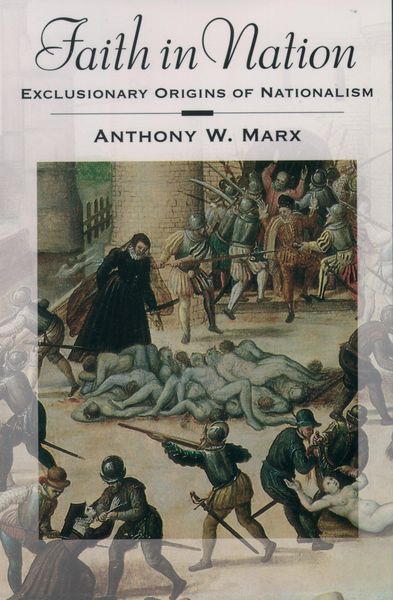
Faith in Nation Exclusionary Origins of Nationalism
-
- Taschenbuch
- eBook ausgewählt
-
Form:Einzelkauf Download
-
Sprache:Englisch
-
eBook Format:ePUB
- PDF 21,99 €
- ePUB 20,49 € ausgewählt
20,49 €
inkl. gesetzl. MwSt.Beschreibung
Produktdetails
Format
ePUB
Kopierschutz
Ja
Family Sharing
Nein
Text-to-Speech
Ja
Erscheinungsdatum
21.04.2005
Verlag
OUP eBookSeitenzahl
(Printausgabe)
Dateigröße
531 KB
Sprache
Englisch
EAN
9780190292966
Common wisdom has long held that the ascent of the modern nation coincided with the flowering of Enlightenment democracy and the decline of religion, ringing in an age of tolerant, inclusive, liberal states.
Not so, demonstrates Anthony W. Marx in this landmark work of revisionist political history and analysis. In a startling departure from a historical consensus that has dominated views of nationalism for the past quarter century, Marx argues that European nationalism emerged two centuries earlier, in the early modern era, as a form of mass political engagement based on religious conflict, intolerance, and exclusion. Challenging the self-congratulatory geneaology of civic Western nationalism, Marx shows how state-builders attempted to create a sense of national solidarity to support their burgeoning authority. Key to this process was the transfer of power from local to central rulers; the most suitable vehicle for effecting this transfer was religion and fanatical passions.
Religious intolerance--specifically the exclusion of religious minorities from the nascent state--provided the glue that bonded the remaining populations together. Out of this often violent religious intolerance grew popular nationalist sentiment. Only after a core and exclusive nationality was formed in England and France, and less successfully in Spain, did these countries move into the "enlightened" 19th century, all the while continuing to export intolerance and exclusion to overseas colonies.
Providing an explicitly political theory of early nation-building, rather than an account emphasizing economic imperatives or literary imaginings, Marx reveals that liberal, secular Western political traditions were founded on the basis of illiberal, intolerant origins. His provocative account also suggests that present-day exclusive and violent nation-building, or efforts to form solidarity through cultural or religious antagonisms, are not fundamentally different from the West's own earlier experiences.
Not so, demonstrates Anthony W. Marx in this landmark work of revisionist political history and analysis. In a startling departure from a historical consensus that has dominated views of nationalism for the past quarter century, Marx argues that European nationalism emerged two centuries earlier, in the early modern era, as a form of mass political engagement based on religious conflict, intolerance, and exclusion. Challenging the self-congratulatory geneaology of civic Western nationalism, Marx shows how state-builders attempted to create a sense of national solidarity to support their burgeoning authority. Key to this process was the transfer of power from local to central rulers; the most suitable vehicle for effecting this transfer was religion and fanatical passions.
Religious intolerance--specifically the exclusion of religious minorities from the nascent state--provided the glue that bonded the remaining populations together. Out of this often violent religious intolerance grew popular nationalist sentiment. Only after a core and exclusive nationality was formed in England and France, and less successfully in Spain, did these countries move into the "enlightened" 19th century, all the while continuing to export intolerance and exclusion to overseas colonies.
Providing an explicitly political theory of early nation-building, rather than an account emphasizing economic imperatives or literary imaginings, Marx reveals that liberal, secular Western political traditions were founded on the basis of illiberal, intolerant origins. His provocative account also suggests that present-day exclusive and violent nation-building, or efforts to form solidarity through cultural or religious antagonisms, are not fundamentally different from the West's own earlier experiences.
Noch keine Bewertungen vorhanden
Verfassen Sie die erste Bewertung zu diesem Artikel
Helfen Sie anderen Kundinnen und Kunden durch Ihre Meinung.
Kurze Frage zu unserer Seite
Vielen Dank für Ihr Feedback
Wir nutzen Ihr Feedback, um unsere Produktseiten zu verbessern. Bitte haben Sie Verständnis, dass wir Ihnen keine Rückmeldung geben können. Falls Sie Kontakt mit uns aufnehmen möchten, können Sie sich aber gerne an unseren Kund*innenservice wenden.
zum Kundenservice