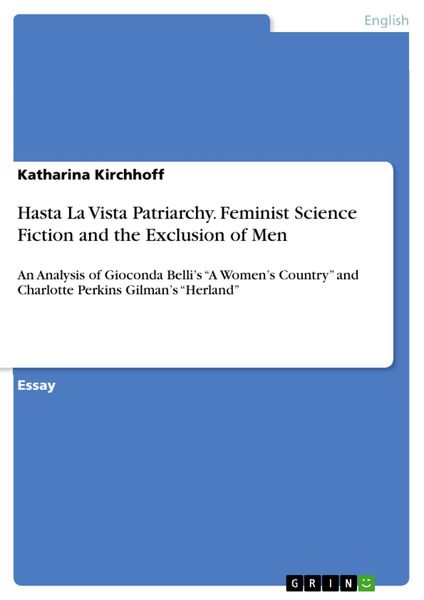
Hasta La Vista Patriarchy. Feminist Science Fiction and the Exclusion of Men An Analysis of Gioconda Belli's "A Women's Country" and Charlotte Perkins Gilman's "Herland"
-
- Taschenbuch
- eBook ausgewählt
-
Form:Einzelkauf Download
-
Sprache:Englisch
13,99 €
inkl. gesetzl. MwSt.Beschreibung
Produktdetails
Format
ePUB
Kopierschutz
Nein
Family Sharing
Nein
Text-to-Speech
Ja
Erscheinungsdatum
09.02.2015
Verlag
GRINSeitenzahl
20 (Printausgabe)
Dateigröße
343 KB
Auflage
1. Auflage
Sprache
Englisch
EAN
9783656892663
Essay from the year 2014 in the subject English Language and Literature Studies - Literature, grade: 1,6, Free University of Berlin (Englische Philologie), language: English, abstract: In times of 'no alternative' we need alternatives. In times of 'post-feminism' we need feminism. In times where Science Fiction is derided and 'nerdy' we need to beam it back into the academic context. In times where utopia is almost an obscene swearword we need to put it back into perspective. What else are we supposed to imagine other than the utopian?
Is there really no alternative to ecological crisis, to femicide, poverty and inequality? Of course there is, because all it needs is our imagination. If we imagine something different, this is the alternative, this is utopian.
In a feminist academic context there has been utopian imagination. When Christine de Pizan wrote "Le Livre de la Cité des Femmes" (engl. "The book of the city of women") in 1405 she created a milestone for feminist utopias, long before Thomas More established the literary genre of the utopia with his famous novel Utopia in 1516. Momentous for feminist utopias was Pizane's decision that female happiness can only be established without men. During the first wave of feminism in the 19th and early 20th century, Charlotte Perkins Gilman, a women's right activist took a chance on the utopian genre and wrote "Herland" (1915), about an all-female society which is able to reproduce via parthenogenesis and became herewith a leading figure for further feminist writers of utopia.
During second-wave feminism (1960-1970's) most feminist utopias concentrated on protecting this perfectly equal society, as in Marge Piercy's "Woman on the Edge of Time" (1976). It was during the third wave of feminism that this model was questioned in feminist utopian fiction and the genre critical utopia emerged.
These days, the genre of the critical utopia has grown quiet. Inequality between the sexes and the oppression of women is no longer seen as the reason for the world going wrong. It is claimed that we have reached the period of post-feminism. Feminism is dead, unfashionable and useless as equality is achieved, therefore there's no need for a feminist utopia. What should we imagine if there is no desirable alternative or no alternative at all? Fortunately, few but strong female writers refute those assumptions. Nicaraguan author and declared feminist Gioconda Belli published El Pais de las Mujeres (engl. A Women's Country). [...]
Is there really no alternative to ecological crisis, to femicide, poverty and inequality? Of course there is, because all it needs is our imagination. If we imagine something different, this is the alternative, this is utopian.
In a feminist academic context there has been utopian imagination. When Christine de Pizan wrote "Le Livre de la Cité des Femmes" (engl. "The book of the city of women") in 1405 she created a milestone for feminist utopias, long before Thomas More established the literary genre of the utopia with his famous novel Utopia in 1516. Momentous for feminist utopias was Pizane's decision that female happiness can only be established without men. During the first wave of feminism in the 19th and early 20th century, Charlotte Perkins Gilman, a women's right activist took a chance on the utopian genre and wrote "Herland" (1915), about an all-female society which is able to reproduce via parthenogenesis and became herewith a leading figure for further feminist writers of utopia.
During second-wave feminism (1960-1970's) most feminist utopias concentrated on protecting this perfectly equal society, as in Marge Piercy's "Woman on the Edge of Time" (1976). It was during the third wave of feminism that this model was questioned in feminist utopian fiction and the genre critical utopia emerged.
These days, the genre of the critical utopia has grown quiet. Inequality between the sexes and the oppression of women is no longer seen as the reason for the world going wrong. It is claimed that we have reached the period of post-feminism. Feminism is dead, unfashionable and useless as equality is achieved, therefore there's no need for a feminist utopia. What should we imagine if there is no desirable alternative or no alternative at all? Fortunately, few but strong female writers refute those assumptions. Nicaraguan author and declared feminist Gioconda Belli published El Pais de las Mujeres (engl. A Women's Country). [...]
Noch keine Bewertungen vorhanden
Verfassen Sie die erste Bewertung zu diesem Artikel
Helfen Sie anderen Kundinnen und Kunden durch Ihre Meinung.
Kurze Frage zu unserer Seite
Vielen Dank für Ihr Feedback
Wir nutzen Ihr Feedback, um unsere Produktseiten zu verbessern. Bitte haben Sie Verständnis, dass wir Ihnen keine Rückmeldung geben können. Falls Sie Kontakt mit uns aufnehmen möchten, können Sie sich aber gerne an unseren Kund*innenservice wenden.
zum Kundenservice