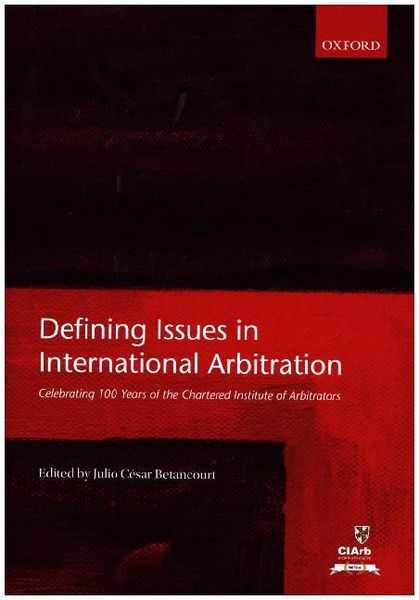
Produktbild: Defining Issues in International Arbitration

Defining Issues in International Arbitration Celebrating 100 Years of the Chartered Institute of Arbitrators

307,99 €

inkl. gesetzl. MwSt., Versandkostenfrei


Beschreibung

Produktdetails

Einband

Gebundene Ausgabe

Erscheinungsdatum

12.07.2016

Herausgeber

Julio César Betancourt

Verlag

Oxford University Press

Seitenzahl

518

Maße (L/B/H)

25,1/17,4/3,8 cm

Gewicht

1096 g

Sprache

Englisch

ISBN

978-0-19-878320-6

Beschreibung

Rezension

This is no ordinary liber amicorum. A constellation of the brightest stars in the firmament of international commercial arbitration has shone new light on a comprehensive selection of contemporary problems. Professor Derek Roebuck, Institute of Advanced Legal Studies

Produktdetails

Einband

Gebundene Ausgabe

Erscheinungsdatum

12.07.2016

Herausgeber

Julio César Betancourt

Verlag

Oxford University Press

Seitenzahl

518

Maße (L/B/H)

25,1/17,4/3,8 cm

Gewicht

1096 g

Sprache

Englisch

ISBN

978-0-19-878320-6

Herstelleradresse

Libri GmbH
Europaallee 1
36244 Bad Hersfeld
DE

Email: gpsr@libri.de

Ein neues Kapitel für Ihre Bücher

Ein neues Kapitel für Ihre Bücher

Schenken Sie Ihren alten Schätzen ein zweites Leben: Einfach Barcode scannen, Versandetikett ausdrucken, Bücher verschicken und Thalia Geschenkkarte erhalten.

Jetzt verkaufen
Jetzt verkaufen

Noch keine Bewertungen vorhanden

Verfassen Sie die erste Bewertung zu diesem Artikel

Helfen Sie anderen Kundinnen und Kunden durch Ihre Meinung.

Kundinnen und Kunden meinen

Bewertungen (0)

Die Leseprobe wird geladen.
  • Produktbild: Defining Issues in International Arbitration
    • The Chartered Institute of Arbitrators (1915-2015)

    • I. International Arbitration Law, Arbitral Jurisdiction, and Arbitral Institutions

    • 1: William W Park: Explaining arbitration law

    • 2: Karl-Heinz Böckstiegel: Experiences and suggestions regarding the functioning of international arbitration institutions

    • 3: V V Veeder: The 2014 new LCIA rules: An introductory explanation

    • II. Understanding the Users of International Arbitration

    • 4: Peter J Rees: Putting the client first

    • 5: Mauro Rubino-Sammartano: How easy is it not to take adequate care of the proper expectations of the parties?

    • III. International Arbitration Agreements: Issues and Perspectives

    • 6: Lord Saville: Some reflections on the making of international arbitration agreements for the resolution of commercial disputes

    • 7: John J Barceló III: Arbitrability decisions before, during, and after arbitration

    • 8: Neil Kaplan and Olga Boltenko: The dangers of neglect: Governing law of arbitration agreements

    • 9: Renato Nazzini: The law governing the arbitration agreement: A transnational solution?

    • 10: Michael Young: Identifying the language of an arbitration when the arbitration clause is silent

    • IV. Arbitral Procedure and Procedural Misdemeanour

    • 11: Hilary Heilbron: Is international arbitration becoming too confrontational and counterintuitive? And some guidelines as to how not to irritate a tribunal!

    • 12: Elizabeth Snodgrass: Procedural efficiency in international commercial arbitration: Building it into the process

    • 13: Lord Hacking and Sophia Berry: Ethics in arbitration: Party and arbitral misconduct

    • V. Emergency Arbitrators and Interim Relief

    • 14: Doug Jones: Emergency arbitrators and court-ordered interim measures: Is the choice important?

    • 15: Grant Hanessian: Legal standards applicable to deciding applications for interim relief

    • VI. Discovery and Document Production

    • 16: Alexander Yanos: Discovery in arbitration: Can parties use 28 USC 1782 to circumvent the process ordered by the arbitral tribunal?

    • 17: Mark McNeill and Margaret Clare Ryan: Meeting the requirements of article 3(3) of the IBA rules: Recommendations for successful requests for document production

    • VII. Witnesses and Perjury

    • 18: Lawrence W Newman: Cross-examination of fact witness statements in international arbitration

    • 19: Bernardo M Cremades: The expert witness in international arbitration

    • 20: Audley Sheppard: Oaths and perjury

    • VIII. Arbitrators' Decision-Making Power and Arbitral Tribunals' Cessation of Functions

    • 21: Margaret L Moses: Inherent and implied powers of arbitrators

    • 22: Sébastien Besson: Good (and bad) initiatives of arbitrators: Where to draw the line between activism and passivity?

    • 23: Thomas Schultz and Robert Kovacs: The law is what the arbitrator had for breakfast: How income, reputation, justice, and reprimand act as determinants of arbitrator behaviour

    • 24: Greg Fullelove: Functus officio?

    • IX. Costs, Funding, and Ideas for Optimization

    • 25: Michael O'Reilly: The harmonization of costs practices in international arbitration: The search for the Holy Grail

    • 26: Joe Tirado, Daniel Meagher, and Arpan Gupta: The costs and funding of international arbitration

    • 27: Marie Berard: 'Other costs' in international arbitration: A review of the recoverability of internal and third-party funding costs

    • 28: Jeffrey Waincymer: Optimizing the use of mediation in international arbitration: A cost-benefit analysis of 'two hat' versus 'two people' models

    • X. Judicial Review, Judicial Performance, and Enforcement

    • 29: Sir Bernard Rix: Judicial review of the merits of arbitration awards under English law

    • 30: S I Strong: Improving judicial performance in matters involving international arbitration

    • 31: Alex Mills: The principled English ambivalence to law and dispute resolution beyond the state

    • XI. Public Policy and Abuse of Process

    • 32: Stavros Brekoulakis: Public policy rules in English arbitration law

    • 33: David J Sandy: The role of abuse of process in protecting the integrity of arbitration awards

    • XII. International Arbitration: Myths and Perspectives

    • 34: Gordon Blanke: Arbitration in the UAE: Demystifying the myths

    • XIII. Dispute Resolution in the Construction Industry

    • 35: Thomas J Stipanowich: Managing construction conflict: Unfinished revolution, continuing evolution

    • 36: Andrew Tweeddale and Keren Tweeddale: Shifting the burden of proof: Revisiting adjudication decisions

    • XIV. Final Reflections and Looking Ahead

    • 37: Martin Hunter: Recollections of past events and reflections on future trends