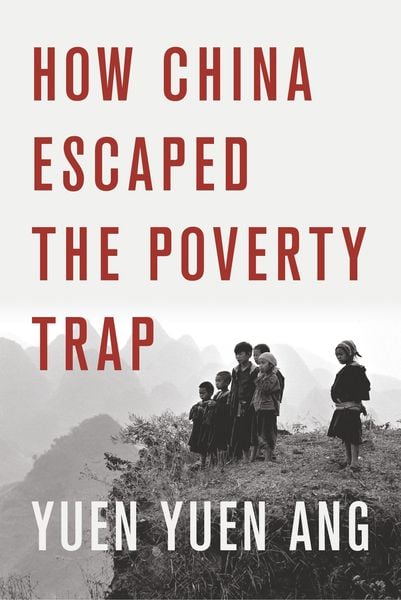
How China Escaped the Poverty Trap
-
- Hardcover ausgewählt
- Taschenbuch
-
Sprache:Englisch
152,99 €
inkl. gesetzl. MwSt.,
Beschreibung
Produktdetails
Einband
Gebundene Ausgabe
Erscheinungsdatum
06.09.2016
Abbildungen
11 halftones, 1 map, 15 tables, 24 charts - 11 Halftones, black and white
Verlag
Cornell University PressSeitenzahl
344
Maße (L/B/H)
23,6/15,9/2,7 cm
Gewicht
642 g
Sprache
Englisch
ISBN
978-1-5017-0020-0
WINNER OF THE 2017 PETER KATZENSTEIN BOOK PRIZE
"BEST OF BOOKS IN 2017" BY FOREIGN AFFAIRS
WINNER OF THE 2018 VIVIAN ZELIZER PRIZE BEST BOOK AWARD IN ECONOMIC SOCIOLOGY
"How China Escaped the Poverty Trap truly offers game-changing ideas for the analysis and implementation of socio-economic development and should have a major impact across many social sciences."
- Zelizer Best Book in Economic Sociology Prize Committee
Acclaimed as "game changing" and "field shifting," How China Escaped the Poverty Trap advances a new paradigm in the political economy of development and sheds new light on China's rise.
How can poor and weak societies escape poverty traps? Political economists have traditionally offered three answers: "stimulate growth first," "build good institutions first," or "some fortunate nations inherited good institutions that led to growth."
Yuen Yuen Ang rejects all three schools of thought and their underlying assumptions: linear causation, a mechanistic worldview, and historical determinism. Instead, she launches a new paradigm grounded in complex adaptive systems, which embraces the reality of interdependence and humanity's capacity to innovate.
Combining this original lens with more than 400 interviews with Chinese bureaucrats and entrepreneurs, Ang systematically reenacts the complex process that turned China from a communist backwater into a global juggernaut in just 35 years. Contrary to popular misconceptions, she shows that what drove China's great transformation was not centralized authoritarian control, but "directed improvisation"-top-down directions from Beijing paired with bottom-up improvisation among local officials.
Her analysis reveals two broad lessons on development. First, transformative change requires an adaptive governing system that empowers ground-level actors to create new solutions for evolving problems. Second, the first step out of the poverty trap is to "use what you have"-harnessing existing resources to kick-start new markets, even if that means defying first-world norms.
Bold and meticulously researched, How China Escaped the Poverty Trap opens up a whole new avenue of thinking for scholars, practitioners, and anyone seeking to build adaptive systems.
Ein neues Kapitel für Ihre Bücher
Ein neues Kapitel für Ihre Bücher
Schenken Sie Ihren alten Schätzen ein zweites Leben und erhalten dafür eine Thalia Geschenkkarte.
Noch keine Bewertungen vorhanden
Verfassen Sie die erste Bewertung zu diesem Artikel
Helfen Sie anderen Kundinnen und Kunden durch Ihre Meinung.
Kurze Frage zu unserer Seite
Vielen Dank für Ihr Feedback
Wir nutzen Ihr Feedback, um unsere Produktseiten zu verbessern. Bitte haben Sie Verständnis, dass wir Ihnen keine Rückmeldung geben können. Falls Sie Kontakt mit uns aufnehmen möchten, können Sie sich aber gerne an unseren Kund*innenservice wenden.
zum Kundenservice