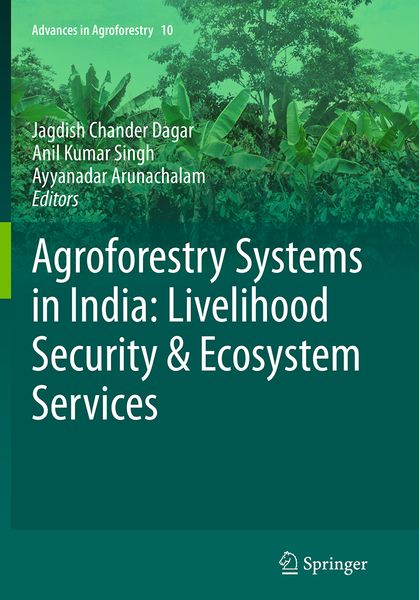
Produktbild: Agroforestry Systems in India: Livelihood Security & Ecosystem Services
Band 10

Agroforestry Systems in India: Livelihood Security & Ecosystem Services

Aus der Reihe Advances in Agroforestry

138,99 €

inkl. gesetzl. MwSt., Versandkostenfrei


Beschreibung

Produktdetails

Einband

Taschenbuch

Erscheinungsdatum

27.08.2016

Abbildungen

X, 66 illus., 55 illus. in color., schwarz-weiss Illustrationen, farbige Illustrationen

Herausgeber

Jagdish Chander Dagar + weitere

Verlag

Springer India

Seitenzahl

400

Maße (L/B/H)

25,4/17,8/2,3 cm

Gewicht

771 g

Auflage

Softcover reprint of the original 1st ed. 2014

Sprache

Englisch

ISBN

978-81-322-2922-3

Beschreibung

Portrait

Dr. Jagdish Chander Dagar has been well recognized for his research in the areas of management of natural resources, agroforestry, rehabilitation of degraded lands, biosaline agriculture, biodrainage, climate change, sustainable agriculture and policy; both nationally and internationally. Dr. Dagar was the Assistant Director General (Agronomy/Agroforestry) at the headquarters of ICAR. He has written several books and published more than 200 research papers of high repute in international and national level journals and has been conferred with several awards and honors. He is a Fellow of National Academy of Agricultural Sciences and several other professional societies. He has also been consulting several national and international agencies such as FAO and CIMMYT.

Dr. A. Arunachalam is a trained ecologist from the North-Eastern Hill University, Shillong, and has grown professionally through strong pursuit in ecological research that is evident from his more than 135 research papers. Currently, he is working as a Principal Scientist in the headquarters of Indian Council of Agricultural Research (ICAR), Krishi Bhawan, New Delhi. His academic excellence is also evident from several awards/honors he has received. Dr. Arunachalam is a Fellow/Associate of several professional societies.

Dr. Anil Kumar Singh is currently the Vice-Chancellor of the Rajmata Vijayaraje Scindia Krishi VishwaVidyalaya, Gwalior. Earlier, he was the Deputy Director General (NRM) in ICAR – 2007-2012; Acting Director, IARI – 2005-2006; Project Director, Water Technology Centre – 1999-2007. His areas of research interest have been soil-water-nutrient-plant-atmosphere interactions, crop growth simulation, irrigation water management and integrated watershed management. Dr. Singh is a recipient of several award/honors and is a Fellow of National Academy of Agricultural Sciences.

Produktdetails

Einband

Taschenbuch

Erscheinungsdatum

27.08.2016

Abbildungen

X, 66 illus., 55 illus. in color., schwarz-weiss Illustrationen, farbige Illustrationen

Herausgeber

Verlag

Springer India

Seitenzahl

400

Maße (L/B/H)

25,4/17,8/2,3 cm

Gewicht

771 g

Auflage

Softcover reprint of the original 1st ed. 2014

Sprache

Englisch

ISBN

978-81-322-2922-3

Herstelleradresse

Springer-Verlag KG
Sachsenplatz 4-6
1201 Wien
AT

Email: GPSR Kontakt

Ein neues Kapitel für Ihre Bücher

Ein neues Kapitel für Ihre Bücher

Schenken Sie Ihren alten Schätzen ein zweites Leben und erhalten dafür eine Thalia Geschenkkarte.

Jetzt verkaufen
Jetzt verkaufen

Noch keine Bewertungen vorhanden

Verfassen Sie die erste Bewertung zu diesem Artikel

Helfen Sie anderen Kundinnen und Kunden durch Ihre Meinung.

Kundinnen und Kunden meinen

Bewertungen (0)

  • Produktbild: Agroforestry Systems in India: Livelihood Security & Ecosystem Services
  • 1. Introduction.- 2. Soil conservation and ecosystem stability: Natural resource management through agroforestry in the northwestern Himalayan region.- 3. From shifting cultivation to integrating farming: Experience of agroforestry development in the northeastern Himalayan region.- 4. Agroforestry inroads into the traditional two-crop system heartlands of the Indo-Gangetic plains.- 5. Agroforestry as a strategy for livelihood security in the rainfed areas: experiences and expectations.- 6. Livelihood improvements and climate-change adaptations through agroforestry in hot arid environments.- 7. Agroforestry: A way forward for sustaining fragile coastal and island agro-ecosystems.- 8. Agroforestry for wasteland rehabilitation: mined, ravine and degraded watershed areas.- 9. Greening salty and waterlogged lands through agroforestry systems for livelihood security and better environment.- 10. Wetland based agroforestry systems: balancing between carbon sink and source.- 11. Agroforestry for ecosystem services and mitigation of climate change.- 12. Agroforestry policy issues and challenges.- 13. Synthesis.