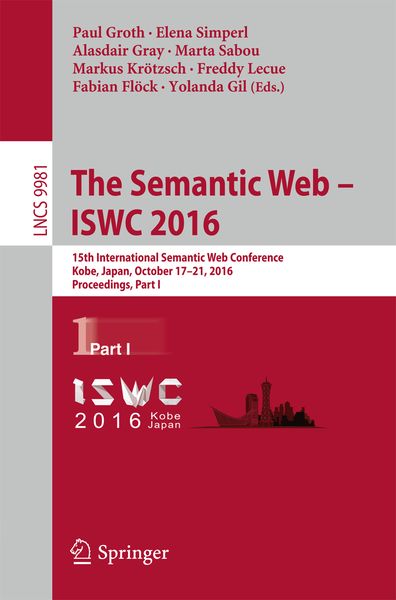
The Semantic Web – ISWC 2016 15th International Semantic Web Conference, Kobe, Japan, October 17–21, 2016, Proceedings, Part I
-
- Taschenbuch ausgewählt
- eBook
-
Sprache:Englisch
-
Auflage:1st ed. 2016
- 1st ed. 2016 49,99 €
- 1st ed. 2016 49,99 € ausgewählt
49,99 €
inkl. gesetzl. MwSt.,
Beschreibung
Produktdetails
Einband
Taschenbuch
Erscheinungsdatum
23.09.2016
Abbildungen
XXVIII, 672 p. 158 illus.
Herausgeber
Paul Groth + weitereVerlag
SpringerSeitenzahl
672
Maße (L/B/H)
23,5/15,5/3,8 cm
Gewicht
1042 g
Auflage
1st ed. 2016
Sprache
Englisch
ISBN
978-3-319-46522-7
The two-volume set LNCS 9981 and 9982 constitutes the refereed proceedings of the 15th International Semantic Web Conference, ISWC 2016, which was held in Kobe, Japan, in October 2016. The 75 full papers presented in these proceedings were carefully reviewed and selected from 326 submissions.
The International Semantic Web Conference is the premier forum for Semantic Web research, where cutting edge scientific results and technological innovations are presented, where problems and solutions are discussed, and where the future of this vision is being developed. It brings together specialists in fields such as artificial intelligence, databases, social networks, distributed computing, Web engineering, information systems, human-computer interaction, natural language processing, and the social sciences.
The Research Track solicited novel and significant research contributions addressing theoretical, analytical, empirical, and practical aspects of the Semantic Web. The Applications Track solicited submissions exploring the benefits and challenges of applying semantic technologies in concrete, practical applications, in contexts ranging from industry to government and science. The newly introduced Resources Track sought submissions providing a concise and clear description of a resource and its (expected) usage. Traditional resources include ontologies, vocabularies, datasets, benchmarks and replication studies, services and software. Besides more established types of resources, the track solicited submissions of new types of resources such as ontology design patterns, crowdsourcing task designs, workflows, methodologies, and protocols and measures.
Ein neues Kapitel für Ihre Bücher
Ein neues Kapitel für Ihre Bücher
Schenken Sie Ihren alten Schätzen ein zweites Leben und erhalten dafür eine Thalia Geschenkkarte.
Noch keine Bewertungen vorhanden
Verfassen Sie die erste Bewertung zu diesem Artikel
Helfen Sie anderen Kundinnen und Kunden durch Ihre Meinung.
Kurze Frage zu unserer Seite
Vielen Dank für Ihr Feedback
Wir nutzen Ihr Feedback, um unsere Produktseiten zu verbessern. Bitte haben Sie Verständnis, dass wir Ihnen keine Rückmeldung geben können. Falls Sie Kontakt mit uns aufnehmen möchten, können Sie sich aber gerne an unseren Kund*innenservice wenden.
zum Kundenservice