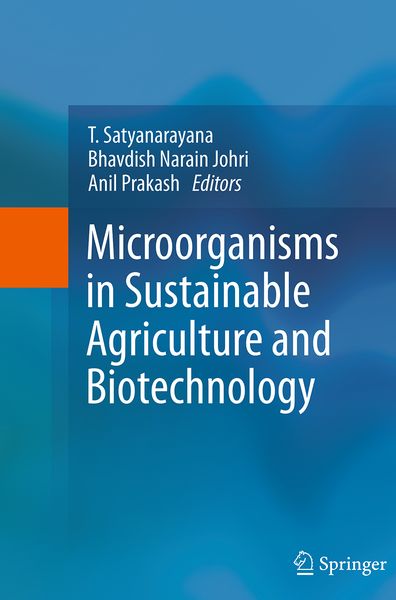
Microorganisms in Sustainable Agriculture and Biotechnology
-
- Hardcover
- Taschenbuch ausgewählt
- eBook
-
Sprache:Englisch
185,99 €
inkl. gesetzl. MwSt.,
Beschreibung
Produktdetails
Einband
Taschenbuch
Erscheinungsdatum
23.08.2016
Herausgeber
T. Satyanarayana + weitereVerlag
Springer NetherlandSeitenzahl
829
Maße (L/B/H)
23,5/15,5/4,6 cm
Gewicht
1282 g
Auflage
Softcover reprint of the original 1st ed. 2012
Sprache
Englisch
ISBN
978-94-024-0577-4
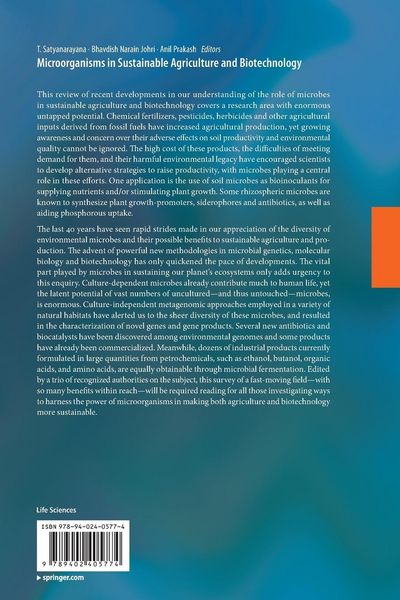
This review of recent developments in our understanding of the role of microbes in sustainable agriculture and biotechnology covers a research area with enormous untapped potential. Chemical fertilizers, pesticides, herbicides and other agricultural inputs derived from fossil fuels have increased agricultural production, yet growing awareness and concern over their adverse effects on soil productivity and environmental quality cannot be ignored. The high cost of these products, the difficulties of meeting demand for them, and their harmful environmental legacy have encouraged scientists to develop alternative strategies to raise productivity, with microbes playing a central role in these efforts. One application is the use of soil microbes as bioinoculants for supplying nutrients and/or stimulating plant growth. Some rhizospheric microbes are known to synthesize plant growth-promoters, siderophores and antibiotics, as well as aiding phosphorous uptake.
The last 40 years have seen rapid strides made in our appreciation of the diversity of environmental microbes and their possible benefits to sustainable agriculture and production. The advent of powerful new methodologies in microbial genetics, molecular biology and biotechnology has only quickened the pace of developments. The vital part played by microbes in sustaining our planet’s ecosystems only adds urgency to this enquiry. Culture-dependent microbes already contribute much to human life, yet the latent potential of vast numbers of uncultured—and thus untouched—microbes, is enormous. Culture-independent metagenomic approaches employed in a variety of natural habitats have alerted us to the sheer diversity of these microbes, and resulted in the characterization of novel genes and gene products. Several new antibiotics and biocatalysts have been discovered among environmental genomes and some products have already been commercialized. Meanwhile, dozens ofindustrial products currently formulated in large quantities from petrochemicals, such as ethanol, butanol, organic acids, and amino acids, are equally obtainable through microbial fermentation. Edited by a trio of recognized authorities on the subject, this survey of a fast-moving field—with so many benefits within reach—will be required reading for all those investigating ways to harness the power of microorganisms in making both agriculture and biotechnology more sustainable.
Ein neues Kapitel für Ihre Bücher
Ein neues Kapitel für Ihre Bücher
Schenken Sie Ihren alten Schätzen ein zweites Leben: Einfach Barcode scannen, Versandetikett ausdrucken, Bücher verschicken und Thalia Geschenkkarte erhalten.
Jetzt verkaufenNoch keine Bewertungen vorhanden
Verfassen Sie die erste Bewertung zu diesem Artikel
Helfen Sie anderen Kundinnen und Kunden durch Ihre Meinung.
Kurze Frage zu unserer Seite
Vielen Dank für Ihr Feedback
Wir nutzen Ihr Feedback, um unsere Produktseiten zu verbessern. Bitte haben Sie Verständnis, dass wir Ihnen keine Rückmeldung geben können. Falls Sie Kontakt mit uns aufnehmen möchten, können Sie sich aber gerne an unseren Kund*innenservice wenden.
zum Kundenservice