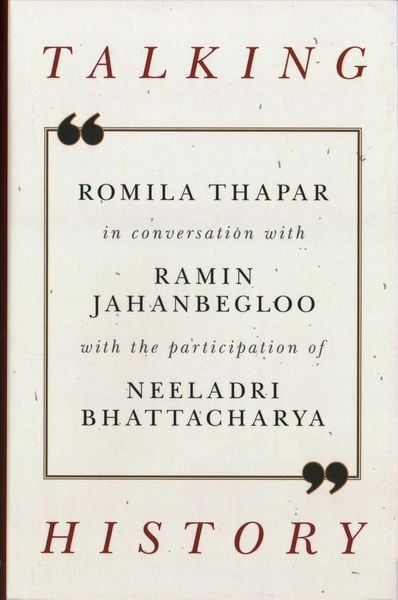
Produktbild: Talking History

Talking History Romila Thapar in Conversation with Ramin Jahanbegloo

54,99 €

inkl. gesetzl. MwSt., Versandkostenfrei


Beschreibung

Produktdetails

Einband

Gebundene Ausgabe

Erscheinungsdatum

30.08.2017

Verlag

Oxford University Press

Seitenzahl

368

Maße (L/B/H)

22,1/14,7/3 cm

Gewicht

481 g

Sprache

Englisch

ISBN

978-0-19-947427-1

Beschreibung

Produktdetails

Einband

Gebundene Ausgabe

Erscheinungsdatum

30.08.2017

Verlag

Oxford University Press

Seitenzahl

368

Maße (L/B/H)

22,1/14,7/3 cm

Gewicht

481 g

Sprache

Englisch

ISBN

978-0-19-947427-1

Herstelleradresse

Libri GmbH
Europaallee 1
36244 Bad Hersfeld
DE

Email: gpsr@libri.de

Ein neues Kapitel für Ihre Bücher

Ein neues Kapitel für Ihre Bücher

Schenken Sie Ihren alten Schätzen ein zweites Leben: Einfach Barcode scannen, Versandetikett ausdrucken, Bücher verschicken und Thalia Geschenkkarte erhalten.

Jetzt verkaufen
Jetzt verkaufen

Kundinnen und Kunden meinen

0 Bewertungen

Informationen zu Bewertungen

Zur Abgabe einer Bewertung ist eine Anmeldung im Konto notwendig. Die Authentizität der Bewertungen wird von uns nicht überprüft. Wir behalten uns vor, Bewertungstexte, die unseren Richtlinien widersprechen, entsprechend zu kürzen oder zu löschen.

Die Bewertungen sind nach Format, Anzahl Sterne und Datum sortiert.

Verfassen Sie die erste Bewertung zu diesem Artikel

Helfen Sie anderen Kund*innen durch Ihre Meinung

Kundinnen und Kunden meinen

0 Bewertungen filtern

  • Produktbild: Talking History
    • Introduction: Thinking History in Critical Times

    • Part I: From Punjab to London

    • Chapter I: A Happy Half-Way

    • Chapter II: Religions and Storytelling

    • Chapter III: A Secular Environment

    • Chapter IV: Talking Politics

    • Chapter V: Following Gandhi

    • Chapter VI: Facing Hindu Fundamentalism

    • Chapter VII: Living with the British

    • Chapter VIII: Reading Novels

    • Chapter IX: Discovering the Indian Classics

    • Chapter X: A Nehruvian Ideal

    • Chapter XI: A Radical-Minded Student

    • Chapter XII: Reading Philosophy

    • Chapter XIII: Hollywood or Bollywood?

    • Chapter XIV: Living in London in the 1950s

    • Chapter XV: Becoming a Historian

    • Chapter XVI: Return to India

    • Chapter XVII: Marx and Marxism

    • Chapter XVIII: Stalinism and After

    • Chapter XIX: Teaching at JNU

    • Part II: The Function of the Historian

    • Chapter I: Reading the Past

    • Chapter II: Is There a Pattern in History?

    • Chapter III: What Is a Historical Fact?

    • Chapter IV: Objectivity in the Work of a Historian

    • Chapter V: The Sources in History

    • Chapter VI: Is History a Single Voice?

    • Chapter VII: Is Historical Narrative a Rational System?

    • Chapter VIII: Historians and Philosophy of History

    • Chapter XIX: What Is Oral History?

    • Chapter X: What Is Historicity?

    • Chapter XI: A Two Way Process

    • Chapter XII: Which Authority Festures in Historical Research?

    • Chapter XIII: History and the Greeks

    • Chapter XIV: History and Epic

    • Part III: Modern Writing of Early Indian History

    • Chapter I: The Orientalists and the Utilitarians

    • Chapter II: What Is Oriental Despotism?

    • Chapter III: Kingship or Empire

    • Chapter IV: India without the British

    • Chapter V: Culture of Civilization?

    • Chapter VI: The Idea of the Indian Nation

    • Chapter VII: Tradition and Culture in India

    • Chapter VIII: Tradition and Non-Violence

    • Chapter IX: Going beyond the Blurriness

    • Chapter X: Memory and Forgetfulness

    • Part IV: Lineage and Kingship

    • Chapter I: Ashoka: Between the Ethical and the Political

    • Chapter II: Ashoka and Gandhi

    • Chapter III: Ashoka and Marxist Historians

    • Chapter IV: History and Charismatic Literature

    • Chapter V: Attitude towards Spiritualism and Mysticism

    • Chapter VI: A Rationalist Historian

    • Chapter VII: Communal Ideologies in India

    • Chapter VIII: The Role of Archaeology and Anthropology

    • Chapter IX: Blood, Kinship and Lineage

    • Chapter X: History and Political Ideologies

    • Chapter XI: The Ideas of Hindusim

    • Chapter XII: The Ideologues of Hindu Nationalism

    • Part V: The Historian and the Epic

    • Chapter I: Looking at the Epic

    • Chapter II: The Historicity of the Epic

    • Chapter III: The Two Levels of Temporality

    • Chapter IV: Concepts of Time

    • Chapter V: The Moderns and the Concept of Inevitability

    • Chapter VI: Linearity and Evolution

    • Chapter VII: The Heroes and Exile

    • Chapter VIII: Retaliation and Forgiveness

    • Chapter IX: Tragic Drama in India

    • Chapter X: Machiavelli and the Arthashastra

    • Part VI: Shakuntala and Somanatha

    • Chapter I: The Historian's Impulse

    • Chapter II: Somanatha and Communal Historical Writing

    • Chapter III: The Rashomon Effect

    • Chapter IV: Why Is Somanatha important?

    • Chapter V: The Centrality of the Event

    • Chapter VI: Is There an Indian Marxism?

    • Chapter VII: New Schools of History Writing

    • Chapter VIII: Looking at the Past

    • About the Author