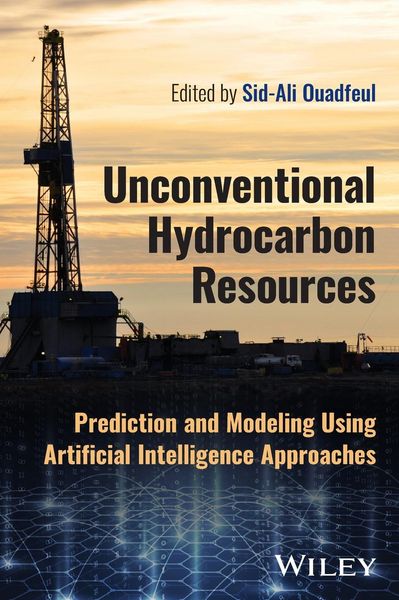
Unconventional Hydrocarbon Resources Prediction and Modeling Using Artificial Intelligence Approaches
227,99 €
inkl. gesetzl. MwSt.,
Beschreibung
Produktdetails
Einband
Gebundene Ausgabe
Erscheinungsdatum
07.08.2023
Herausgeber
Sid-Ali OuadfeulVerlag
John Wiley & SonsSeitenzahl
320
Maße (L/B/H)
26/18,3/2,2 cm
Gewicht
801 g
Auflage
1. Auflage
Sprache
Englisch
ISBN
978-1-119-38936-1
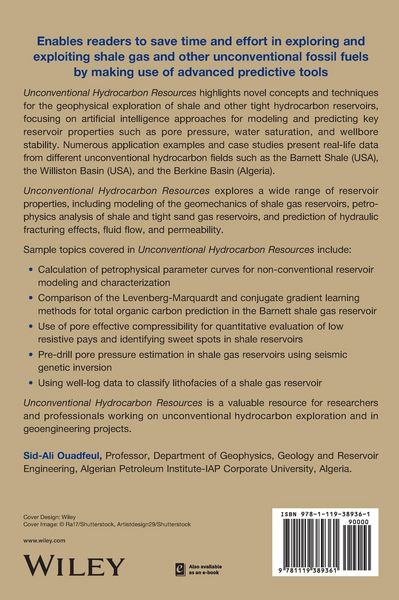
Enables readers to save time and effort in exploring and exploiting shale gas and other unconventional fossil fuels by making use of advanced predictive tools
Unconventional Hydrocarbon Resources highlights novel concepts and techniques for the geophysical exploration of shale and other tight hydrocarbon reservoirs, focusing on artificial intelligence approaches for modeling and predicting key reservoir properties such as pore pressure, water saturation, and wellbore stability. Numerous application examples and case studies present real-life data from different unconventional hydrocarbon fields such as the Barnett Shale (USA), the Williston Basin (USA), and the Berkine Basin (Algeria).
Unconventional Hydrocarbon Resources explores a wide range of reservoir properties, including modeling of the geomechanics of shale gas reservoirs, petrophysics analysis of shale and tight sand gas reservoirs, and prediction of hydraulic fracturing effects, fluid flow, and permeability.
Sample topics covered in Unconventional Hydrocarbon Resources include:
* Calculation of petrophysical parameter curves for non-conventional reservoir modeling and characterization
* Comparison of the Levenberg-Marquardt and conjugate gradient learning methods for total organic carbon prediction in the Barnett shale gas reservoir
* Use of pore effective compressibility for quantitative evaluation of low resistive pays and identifying sweet spots in shale reservoirs
* Pre-drill pore pressure estimation in shale gas reservoirs using seismic genetic inversion
* Using well-log data to classify lithofacies of a shale gas reservoir
Unconventional Hydrocarbon Resources is a valuable resource for researchers and professionals working on unconventional hydrocarbon exploration and in geoengineering projects.
Ein neues Kapitel für Ihre Bücher
Ein neues Kapitel für Ihre Bücher
Schenken Sie Ihren alten Schätzen ein zweites Leben und erhalten dafür eine Thalia Geschenkkarte.
Noch keine Bewertungen vorhanden
Verfassen Sie die erste Bewertung zu diesem Artikel
Helfen Sie anderen Kundinnen und Kunden durch Ihre Meinung.
Kurze Frage zu unserer Seite
Vielen Dank für Ihr Feedback
Wir nutzen Ihr Feedback, um unsere Produktseiten zu verbessern. Bitte haben Sie Verständnis, dass wir Ihnen keine Rückmeldung geben können. Falls Sie Kontakt mit uns aufnehmen möchten, können Sie sich aber gerne an unseren Kund*innenservice wenden.
zum Kundenservice