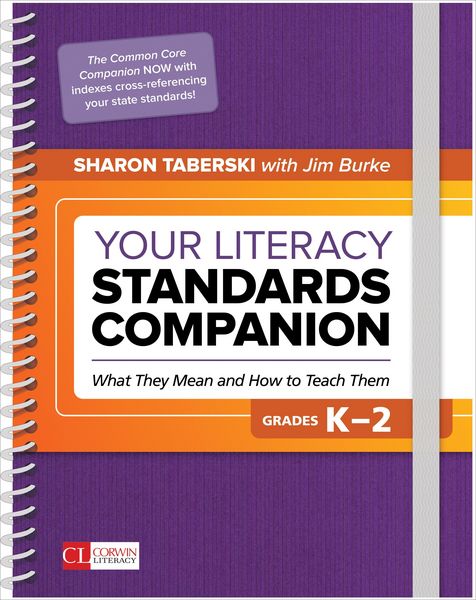
Produktbild: Your Literacy Standards Companion, Grades K-2

Your Literacy Standards Companion, Grades K-2 What They Mean and How to Teach Them

45,99 €

inkl. gesetzl. MwSt., Versandkostenfrei


Beschreibung

Produktdetails

Einband

Taschenbuch

Erscheinungsdatum

09.06.2017

Verlag

Sage Publications

Seitenzahl

376

Maße (L/B/H)

27,7/23,4/2,5 cm

Gewicht

880 g

Sprache

Englisch

ISBN

978-1-5063-8682-9

Beschreibung

Produktdetails

Einband

Taschenbuch

Erscheinungsdatum

09.06.2017

Verlag

Sage Publications

Seitenzahl

376

Maße (L/B/H)

27,7/23,4/2,5 cm

Gewicht

880 g

Sprache

Englisch

ISBN

978-1-5063-8682-9

Ein neues Kapitel für Ihre Bücher

Ein neues Kapitel für Ihre Bücher

Schenken Sie Ihren alten Schätzen ein zweites Leben: Einfach Barcode scannen, Versandetikett ausdrucken, Bücher verschicken und Thalia Geschenkkarte erhalten.

Jetzt verkaufen
Jetzt verkaufen

Noch keine Bewertungen vorhanden

Verfassen Sie die erste Bewertung zu diesem Artikel

Helfen Sie anderen Kundinnen und Kunden durch Ihre Meinung.

Kundinnen und Kunden meinen

Bewertungen (0)

  • Produktbild: Your Literacy Standards Companion, Grades K-2
  • Preface
    Introduction: Turning Standards Into Daily Teaching
    Quick Reference: Common Core State Standards, K-12 English Language Arts
    Key Principles and Additional Teaching Strategies for English Language Learners K-2
    Indexes Cross-Referencing Your State Standards
    The Complete Common Core State Standards: Decoded
    Part 1. Reading
    Key Ideas and Details
    1. Read closely for explicit meaning . . . make logical inferences . . . cite textual evidence
    2. Determine central ideas . . . analyze their development . . . summarize key details
    3. Analyze how and why individuals, events, and ideas develop and interact
    Craft and Structure
    4. Interpret words and phrases as they are used . . . and shape meaning or tone
    5. Analyze the structure of texts, including specific elements and sections
    6. Assess how point of view or purpose shapes the content and style of a text
    Integration of Knowledge and Ideas
    7. Integrate and evaluate content presented in diverse media and formats
    8. Delineate and evaluate the argument and specific claims, including the validity
    9. Analyze how two or more texts address similar themes or topics
    Range of Reading and Level of Text Complexity
    10. Read and comprehend complex literary and informational texts
    Part 2. Reading: Foundational Skills
    Print Concepts
    1. Demonstrate understanding of the organization and basic features of print
    Phonological Awareness
    2. Demonstrate understanding of spoken words, syllables, and sounds (phonemes)
    Phonics and Word Recognition
    3. Know and apply grade-level phonics and word analysis skills in decoding words
    Fluency
    4. Read with sufficient accuracy and fluency to support comprehension
    Part 3. Writing
    Text Types and Purposes
    1. Write arguments to support claims . . . using valid reasoning and . . . evidence
    2. Write informative/explanatory texts to examine and convey complex ideas
    3. Write narratives to develop real or imagined experiences or events
    Production and Distribution of Writing
    4. Produce clear and coherent writing (begins in grade 3)
    5. Develop and strengthen writing . . . by planning, revising, editing, rewriting
    6. Use technology . . . to produce and publish writing and to interact and collaborate
    Research to Build and Present Knowledge
    7. Conduct short as well as more sustained research projects
    8. Gather relevant information from multiple . . . sources . . . avoiding plagiarism
    9. Draw evidence from . . . texts to support analysis, reflection, and research Range of Writing (begins in grade 4)
    10. Write routinely . . . for a range of tasks, purposes, and audiences (begins in grade 3)
    Part 4. Speaking and Listening
    Comprehension and Collaboration
    1. Prepare for and participate in . . . conversations and collaborations
    2. Integrate and evaluate information presented in diverse media and formats
    3. Evaluate a speaker's point of view, reasoning, and use of evidence and rhetoric
    Presentation of Knowledge and Ideas
    4. Present information, findings, and supporting evidence
    5. Make strategic use of digital media and visual displays of data
    6. Adapt speech to a variety of contexts . . . demonstrating command of formal English
    Part 5. Language
    Conventions of Standard English
    1. Demonstrate command of the conventions of standard English grammar and usage
    2. Demonstrate command of the conventions of standard English capitalization, punctuation, and spelling
    Knowledge of Language
    3. Apply knowledge of language to understand how language functions
    Vocabulary Acquisition and Use
    4. Determine or clarify the meaning of unknown . . . words and phrases
    5. Demonstrate understanding of figurative language, word relationships . . . nuances
    6. Acquire and use . . . general academic and domain-specific words and phrases
    Resources
    Resource A. Common Core Recommended Reading Lists
    Resource B. Text Complexity Tool
    Resource C. Planning Calendar Templates