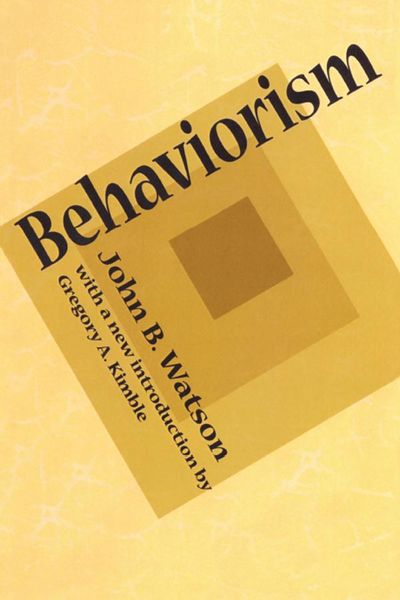
Behaviorism
-
- Hardcover
- Taschenbuch
- eBook ausgewählt
-
Form:Einzelkauf Download
-
Sprache:Englisch
-
eBook Format:ePUB 3
- ePUB 3 72,49 € ausgewählt
- PDF 72,49 €
- ePUB 9,99 €
72,49 €
inkl. gesetzl. MwSt.Beschreibung
Produktdetails
Format
ePUB 3
Kopierschutz
Ja
Family Sharing
Nein
Text-to-Speech
Ja
Erscheinungsdatum
29.09.2017
Verlag
Taylor & Francis eBooksSeitenzahl
251 (Printausgabe)
Dateigröße
3074 KB
Sprache
Englisch
EAN
9781351314305
Watson was the father of behaviorism. His now-revered lectures on the subject defined behaviorism as a natural science that takes the whole field of human adjustment as its own. It is the business of behaviorist psychology to predict and control human activity. The field has as its aim to be able, given the stimulus, to predict the response, or seeing the reaction, to know the stimulus that produced it. Watson argued that psychology is as good as its observations: what the organism does or says in the general environment.
Watson identified "laws" of learning, including frequency and recency. Kimble makes it perfectly clear that Watson's behaviorism, while deeply indebted to Ivan Pavlov, went beyond the Russian master in his treatment of cognition, language, and emotion. It becomes clear that Behaviorism is anything but the reductionist caricature it is often made out to be in the critical literature. For that reason alone, the work merits a wide reading.
Behaviorism, as was typical of the psychology of the time, offered a wide array of applications all of which can be said to fall on the enlightened side of the ledger. At a time of mixed messages, Watson argued against child beating and abuse, for patterns of enlightened techniques of factory management, and for curing the sick and isolating the small cadre of criminals not subject to correction. And anticipating Thomas Szasz, he argued against a doctrine of strictly mental diseases, and for a close scrutiny of behavioral illness and disturbances. Kimble's brilliant introduction to Watson ends with a challenge to subjectivism to provide evidence that Watson's behaviorism cannot explain human actions without introspective notions of the mind. This genuine classic of social science hi our century remains relevant not just for the conduct of psychological research, but for studies in the philosophy of science and the sociology of knowledge.
Noch keine Bewertungen vorhanden
Verfassen Sie die erste Bewertung zu diesem Artikel
Helfen Sie anderen Kundinnen und Kunden durch Ihre Meinung.
Kurze Frage zu unserer Seite
Vielen Dank für Ihr Feedback
Wir nutzen Ihr Feedback, um unsere Produktseiten zu verbessern. Bitte haben Sie Verständnis, dass wir Ihnen keine Rückmeldung geben können. Falls Sie Kontakt mit uns aufnehmen möchten, können Sie sich aber gerne an unseren Kund*innenservice wenden.
zum Kundenservice