• Produktbild: Active Interrogation in Nuclear Security
  • Produktbild: Active Interrogation in Nuclear Security

Active Interrogation in Nuclear Security Science, Technology and Systems

155,99 €

inkl. gesetzl. MwSt., Versandkostenfrei


Beschreibung

Produktdetails

Einband

Gebundene Ausgabe

Erscheinungsdatum

20.06.2018

Abbildungen

XI, 171 illus., 138 illus. in color. With online files/update., farbige Illustrationen, schwarz-weiss Illustrationen

Herausgeber

Igor Jovanovic + weitere

Verlag

Springer

Seitenzahl

361

Maße (L/B/H)

24,1/16/2,6 cm

Gewicht

729 g

Auflage

1st ed. 2018

Sprache

Englisch

ISBN

978-3-319-74466-7

Beschreibung

Portrait

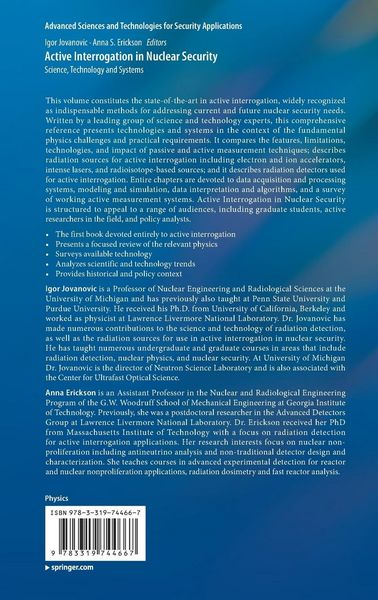
Igor Jovanovic  is a Professor of Nuclear Engineering and Radiological Sciences at the University of Michigan and has previously also taught at Penn State University and Purdue University. He received his Ph.D. from University of California, Berkeley and worked as physicist at Lawrence Livermore National Laboratory. Dr. Jovanovic has made numerous contributions to the science and technology of radiation detection, as well as the radiation sources for use in active interrogation in nuclear security. He has taught numerous undergraduate and graduate courses in areas that include radiation detection, nuclear physics, and nuclear security. At University of Michigan Dr. Jovanovic is the director of Neutron Science Laboratory and is also associated with the Center for Ultrafast Optical Science.  

Anna Erickson  is an Assistant Professor in the Nuclear and Radiological Engineering Program of the G.W. Woodruff School of Mechanical Engineering at Georgia Institute of Technology. Previously, she was a postdoctoral researcher in the Advanced Detectors Group at Lawrence Livermore National Laboratory. Dr. Erickson received her PhD from Massachusetts Institute of Technology with a focus on radiation detection for active interrogation applications. Her research interests focus on nuclear non-proliferation including antineutrino analysis and non-traditional detector design and characterization. She teaches courses in advanced experimental detection for reactor and nuclear nonproliferation applications, radiation dosimetry and fast reactor analysis.

Produktdetails

Einband

Gebundene Ausgabe

Erscheinungsdatum

20.06.2018

Abbildungen

XI, 171 illus., 138 illus. in color. With online files/update., farbige Illustrationen, schwarz-weiss Illustrationen

Herausgeber

Verlag

Springer

Seitenzahl

361

Maße (L/B/H)

24,1/16/2,6 cm

Gewicht

729 g

Auflage

1st ed. 2018

Sprache

Englisch

ISBN

978-3-319-74466-7

Herstelleradresse

Springer-Verlag KG
Sachsenplatz 4-6
1201 Wien
AT

Email: GPSR Kontakt

Ein neues Kapitel für Ihre Bücher

Ein neues Kapitel für Ihre Bücher

Schenken Sie Ihren alten Schätzen ein zweites Leben: Einfach Barcode scannen, Versandetikett ausdrucken, Bücher verschicken und Thalia Geschenkkarte erhalten.

Jetzt verkaufen
Jetzt verkaufen

Noch keine Bewertungen vorhanden

Verfassen Sie die erste Bewertung zu diesem Artikel

Helfen Sie anderen Kundinnen und Kunden durch Ihre Meinung.

Kundinnen und Kunden meinen

Bewertungen (0)

  • Produktbild: Active Interrogation in Nuclear Security
  • Produktbild: Active Interrogation in Nuclear Security
  • Preface   1. Introduction  1.1. Historical perspective on nuclear security 1.2. The problem of nuclear terrorism in the broader context of nuclear security 1.3. The role of policy in nuclear security 1.4. Overview of active measurements 1.5. Overview of fielded AI systems and main challenges 2. Measurement needs and challenges in nuclear security  2.1. Special nuclear material (SNM) and other material of relevance  2.2. Signatures of SNM 2.3. Natural backgrounds 2.4. Detection limits 3. Features and limitations of passive measurements  3.1. Principles of passive measurements 3.2. Magnitude of passive signatures 3.3. Technology for passive measurements 3.4. Limitations of passive measurements 4. Foundations of active measurements  4.1. The active interrogation technique 4.2. Comparison of active and passive measurement techniques 4.3. Impact of active measurements on detectability 4.4. Technology for active measurements 4.5. Limitations of active measurements 5. Radiation sources for active interrogation  5.1. General characteristics of AI probe technologies 5.2. Linear accelerators and bremsstrahlung sources 5.3. DD and DT portable neutron sources 5.4. Laser-based radiation sources 5.5. Ion accelerators and low-energy nuclear reactions 5.6. Radioisotope sources 5.7. Natural radiation background as an AI probe 6. Detectors and measurement techniques  6.1. General characteristic of detectors for AI  6.2. Gamma-ray spectroscopy 6.3. Thermal neutron detection 6.4. Fast neutron detection and spectroscopy 6.5. X-ray and gamma ray imaging 6.6. Neutron imaging6.7. Other detector systems 7. Data acquisition and processing systems  7.1. Analog systems 7.2. Digital systems 7.3. Data processing and storage 8. Modeling and simulation  8.1. Analytical vs Monte Carlo techniques 8.2. Standard Monte Carlo simulation frameworks 8.3. Fidelity of Monte Carlo simulations 8.4. Examples of modeling of active measurement systems 9. Data interpretation and algorithms   9.1. Planar and tomographic imaging systems 9.2. Principal component analysis and related methods 9.3. Signature unfolding techniques  9.4. Advanced algorithms for distributed detection systems 10. Examples of active measurement systems  10.1. Neutron activation analysis based techniques 10.2. Rapiscan 10.3. Nuclear Carwash 10.4. Passport Systems 10.5. Muon tomography systems 10.6. Inverse Compton scattering prototype systems 11. Radiation dose in various systems  11.1. Regulations of dose exposure  11.2. External dose assessment 11.3. Cargo activation in active measurements 11.4. Methods of dose reduction in active interrogation 12. Science and technology trends 13. Conclusion