Beschreibung
Produktdetails
Einband
Gebundene Ausgabe
Erscheinungsdatum
23.02.2021
Verlag
John Wiley & Sons IncSeitenzahl
208
Maße (L/B/H)
25,4/17,8/1,3 cm
Gewicht
585 g
Auflage
1. Auflage
Sprache
Englisch
ISBN
978-1-119-50635-5
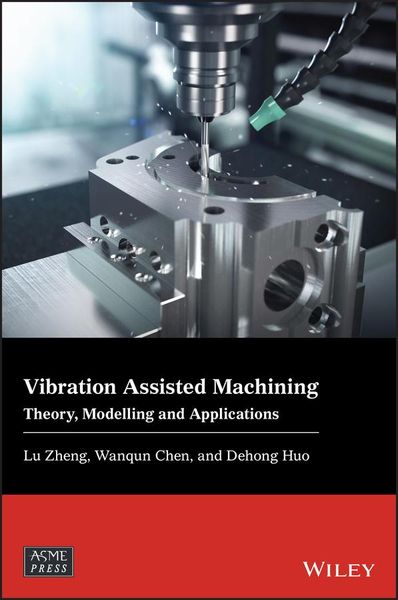
Vibration Assisted Machining: Theory, Modelling and Applications covers all key aspects of vibration assisted machining, including cutting kinematics and dynamics, the effect of workpiece materials and wear of cutting tools. It also addresses practical applications for these techniques. Case studies provide detailed guidance on the design, modeling and testing of VAM systems. Experimental machining methods are also included, alongside considerations of state-of-the-art research developments on cutting force modeling and surface texture generation.
Advances in computational modelling, surface metrology and manufacturing science over the past few decades have led to tremendous benefits for industry. This is the first comprehensive book dedicated to design, modelling, simulation and integration of vibration assisted machining system and processes, enabling wider industrial application of the technology. This book enables engineering students and professionals in manufacturing to understand and implement the latest vibration assisted machining techniques. Highlights include:
* Comprehensive coverage of the theory, kinematics modelling, numerical simulation and applications of vibration assisted machining (VAM)
* Case studies with detailed guidance on design, modelling and testing of VAM systems, as well as experimental machining methods
* Discussion of state-of-the-art research developments on cutting force modelling and surface texture generation
* Coverage of the history of VAM, its current applications and future directions for the technology
Vibration Assisted Machining: Theory, Modelling and Applications provides engineering students, researchers, manufacturing engineers, production supervisors, tooling engineers, planning and application engineers and machine tool designers with the fundamentals of vibration assisted machining, along with methodologies for developing and implementing the technology to solve practical industry problems.
Ein neues Kapitel für Ihre Bücher
Ein neues Kapitel für Ihre Bücher
Schenken Sie Ihren alten Schätzen ein zweites Leben: Einfach Barcode scannen, Versandetikett ausdrucken, Bücher verschicken und Thalia Geschenkkarte erhalten.
Jetzt verkaufenNoch keine Bewertungen vorhanden
Verfassen Sie die erste Bewertung zu diesem Artikel
Helfen Sie anderen Kundinnen und Kunden durch Ihre Meinung.
Kurze Frage zu unserer Seite
Vielen Dank für Ihr Feedback
Wir nutzen Ihr Feedback, um unsere Produktseiten zu verbessern. Bitte haben Sie Verständnis, dass wir Ihnen keine Rückmeldung geben können. Falls Sie Kontakt mit uns aufnehmen möchten, können Sie sich aber gerne an unseren Kund*innenservice wenden.
zum Kundenservice